
Why AI-171 Crashed? 5 Technical Findings From Preliminary Report | Explained
Air India AI-171 crash: Preliminary report revealed sudden engine shutdown due to fuel cutoff switches, cockpit confusion, and RAT deployment.
- India News
- 2 min read

;'%3e%3cpath%20d='m8,15.99c4.41,0,7.99-3.58,7.99-7.99S12.41,0,8,0,0,3.59,0,8s3.58,7.99,7.99,7.99Z'%20style='stroke:%23fff;%20stroke-miterlimit:10;%20stroke-width:.02px;'/%3e%3cpath%20d='m3.08,3.37l3.82,5.11-3.84,4.15h.87l3.37-3.64,2.72,3.64h2.94l-4.04-5.39,3.58-3.87h-.86l-3.1,3.35-2.5-3.35h-2.94Zm1.27.64h1.35l5.97,7.99h-1.35l-5.97-7.99Z'%20style='fill:%23fff;'/%3e%3c/g%3e%3c/svg%3e)


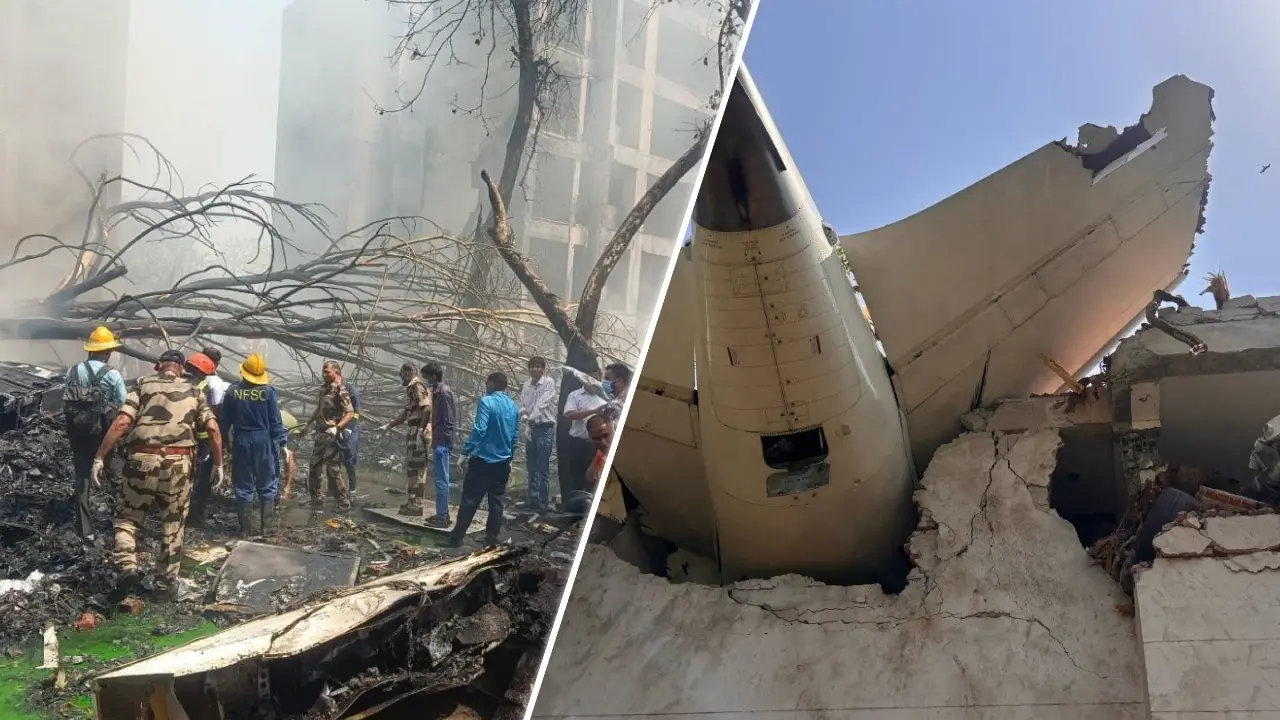
New Delhi: On June 12, Air India Flight AI-171, a Boeing 787-8 bound for London Gatwick, crashed shortly after takeoff from Ahmedabad, killing over 260 people, including crew, passengers, and civilians on the ground. The Aircraft Accident Investigation Bureau (AAIB) has now released its preliminary report, offering the first official insight into what went wrong. At the heart of the tragedy lies a sudden and unexplained shutdown of both engines during the initial climb — an event that left the pilots with no altitude, time, or thrust to recover. From cockpit confusion to known switch vulnerabilities, here are the five key technical findings that shed light on why AI-171 went down.
What Caused AI-171 Crash? 5 Technical Findings From Preliminary Investigation:
1. Dual Engine Shutdown Immediately After Takeoff
The most critical technical event was the inadvertent shutdown of both engines during the initial climb, just seconds after takeoff. Flight data shows that both fuel control switches transitioned from RUN to CUTOFF—first Engine 1, then Engine 2—with a 1-second gap. This led to an immediate and total loss of thrust at a dangerously low altitude.
2. Uncommanded Action Suspected in Cockpit
Advertisement
The cockpit voice recorder captured a revealing exchange:
One pilot asked, “Why did you cut off?”
Advertisement
The other replied, “I didn’t.”
This suggests that the action was unintentional and possibly not initiated knowingly by either pilot, raising questions about potential mechanical or human factors (such as inadvertent contact or switch malfunction).
3. Known Vulnerability in Fuel Control Switch Design
The report highlights a 2018 FAA Special Airworthiness Information Bulletin (SAIB NM-18-33) about the locking mechanism of fuel control switches, noting they can become disengaged unintentionally.
This bulletin applies to multiple Boeing models, including the switch part number (4TL837-3D) used in VT-ANB.
Air India did not conduct the recommended inspections, as the SAIB was advisory and not mandatory.
4. Recovery Actions Were Initiated, But Too Late
After shutdown:
The fuel control switches were moved back to RUN within seconds.
This triggered automatic engine relight sequences via FADEC systems.
Engine 1 began recovering; Engine 2 failed to stabilise.
Despite Ram Air Turbine (RAT) deployment and APU auto-start, the aircraft did not have sufficient altitude or time to recover power and maintain flight.
5. Throttle Levers Still in Takeoff Position
Despite the thrust levers being found in the idle position due to crash damage, flight data confirmed they were in takeoff thrust until the engines lost power. This rules out intentional engine shutdown as part of any normal procedure.
Get Current Updates on India News, Entertainment News, Cricket News along with Latest News and Web Stories from India and around the world.