
Why Aravallis Are Called 'Lungs Of North India' And Why They Need To Be Protected | Explained
Aravalli Hills are called the 'green lungs of north India' because these forests act as a crucial natural barrier, filtering Delhi-NCR's air, trapping dust from the Thar Desert, slowing desertification, regulating local climate, and supporting vital ecosystems and groundwater.
- India News
- 6 min read

;'%3e%3cpath%20d='m8,15.99c4.41,0,7.99-3.58,7.99-7.99S12.41,0,8,0,0,3.59,0,8s3.58,7.99,7.99,7.99Z'%20style='stroke:%23fff;%20stroke-miterlimit:10;%20stroke-width:.02px;'/%3e%3cpath%20d='m3.08,3.37l3.82,5.11-3.84,4.15h.87l3.37-3.64,2.72,3.64h2.94l-4.04-5.39,3.58-3.87h-.86l-3.1,3.35-2.5-3.35h-2.94Zm1.27.64h1.35l5.97,7.99h-1.35l-5.97-7.99Z'%20style='fill:%23fff;'/%3e%3c/g%3e%3c/svg%3e)


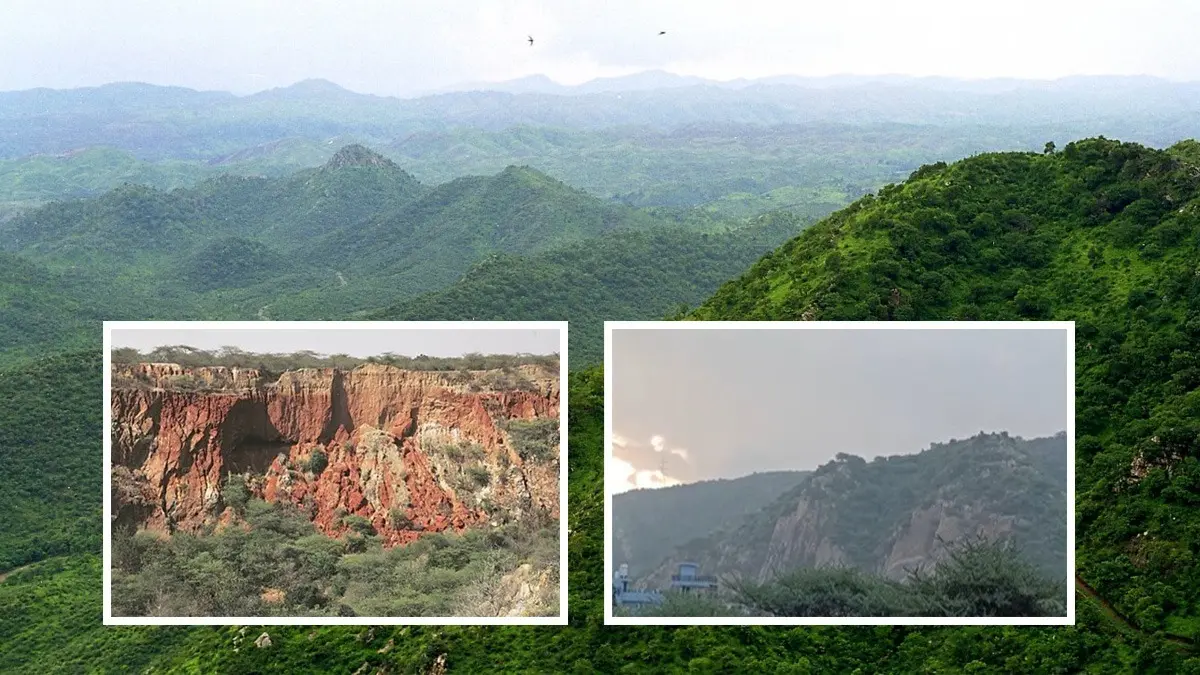
New Delhi: The Supreme Court's acceptance of the Centre's definition of the Aravalli hills on November 20 has sparked widespread controversy. As per the ruling, any hills in the range with an elevation of less than 100 metres are not subject to restrictions on mining. In effect, any landform within Aravalli districts must have at least 100 metres of elevation above the local relief - including its slopes and adjoining areas - to be treated as part of the Aravalli Hills.
The decision, however, has created nationwide furore as the Aravallis- one of the world’s oldest mountain ranges- span nearly 650 km from Delhi to Gujarat, with about two-thirds of the range running through 15 districts of Rajasthan. The hills play a crucial role in protecting the region’s ecology, but sustained mining and encroachments are pushing the ancient range towards environmental degradation.
The Aravalli Hills, older than even the Himalayas, also forms the backbone of north India’s ecology and are called the 'green lungs of north India' because these forests act as a crucial natural barrier, filtering Delhi-NCR's air, trapping dust from the Thar Desert, slowing desertification, regulating local climate, and supporting vital ecosystems and groundwater.
These hills are also vital for preventing Delhi from suffocating under extreme heat and dust, protecting biodiversity, and maintaining a semblance of breathable air in a highly polluted region, making their protection critical for public health.
Advertisement
Reasons Why It's North India's Lungs?
Dust Barrier: The Aravallis lock hot, sandy winds from the Thar Desert, preventing dust storms from engulfing Delhi, Haryana, and surrounding areas. The green forests on the slopes of these hill ranges serve as green lungs, essential in mitigating air pollution in the national capital area and other cities. The vegetation also prevents soil erosion, benefitting local regions.
Pollution Filter: Vegetation in the Aravallis traps particulate matter and pollutants, significantly improving air quality in the dense urban areas of Delhi-NCR.
Advertisement
Climate Regulation: The Aravallis span across different regions, each of which has its distinct climate. The hills influence weather patterns, increase humidity, and help regulate temperatures, mitigating heatwaves and extreme weather.
Groundwater Recharge: They play a crucial role in recharging groundwater, essential for water security in the region. The Aravallis also help in causing some rainfall and helps in maintaining the water cycle and supporting various ecosystems downstream.
Biodiversity Hub: The Aravalli ecosystem supports significant biodiversity, contributing to ecological balance. The rainfall influenced by the Aravalli Hills enriches the rich biodiversity in the region.
Source of Minerals: The Aravalli range being the oldest mountain range in northern India, is a treasure trove of minerals like copper, rock phosphate, lead-zinc-silver deposits at Zawar, marble, kyanite, asbestos, which can be mined in commercially viable quantities.
The Supreme Court bench headed by former Chief Justice of India BR Gavai on November 20 had pronounced an order accepting the definition of the Aravalli hills and ranges as per the Ministry of Environment, Forest and Climate Change. The apex court also accepted the recommendations for sustainable mining in the Aravalli Hills and the steps to be taken for preventing illegal mining. A new definition proposed by the Ministry of Environment, Forest and Climate Change has thereby alarmed experts and residents alike.
What Lies Ahead
Catastrophic Effects: The acceptance of the new definition of the Aravalli hills by the Supreme Court bench will be catastrophic for this already beleaguered landscape, as it will exclude more than 90 per cent of the Aravallis, including vast stretches of low-lying scrub hills, grasslands and ridges -from protection, opening them up for mining. Most of these areas can then be opened for mining. This would undo three decades of legal protection to these critical ecosystems.
More hills will be razed: If the Aravallis cease to exist, more hills will be razed to the ground on account of mining, which will in turn result in India’s oldest mountain range losing its continuity, and more gaps and breaches being created from where the Thar desert will advance more rapidly towards eastern Rajasthan, western Uttar Pradesh, Haryana and Delhi-NCR, negatively impacting the food security of this region
Stark Impact: Starkest impact might be seen in Rajasthan where Udaipur may dry up, Jaipur may face extreme dust pollution, and temperatures in Jodhpur may soar to extreme levels.
Pollution Issues: It will also lead to breathing problems among many individuals and may also lead to water shortage and deforestation, which in turn can impact wildlife in the region and dust pollution levels might also spike up. The pollution levels will increase manifold as the Aravallis would have helped in filtering out this harmful air. PM2.5 and PM10 particles may increase. This will put the health conditions of people at risk.
Forest Cover: As a result of the recent SC judgement, Haryana’s natural forest cover of 3.6 per cent of its land area, already the lowest in the country, could further decline as a result of the recent judgement. Also, more surface-water bodies will disappear, severely impacting water availability in north-west India. Agricultural productivity may also be adsversely affected as more hills are opened for mining.
Wildlife effect: The new definition of the Aravalli hills will erase many hills and forests, thereby shrinking wildlife habitats and increasing human–wildlife conflict in the region.
Rainfall: The disappearance of the Aravalli may lead to sparse rainfall, reducing groundwater recharge. This may heighten soil erosion, increase desertification and render land barren, severely impacting agricultural activities in the region.
Deforestation: If these hills disappear, strong winds will continue moving eastwards, leading to frequent dust storms. Deforestation will also lead to less rainfall, increased daily temperature. This will make the region more prone to heatwaves.
Experts warn that if such trends continue, north India, especially Delhi, could face a severe environmental collapse in the next decade — with hotter summers, dirtier air, and no groundwater.
Get Current Updates on India News, Entertainment News, Cricket News along with Latest News and Web Stories from India and around the world.