
Delhi’s AQI Hits ‘Severe’ Levels Despite Government Measures; Supreme Court Calls Efforts a ‘Total Failure'
Given how frequently Delhi’s AQI hits this score, Indian System of Air Quality and Weather Forecasting And Research (SAFAR), has repeatedly categorised it as ranging from very poor to severe.
- India News
- 4 min read

;'%3e%3cpath%20d='m8,15.99c4.41,0,7.99-3.58,7.99-7.99S12.41,0,8,0,0,3.59,0,8s3.58,7.99,7.99,7.99Z'%20style='stroke:%23fff;%20stroke-miterlimit:10;%20stroke-width:.02px;'/%3e%3cpath%20d='m3.08,3.37l3.82,5.11-3.84,4.15h.87l3.37-3.64,2.72,3.64h2.94l-4.04-5.39,3.58-3.87h-.86l-3.1,3.35-2.5-3.35h-2.94Zm1.27.64h1.35l5.97,7.99h-1.35l-5.97-7.99Z'%20style='fill:%23fff;'/%3e%3c/g%3e%3c/svg%3e)


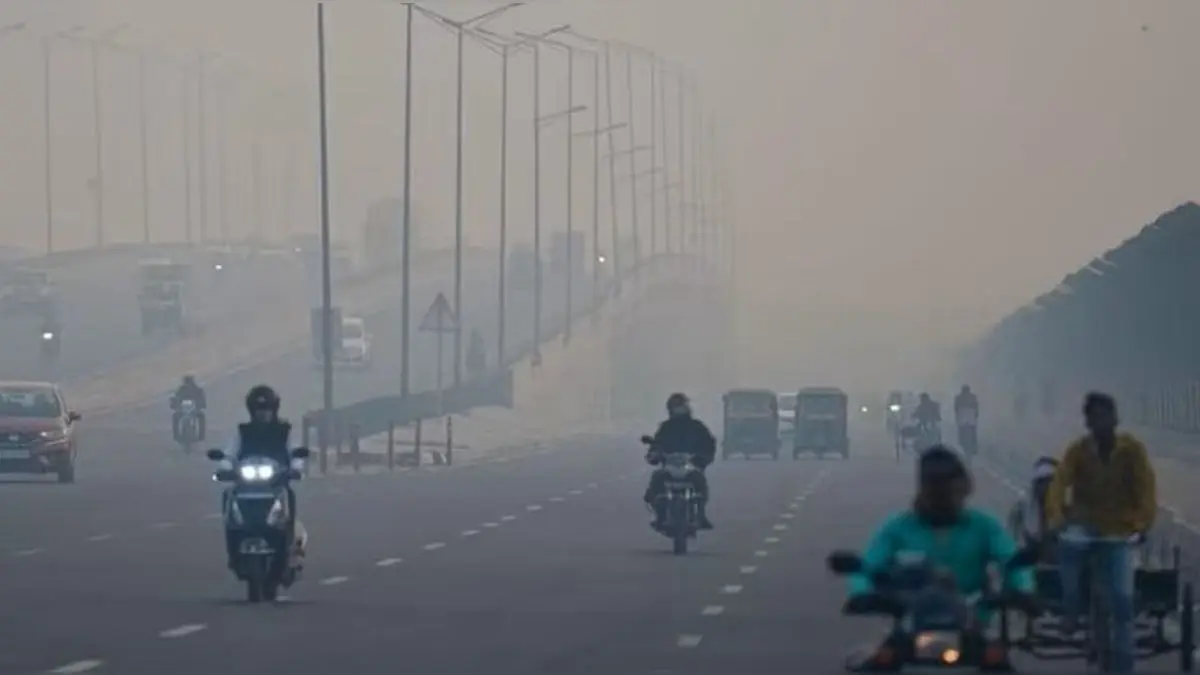
New Delhi: With the Air Quality Index (AQI) in Delhi today oscillating between 300 and 400 AQI, and with pockets of New Delhi going upwards of 400, there is a dire need to bring down the AQI to a level that is liveable.
Given how frequently Delhi’s AQI hits this score, Indian System of Air Quality and Weather Forecasting And Research (SAFAR), has repeatedly categorised it as ranging from very poor to severe.
High AQI is not a new phenomenon for Delhi, the smog, pollution and respiratory issues are instead an annual event that at this point, the public simultaneously anticipates and dreads. The Delhi government has, in fact, tried to combat the soaring AQI via Graded Response Action Plan (GRAP); ban on the entry of trucks into Delhi, except for those carrying essential commodities or providing essential services; along with an additional ban on construction and demolition activities.
Despite these efforts, AQI has not been controlled, reduced or even managed well enough to lead the Supreme Court to call these efforts “a total failure”.
Advertisement
2023 STUDY
A 2023 study titled- Geographic information system-based mapping of air pollution & emergency room visits of patients for acute respiratory symptoms in Delhi, India (March 2018-February 2019), studied the correlation between a data set of patients who visited the emergency room for acute respiratory symptoms and air pollution from March 2018 to February 2019.
The study used a geographic information system to map air pollution - including high AQI and particulate matter (PM), and patients data to see how the two were correlated and whether there was a link of causality present.
Advertisement
The study on AQI in Delhi stated their findings as: “The alarming levels of PM2.5 are regional problem and are significantly contributed by vehicular (20%) and industrial emissions (11%), cooking related emissions, biomass burning, construction activities, burning of Kharif (local term for monsoon or autumn crops) crop residue, windblown dust, Diwali fireworks, etc.”
Furthermore, the study found, “Winter days had poor AQI compared to moderate and satisfactory AQI during summer and monsoon days, respectively. None of the days reported a good AQI (<50). During winters, an increase in acute respiratory ER visits of patients was associated with higher PM2.5 concentrations in the highly polluted northwest region of Delhi.”
In comparison to a moderately polluted region the study stated, “In contrast, a lower number of acute respiratory ER visits of patients were seen from the ‘moderately polluted’ south-west region of Delhi with relatively lower PM2.5 concentrations.”
NCDC’S HEALTH ADVISORY
Moreover, National Centre for Disease Control (NCDC) in a November health advisory listed its warning on worsening of AQI stating, “Worsening of Air Quality Index (higher AQI value) especially of 'poor to severe' in an area may lead to increase in health complications among those exposed particularly vulnerable populations such as children, elderly, individuals with underlying medical conditions etc.”
EFFECTS OF SHORT-TERM AND LONG-TERM EXPOSURE
Exposure to high AQI and polluted air has been medically studied in terms of short-term and long-term effects. According to NCDC’s health advisory, short-term high-level exposure results in “acute health reactions with involvement of various human organs and patients may present with certain suggestive symptoms like irritation of eyes, nose, throat and skin, cough, breathing difficulty, wheezing, chest discomfort, chest pain, headache, giddiness, limb weakness, facial deviation, etc.”
While NCDC says that vulnerable groups like children under 5, pregnant women, infants, elderly etc can, “experience more severe effects such as lower respiratory tract inflammation and infection, exacerbation of asthma, bronchitis or exacerbation of chronic illnesses such as chronic obstructive pulmonary disease (Respiratory System), ischemic heart diseases (CVS), and cerebrovascular strokes (CNS) etc.”
In the long term, NCDC states, “exposures to even lower levels of pollution can result in chronic illnesses of the respiratory and cardiovascular systems, lung cancer and premature death.”
In light of these findings, advisories and warnings, we still find Delhi’s AQI surging and rising despite the government’s efforts to improve air quality and reduce air pollution. The performance of the policies, the enforcement, and management has made even the Supreme Court call it “a total failure”.
Also Read: Supreme Court Demands Long-Term Action As Delhi Government Implements Strict Pollution Curbs As AQI Worsens
(Written by Mohini Chandra)
Get Current Updates on India News, Entertainment News, Cricket News along with Latest News and Web Stories from India and around the world.