
A Civilizational Exhale: Making Sense of the Emotional Response to Acharya Prashant
Why are thousands of young Indians and women flocking to Acharya Prashant's sessions? This analysis explores the deeper reasons behind the emotional intensity, long queues, and growing appeal of a teacher who rejects emotional dependence and focuses on self-inquiry, freedom, and clarity.
- Utility News
- 7 min read

;'%3e%3cpath%20d='m8,15.99c4.41,0,7.99-3.58,7.99-7.99S12.41,0,8,0,0,3.59,0,8s3.58,7.99,7.99,7.99Z'%20style='stroke:%23fff;%20stroke-miterlimit:10;%20stroke-width:.02px;'/%3e%3cpath%20d='m3.08,3.37l3.82,5.11-3.84,4.15h.87l3.37-3.64,2.72,3.64h2.94l-4.04-5.39,3.58-3.87h-.86l-3.1,3.35-2.5-3.35h-2.94Zm1.27.64h1.35l5.97,7.99h-1.35l-5.97-7.99Z'%20style='fill:%23fff;'/%3e%3c/g%3e%3c/svg%3e)


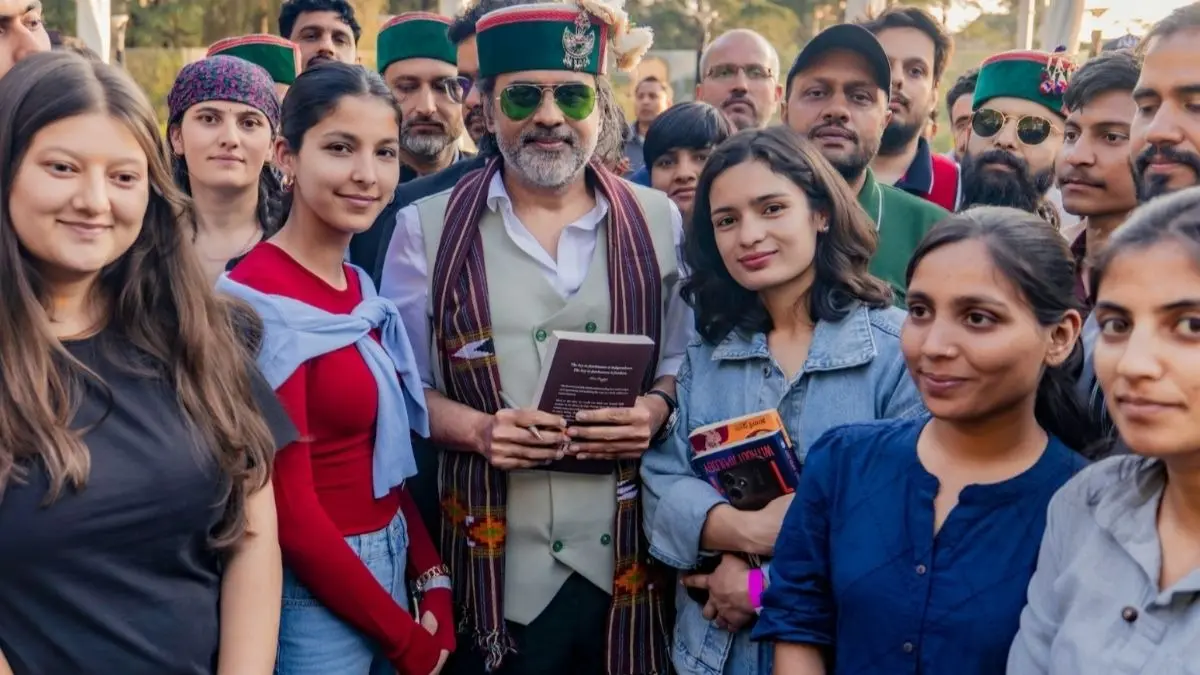
Over the past few years, a curious pattern has begun to repeat itself across cities and campuses in India. Auditoriums fill beyond capacity, queues stretch for hours, sessions scheduled for two hours spill late into the night. At elite technical institutes, students accustomed to speed and scepticism remain seated long past midnight. In small towns, middle-aged women travel alone to attend public dialogues, often for the first time in their lives.
For an outside observer, the scene carries a familiar look: crowds, intensity, visible emotion, folded hands, tears. India has seen this before around spiritual figures. Something about these gatherings, though, feels slightly out of place, as if the usual explanations do not quite fit.
The person drawing these audiences is Acharya Prashant, a contemporary philosopher best known for his uncompromising, inquiry-driven reading of Vedanta and wisdom literature from around the world. His public work ranges across scripture, psychology, social conditioning, and modern life. He is followed by over 100 million people across social media platforms, and frequently invited to campuses and public forums. What distinguishes him is not style or spectacle, but the nature of what he refuses to offer.
What makes this moment puzzling is that Acharya Prashant is not an emotional speaker. He does not console. He does not reassure. His philosophical framework, documented as the AP Framework, consistently questions sentimentality, warns against emotional dependence, and treats devotional excess as another form of psychological bondage. He has repeatedly challenged the devotion-heavy mode that Indian audiences often bring to spiritual discourse. Emotionality, in his teaching, is not liberation; it is usually the mind's escape from clarity.
Advertisement
The emotional intensity around his sessions, then, is genuinely puzzling.
So why the crowds? Why the long queues, the late nights, the visible release? Why are people responding with such feeling to someone who explicitly tells them that feeling is not the point?
Advertisement
Two demographics stand out. The emotional energy appears most visibly in young people at elite institutions and in women from non-metro India, particularly housewives and those with limited economic independence. These are not the usual constituencies of spiritual gatherings, and their engagement does not resemble polite curiosity. It looks like hunger.
The youth: a generation starved for meaning
The youth phenomenon is perhaps easier to explain on the surface. Here is someone who speaks their language: rational, irreverent, anti-establishment. He validates their scepticism toward inherited religion and yet offers something beyond the nihilism or careerism that often remain the only alternatives.
There is something deeper at work, though. Indian youth today appear caught in a peculiar bind, one visible in the questions they bring to these sessions. Materially, they are chasing the IIT-IIM-package dream more intensely than any previous generation. Spiritually, they have largely been handed either superstition in the name of religion or a superficially understood Western secularism, and neither satisfies. Psychologically, many appear anxious, competitive, lonely, drowning in content yet starved for meaning: a pattern that surfaces repeatedly in the questions they ask long past midnight, about purpose, about identity, about what comes after the degree and the job offer.
Acharya Prashant offers an unusual kind of relief. He says: you were right to reject the nonsense, but here is something that is not nonsense. The intensity of the audience response may come from finally encountering someone who does not ask them to suspend their critical faculties in order to access depth.
The post-midnight sessions at IITs, the six-hour engagements, the reluctance of the audience to leave even after formal events end: none of this is polite curiosity. A generation that was told self-knowledge is a luxury is beginning to discover it might be the only necessity. The emotional charge here is less devotional and more recognitional. It carries the texture of a long-unheard sentiment: finally, someone is taking my existential confusion seriously, without offering platitudes or motivational slogans.
The women: the more striking phenomenon
The intensity among women, particularly housewives and those from non-metro India, is the more striking and perhaps more consequential part of this picture.
At a surface level, the explanation appears straightforward. Acharya Prashant speaks extensively on women's conditioning, marriage, motherhood, economic independence, and the moralisation of adjustment. He directly challenges patriarchal frameworks and treats women not as recipients of sympathy, but as thinking individuals capable of clarity. For women who have spent decades being told that their worth lies primarily in service and silence, hearing this dismantling can be deeply unsettling and deeply energising.
The emotional intensity, however, requires a closer look.
These women have the most at stake, and therefore the most to gain. Consider a young student engaging with Vedanta at an elite campus: she is taking an intellectual risk. A middle-aged woman in a non-metro town questioning the structure of her entire life is taking an existential one. The stakes are categorically different. When Acharya Prashant says your life belongs to you, not to the roles imposed on you, the young man may nod thoughtfully. The woman who has spent decades subordinating herself often feels the statement viscerally. The emotional charge is proportional to what is being destabilised.
These women have also lived the longest under distorted forms of spirituality. Popular religion, as several women in these audiences describe it, has often functioned as an ethical command to endure: be devoted, be patient, serve, accept. Spiritual language has repeatedly been used, in their experience, to normalise the erasure of freedom. When someone comes along and says, with scriptural grounding, that this is a distortion of the Gita and a misreading of Vedanta, the relief can be immense, and relief of that magnitude does not emerge quietly.
Many of these women also have fewer outlets for inner questioning. A young professional can diffuse existential tension into career, travel, ambition, or relationships. A middle-aged woman in a small town, who in many cases describes limited mobility and economic dependence as simply the texture of her daily life, has fewer such channels. When something resonates, it does so fully. The intensity is not necessarily greater; it is less dispersed.
There is one further dimension. Acharya Prashant does not treat women's issues as a peripheral concern. His work repeatedly names their condition clearly, without sentimentality or moral flattery. For many listeners, this may be the first time their situation has been recognised precisely rather than glossed over. Being seen, truly seen, after decades of invisibility, produces emotion. That is not devotion. It is recognition, and recognition of that depth does not arrive silently.
Does the emotional energy compromise the teaching?
The risk is real. Youth or women might simply transfer their need for an anchor from family and society to the teacher himself, trading one form of dependence for another. The teaching could then become an object of attachment rather than a means of dissolution.
There is another way to understand what is unfolding, though. The emotion may be transitional rather than terminal. A housewife in tears during a session is not necessarily stuck. She may be passing through a release. Years of suppression do not dissolve silently; they often discharge first.
The critical question is whether the teaching is strong enough to metabolise that discharge into clarity, rather than letting it crystallise into yet another fixed identity. Here, Acharya Prashant's own conduct becomes relevant. His consistency in not offering comfort, not encouraging emotional dependence, and not playing the role of saviour may itself be the safeguard. He keeps directing attention away from himself and back toward inquiry. Whether listeners follow the direction of that pointing or fixate on its source remains an open question.
A civilizational exhale
The two groups where this intensity is most visible are arguably among the most constrained demographics in contemporary India, trapped in different ways: one by performance without meaning, the other by duty without agency. Both denied authentic selfhood while being offered convincing substitutes: success, family, respectability, adjustment.
If Acharya Prashant's teaching is reaching these groups with particular intensity, it may be because the need runs deepest there. The emotional charge is not a bug in the system. It is a signal.
What we may be witnessing is not another devotional following in formation. It may be something quieter and more significant. The crowds look like devotion. The tears get read as sentimentality. The queues, as herd behaviour. These readings are not entirely wrong, but they are incomplete. Looked at more carefully, something else is visible: not people falling at someone's feet, but people beginning, cautiously, to stand back on their own.