
From London's NHS To Haridwar: The Psychiatrist Leading The Gayatri Pariwar's Centenary
Dr Chinmay Pandya is now the face of the movement's centenary year. He leads the celebrations marking 100 years of the Akhand Deep, the lamp lit by Pandit Shriram Sharma Acharya in 1926, and the birth centenary of Mata Bhagwati Devi Sharma.
- Utility News
- 7 min read


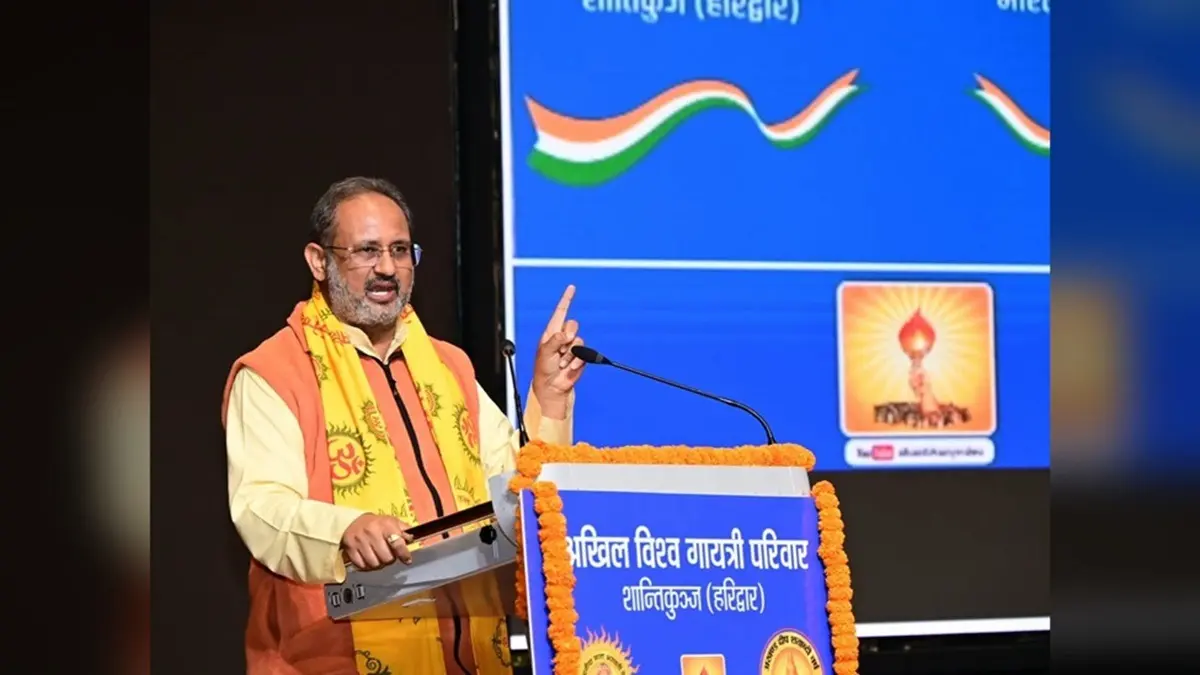
This January, on an island in the Ganga at Haridwar, thousands of people gathered to open one of the biggest years in the history of the Gayatri Pariwar. A Chief Minister and a Union Minister were among the guests. But the man presiding over the ceremony was a trained psychiatrist who once treated dementia patients in West London.
Dr Chinmay Pandya is now the face of the movement's centenary year. He leads the celebrations marking 100 years of the Akhand Deep, the lamp lit by Pandit Shriram Sharma Acharya in 1926, and the birth centenary of Mata Bhagwati Devi Sharma. Later this week, he will lead a three-day centenary event at Delhi's Indira Gandhi Indoor Stadium.
His journey to this stage was not a straight line. It ran from a childhood at Shantikunj, through medical school and nearly a decade in Britain's National Health Service, and back again to Haridwar.
A boy who read his writing to Gurudev
Chinmay Pandya is the grandson of Pandit Shriram Sharma Acharya, the founder of the All World Gayatri Pariwar. His mother is Gurudev's daughter. He grew up at Shantikunj, the movement's headquarters in Haridwar, close to his grandfather.
Advertisement
He likes to play down the family link. "The blood relationship does not mean much," he told the website Lokvani in 2014. What stayed with him, he said, was how much attention Gurudev gave to everyone around him.
He shared one memory from those years. As a young boy, he wanted to impress his grandfather by writing a book. Looking back, he called the writing unimpressive. Yet Gurudev sat and listened to it for about 15 minutes every day. He recalled that it made him feel truly important.
Advertisement
Another lesson came when he was about eight. In a recent interview with The Pioneer, he said he once went to his guru with a doubt while reading a scripture. The reply was simple: "Son, don't reject something without reading it." He still sums up that advice simply: understand first, and believe after.
A doctor he never planned to be
Oddly, medicine was not his plan. In the same 2014 interview, he said he never wanted to go to medical school. Gurudev had predicted when he was a child that he would become a doctor. Despite trying to go another way, he ended up in medicine anyway, which he took as proof of his grandfather's foresight.
After studying medicine in India, he moved to the United Kingdom for advanced training in psychiatry. He earned Membership of the Royal College of Psychiatrists (MRCPsych), a key qualification for psychiatrists in Britain.
In London, he rose through the ranks of the National Health Service. He became Associate Specialist in Older People Services at the West London Mental Health Trust. His work focused on older patients, especially those living with dementia caused by Alzheimer's disease.
He spent around nine and a half years in Britain, he told The Pioneer. Even then, he stayed close to the mission. He said that as a representative of Shantikunj, he gave talks at Trinity College in Cambridge.
Coming home to Haridwar
In 2010, he left his NHS career and came back to India. He has always described the move as a response to an inner calling. Asked by The Pioneer how he felt about returning, he said it was that inner call that brought him home, and that he feels fulfilled.
He joined Dev Sanskriti Vishwavidyalaya (DSVV), the university in Haridwar inspired by his grandfather's vision. Today he is its Pro Vice Chancellor, responsible for the university's ethos, academic standards and the way its policies are carried out.
His desk is a busy one. He edits Dev Sanskriti, an international journal on subjects like Vedic philosophy, psychology, education and Ayurveda. He chairs the International Festival of Yoga, Culture and Spirituality, and is Vice President of the Indian Yoga Association. According to the Gayatri Pariwar, he has organised more than 200 national and international colloquia at DSVV.
The doctor in him has not retired either. The mission's official profile says he still practises psychiatry, free of charge, for those who need it.
A Haridwar voice on world stages
Over the past 16 years, Dr Pandya has become one of the Gayatri Pariwar's best-known faces abroad. He has represented India at a UNESCO intergovernmental meeting on intangible cultural heritage and at an inter-parliamentary conference on interfaith dialogue in Morocco. He has spoken at the United Nations in Vienna, the University of Cambridge and Lambeth Palace in London.
At home, he has addressed audiences at IITs, IIMs, the Indian Military Academy, BARC and DRDO. He sits on the governing body of the Indian Council for Cultural Relations and the advisory council of the AYUSH ministry.
His interfaith work is a big part of his profile. He is one of five directors worldwide of the Global Covenant of Religions. He has also served as a judge for the international Templeton Prize. He was honoured with the Bharat Gaurav Award at the House of Commons in Westminster.
Lately, artificial intelligence has become one of his main themes. He was the only signatory from India when a call for ethics in AI was signed in Hiroshima, Japan. In July this year, he spoke at the UN's AI for Good Global Summit on a panel about AI as a common good. His view, as he explained to The Pioneer, is that the world is investing heavily in powerful technology but not enough in the values of the people who use it.
Leading the centenary
This year, all of that experience has been pointed at one goal. As leader of the Janm Shatabdi Samaroh, the centenary celebrations, Dr Pandya is guiding the Gayatri Pariwar's year-long programme across India and abroad.
He calls 2026 a meeting point of three centenaries: Mataji's birth, the Akhand Deep, and 100 years of Gurudev's spiritual practice. At a gathering of more than 1,000 volunteers at Bharat Mandapam in Delhi this month, he said these milestones should inspire people to turn spiritual practice into service, and values into daily conduct.
The year began on January 18 at Bairagi Island in Haridwar, where he presided over the opening ceremony. There, he shared that the Ministry of Culture had included the centenary in the national calendar. Major programmes from September 2026 to September 2027 are now part of it. Speaking about the Akhand Deep, he said its light can remove selfishness, narrow thinking and ignorance from people's minds.
In recent weeks, he has been meeting public figures in Delhi to invite them to the celebrations. On October 12, three Jyoti Kalash chariots left Shantikunj for more than 50 districts in Delhi, Rajasthan and Uttar Pradesh. Dr Pandya described the campaign as a way to make the centenary a people's event. Their routes link Haridwar, Anwalkheda in Agra and Mathura, the three places most tied to Gurudev's life.
The chariots are due in Delhi by October 28-29. From October 31 to November 2, the Indira Gandhi Indoor Stadium will host the three-day centenary celebration, with thousands of members expected from India and abroad.
A disciple, not a guru
For all his titles, Dr Pandya is careful about how he describes himself. The Pioneer notes that he sees himself only as a representative disciple of the thought revolution movement his grandfather started. An interviewer in 2014 noted that he clearly said he was not a guru.
What ties his two lives together is a belief that science and spirit must work side by side. As a psychiatrist, he spent years caring for the mind. Now his message to young people is that technical skills alone are not enough. Back in 2014, he said many young people have strong training but lack direction, and that a life guided by values is what brings real fulfilment.
It is, in many ways, the same message his grandfather spread from Shantikunj for decades. A century after a lamp was lit in a small village near Agra, the person carrying its light to stadiums and summits is a doctor who once cared for dementia patients in West London. For the Gayatri Pariwar, that mix of modern training and old wisdom may be exactly the point.