
Why Cloud Burst Happen? Decoding India's Monsoon Fury
The Indian monsoon, vital for the nation's economy and agriculture, is a complex weather system monitored and forecasted by the India Meteorological Department (IMD). Key atmospheric features like the monsoon trough and the heat low are crucial to its behavior.
- Utility News
- 4 min read

;'%3e%3cpath%20d='m8,15.99c4.41,0,7.99-3.58,7.99-7.99S12.41,0,8,0,0,3.59,0,8s3.58,7.99,7.99,7.99Z'%20style='stroke:%23fff;%20stroke-miterlimit:10;%20stroke-width:.02px;'/%3e%3cpath%20d='m3.08,3.37l3.82,5.11-3.84,4.15h.87l3.37-3.64,2.72,3.64h2.94l-4.04-5.39,3.58-3.87h-.86l-3.1,3.35-2.5-3.35h-2.94Zm1.27.64h1.35l5.97,7.99h-1.35l-5.97-7.99Z'%20style='fill:%23fff;'/%3e%3c/g%3e%3c/svg%3e)


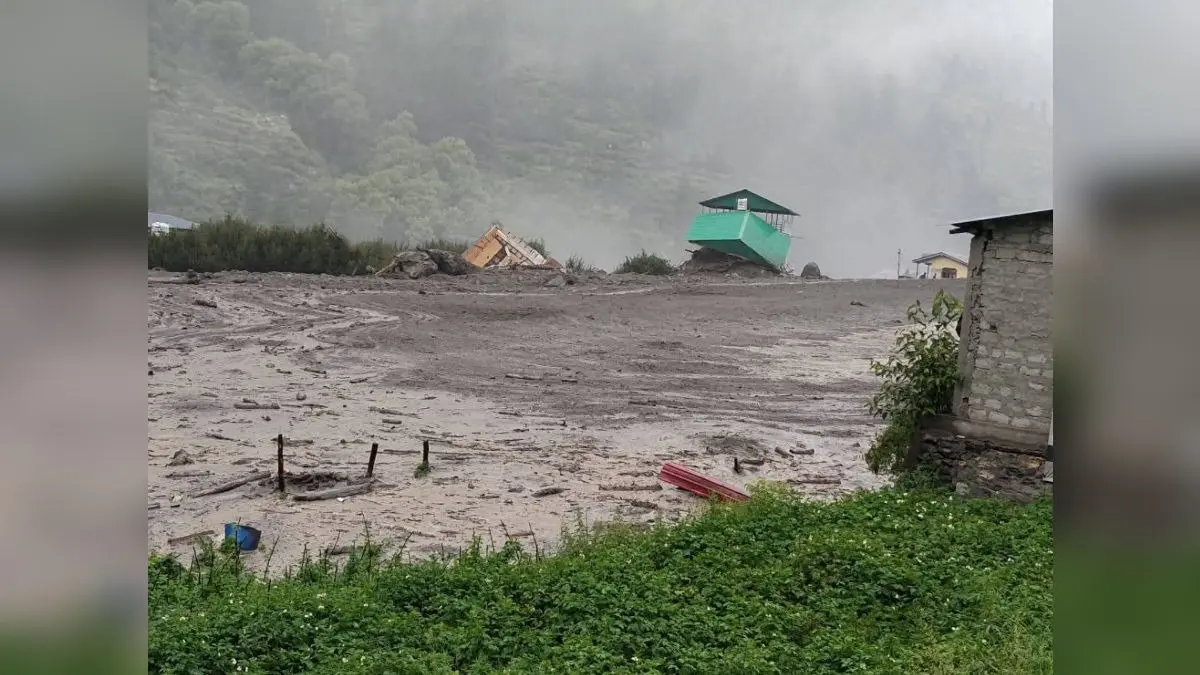
The Indian monsoon is crucial to the nation's economy and agriculture, but because of its complex nature, scientists are always studying and forecasting it.
The India Meteorological Department (IMD) is essential to the monitoring and forecasting of the weather system by using advanced models to understand its behaviour.
What Is A Cloud Burst?
A cloudburst is a sudden, intense, and very heavy downpour of rain over a small area.
The India Meteorological Department (IMD) defines a cloudburst as rainfall of 100 millimeters or more in an hour over a concentrated area of roughly 20-30 square kilometers.
Advertisement
The term "cloudburst" originated from the old idea that clouds could burst like water balloons, releasing their contents all at once.
While this isn't scientifically accurate, the term remains in use to describe this rare and extreme weather event.
Advertisement
How and When Do They Happen?
Cloudbursts are typically associated with intense thunderstorms and the formation of tall heavy clouds.
They happen when strong upward currents of warm, moist air prevent raindrops from falling.
This allows the water droplets to accumulate and grow larger.
When these updrafts suddenly weaken, all the accumulated water is released in a very short period, causing a deluge.
How is Rainfall Measured?
Scientists use the Long Period Average (LPA), a benchmark determined by averaging rainfall over a long period, to put these annual variations in perspective.
They measures the total amount of rainfall in the nation over a specific time period.
By comparing the actual rainfall to this historical average, the LPA assists in dividing rainfall into categories such as normal, deficient, or excess.
Important Factors that control the complexity of monsoon:
A number of atmospheric characteristics control the complexities of the monsoon.
One important factor is the monsoon trough, which is a prolonged region of low pressure.
On the other hand, a shift to the north may result in a "break monsoon" period, with heavy rains in the foothills of the Himalayas and less rainfall across the nation.
The heat low, a shallow low-pressure area that develops over northwest India and Pakistan, is another important factor.
A strong heat low helps create a healthy monsoon by acting as a "suction device" for humid air.
A high-pressure region in the Southern Hemisphere that moves across-equatorial air flow, and the Tibetan High, a high-altitude anticyclone that affects the intensity of the monsoon, are two other significant features.
Other important wind patterns that affect rainfall distribution and monsoon moisture steering are the tropical easterly jet.
Numerous factors affect the monsoon's variability, both within a season and between years.
Global phenomena such as the Indian Ocean Dipole (IOD), El Niño-Southern Oscillation (ENSO), and Madden-Julian Oscillation (MJO) are important drivers of longer-term, year-to-year changes.
Tools to understand Monsoon:
To forecast the monsoon on various time scales, IMD uses a variety of tools.
These include a complex dynamical model called the Monsoon Mission Coupled Forecasting System (MMCFS) and a Statistical Ensemble Forecasting System (SEFS).
With the use of these models, IMD is able to provide both short- to medium-range and long-range seasonal forecasts, which are essential for disaster management and agricultural activity planning.
These forecasts' accuracy has been increasing over time, offering more trustworthy direction for a nation that depends so heavily on the monsoon's rhythm.