
Building New-Age Management Institutions for the AI Age
AI can transform education by enhancing teaching, assessment, student support and institutional decision-making while encouraging responsible, experiential and AI-enabled learning.
- Initiatives News
- 4 min read

;'%3e%3cpath%20d='m8,15.99c4.41,0,7.99-3.58,7.99-7.99S12.41,0,8,0,0,3.59,0,8s3.58,7.99,7.99,7.99Z'%20style='stroke:%23fff;%20stroke-miterlimit:10;%20stroke-width:.02px;'/%3e%3cpath%20d='m3.08,3.37l3.82,5.11-3.84,4.15h.87l3.37-3.64,2.72,3.64h2.94l-4.04-5.39,3.58-3.87h-.86l-3.1,3.35-2.5-3.35h-2.94Zm1.27.64h1.35l5.97,7.99h-1.35l-5.97-7.99Z'%20style='fill:%23fff;'/%3e%3c/g%3e%3c/svg%3e)


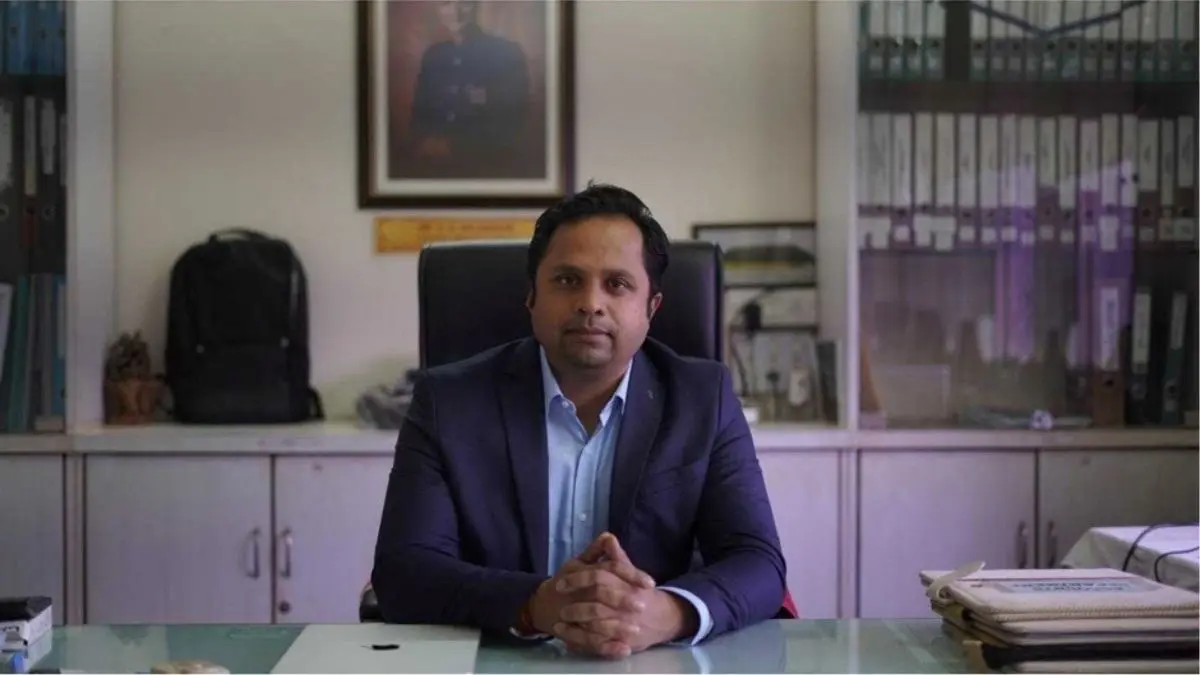
AI can create its greatest educational value when it becomes part of teaching, assessment, student support and institutional problem-solving
Artificial intelligence is becoming an important part of education. Educational institutions are introducing AI-related courses, supporting faculty development and exploring new digital tools. The next opportunity is to build upon these initiatives by treating AI not only as a subject in the curriculum but also as an enabling layer across the education system.
The evolution of the internet offers a useful parallel. Its educational value emerged not merely from teaching students how the internet worked, but from integrating connectivity into classrooms, libraries, research and communication. AI may follow a similar trajectory.
The central question, therefore, is not only, “How should AI be taught?” It is also, “How can AI responsibly improve learning and institutional effectiveness?”
Advertisement
Educational institutions manage numerous academic and administrative processes. Students need assistance in locating policies, learning resources, internship opportunities and career information. Faculty members devote considerable time to preparing assessments, providing feedback and documenting learning outcomes. Administrative teams manage student queries, timetables, accreditation information and institutional data.
Each such process can be examined through an AI lens. An institutional AI assistant could help students find verified information. AI could support faculty members in developing cases, creating formative assessments or identifying learning gaps. Career teams could use it to compare job descriptions with students’ competencies, while administrative teams could improve information retrieval and response times.
Advertisement
Not every problem requires an AI solution. Adoption should be guided by educational purpose, measurable value, privacy and human oversight. The aim should not be to add AI everywhere merely for the sake of technology but to apply it wherever it can meaningfully improve the educational experience.
Faculty members will remain central to this transition. Custom, course-specific AI assistants can be grounded in prescribed readings, cases and learning outcomes. Instead of directly supplying answers, they can ask questions, offer hints, challenge assumptions and provide preliminary feedback.
Such systems may reduce dependence on generic, copy-and-paste responses to an extent, but technology alone cannot ensure academic integrity. Assessment design remains the stronger safeguard. Vivas, live problem-solving, reflective journals, simulations, iterative submissions and project demonstrations can help faculty evaluate how students reached an answer.
Students should be encouraged to disclose their use of AI, verify generated information, explain their reasoning and defend their decisions. Assessment can then move beyond the final answer to evaluate understanding, judgement and ownership.
AI also creates opportunities to make education more experiential. Marketing students could manage simulated markets with changing consumer behaviour. Finance students could assess decisions under different economic conditions. HR students could respond to workplace scenarios, while operations students could manage disruptions in a virtual supply chain.
Gamification and AI-supported simulations can introduce roles, decision rounds, changing constraints and immediate feedback. Students experience the consequences of their choices rather than studying decisions only in theory.
Educational institutions can also consider adding a stronger build component to the curriculum. Students do not necessarily need to become programmers, but they should learn to translate real problems into functional AI-enabled solutions.
They could build a student-support assistant, recruitment prototype, demand forecaster or policy-search tool. In doing so, they would learn to compare AI models, identify inaccuracies, consider costs, understand privacy risks and test whether a solution creates meaningful value.
At SCMHRD, our experiments with custom AI assistants, AI-supported evaluation, simulations and institution-specific applications have helped us explore this approach. One encouraging observation is that students engage differently when asked to solve an authentic problem. They begin moving from consumers of AI-generated content to designers of AI-enabled solutions.
Alongside the wider debate on AI education, I believe attention should also be given to data-centre management. AI depends on physical infrastructure comprising processors, servers, networks, cooling systems, electricity and cybersecurity.
As the AI ecosystem expands, areas such as data centre operations, energy management, cybersecurity, capacity planning and sustainability will become increasingly important. Their relevance extends beyond engineering to management education.
Data centres are capital-intensive enterprises involving decisions about investment, location, energy sourcing, vendors, regulation and operational risk. Students of operations, finance, infrastructure, strategy and sustainability could benefit from understanding this emerging value chain.
AI education will certainly require relevant courses. Its deeper value, however, will emerge when students learn with AI, evaluate it, build with it and understand the infrastructure that powers it.
That is the journey from offering an AI curriculum to building an AI-enabled educational institution.
- By Dr Akhil Damodaran