
Inside Quantum Seeker Dr. Pramod Kumar’s Mind: Redefining Intelligence Through Physics
As the Principal Scientist at Abu Dhabi-based QRDC, he has been paving the way for newer advancements in quantum photonics and beyond.
- Initiatives News
- 3 min read

;'%3e%3cpath%20d='m8,15.99c4.41,0,7.99-3.58,7.99-7.99S12.41,0,8,0,0,3.59,0,8s3.58,7.99,7.99,7.99Z'%20style='stroke:%23fff;%20stroke-miterlimit:10;%20stroke-width:.02px;'/%3e%3cpath%20d='m3.08,3.37l3.82,5.11-3.84,4.15h.87l3.37-3.64,2.72,3.64h2.94l-4.04-5.39,3.58-3.87h-.86l-3.1,3.35-2.5-3.35h-2.94Zm1.27.64h1.35l5.97,7.99h-1.35l-5.97-7.99Z'%20style='fill:%23fff;'/%3e%3c/g%3e%3c/svg%3e)


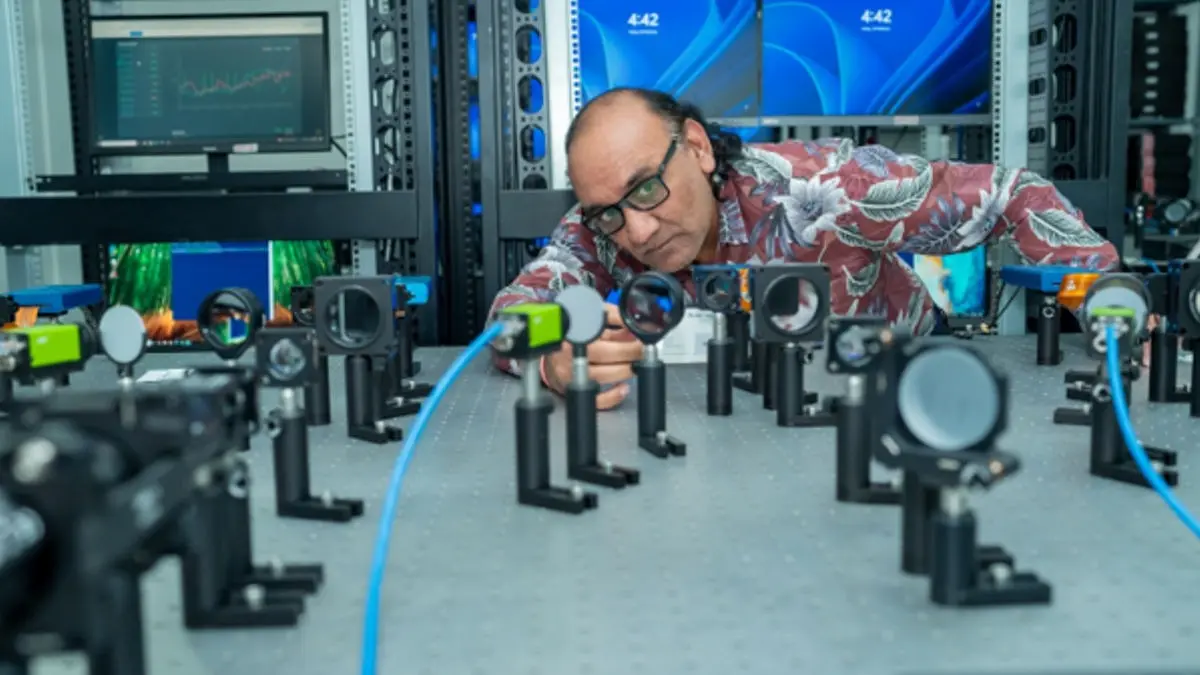
Most of the scientists around the world have been building machines and imitating intelligence. However, there is one Quantum Seeker, as he is known popularly in the field and the Principal Scientist and Director of Research at the QuantLase Research & Development Centre (QRDC) based in Abu Dhabi, Dr. Pramod Kumar, who is asking a far more fundamental question. He asks what if intelligence doesn’t need to be created at all? What if it already exists in probability, in chaos, in the physical behaviour of light, and all that technology needs to harness it? This very question lies at the very centre of his incredible work at the QRDC, where he is helping to shape a radically different path for artificial intelligence (AI), which today is at the forefront of almost all industries worldwide.
In a world dominated by software-first AI, QRDC’s work feels almost countercultural. Instead of focusing only on better algorithms, Dr. Kumar’s team is focused on something more foundational, which is: changing the medium of computation itself. The answer for him and his team is photonics. Photonic computing, he explains, helps replace electrons with photons to perform mathematical operations. Since photons travel faster and generate less heat, they offer a more efficient path for handling the increasingly heavy workloads of AI systems. But for Dr. Kumar, speed is only a part of the entire story. His vision goes beyond that and is deeply rooted in physics.
He points out how intelligence isn’t merely computation; it’s the orchestration of possibility in order. Explaining further, he says that through photonic systems, we are engineering a medium where the orchestration can happen at the speed of nature itself. At QRDC, this vision has taken shape in the form of silicon photonic chips designed with Mach-Zehnder Interferometer networks. Each interferometer acts as a matrix multiplier, enabling AI workloads to be processed optically rather than electronically. These chips may seem too tiny in size, but their implications are only enormous. Matrix multiplication is at the core of every neural network, he says, from image recognition to large language models. By moving this process into the photonic domain, QRDC could dramatically help in reducing the energy burden of AI. In today’s fast-paced and ever-evolving world, where AI energy demand is only becoming a global concern, this really matters.

The project’s transition from concept to commercial reality has been accelerated by Dr. Salman Abdullah, Head of Product Development at QRDC and former photonic chip architect at Lumentum Technology. Together, the team has successfully cleared industry-grade foundry validation and moved the chip into fabrication and hardware integration. This progression has signalled maturity, and yet their most fascinating part of work lies beyond the chip. Their lab-scale infrastructure uses photonic entropy and spatial light modulators for encoding massive datasets directly into laser phase patterns. This has gone ahead in allowing the system to explore multiple solutions simultaneously, a kind of physical intelligence driven by optics. This stands distinctive from traditional AI.
Generative AI approximates reality through data, and photonic intelligence goes ahead in exploring it through physics. That distinction could help in becoming crucial in fields requiring ultrafast anomaly detection, high-throughput computing and precision error correction. This also earned QRDC international recognition with the inclusion among the Hot 10 at Quantum. Tech Europe 2025. However, Dr. Pramod Kumar only sees this as a new beginning, because for him, the goal isn’t simply faster machines. It’s a new scientific understanding of intelligence itself, and a future where machines don’t try to copy thoughts, and instead interact directly with the laws that shape it.