
Inside Sattva Yoga Academy's Integrated Approach to Yoga Teacher Training
Sattva Yoga Academy, founded by Anand Mehrotra in Rishikesh, teaches an expansive approach to yoga beyond physical postures, integrating breathwork, meditation, mantra, kriya, and philosophy in its curriculum. It emphasizes the Himalayan Yog-Vedantic tradition, highlighting interconnected yogic techniques rather than isolated topics.
- Initiatives News
- 4 min read

;'%3e%3cpath%20d='m8,15.99c4.41,0,7.99-3.58,7.99-7.99S12.41,0,8,0,0,3.59,0,8s3.58,7.99,7.99,7.99Z'%20style='stroke:%23fff;%20stroke-miterlimit:10;%20stroke-width:.02px;'/%3e%3cpath%20d='m3.08,3.37l3.82,5.11-3.84,4.15h.87l3.37-3.64,2.72,3.64h2.94l-4.04-5.39,3.58-3.87h-.86l-3.1,3.35-2.5-3.35h-2.94Zm1.27.64h1.35l5.97,7.99h-1.35l-5.97-7.99Z'%20style='fill:%23fff;'/%3e%3c/g%3e%3c/svg%3e)


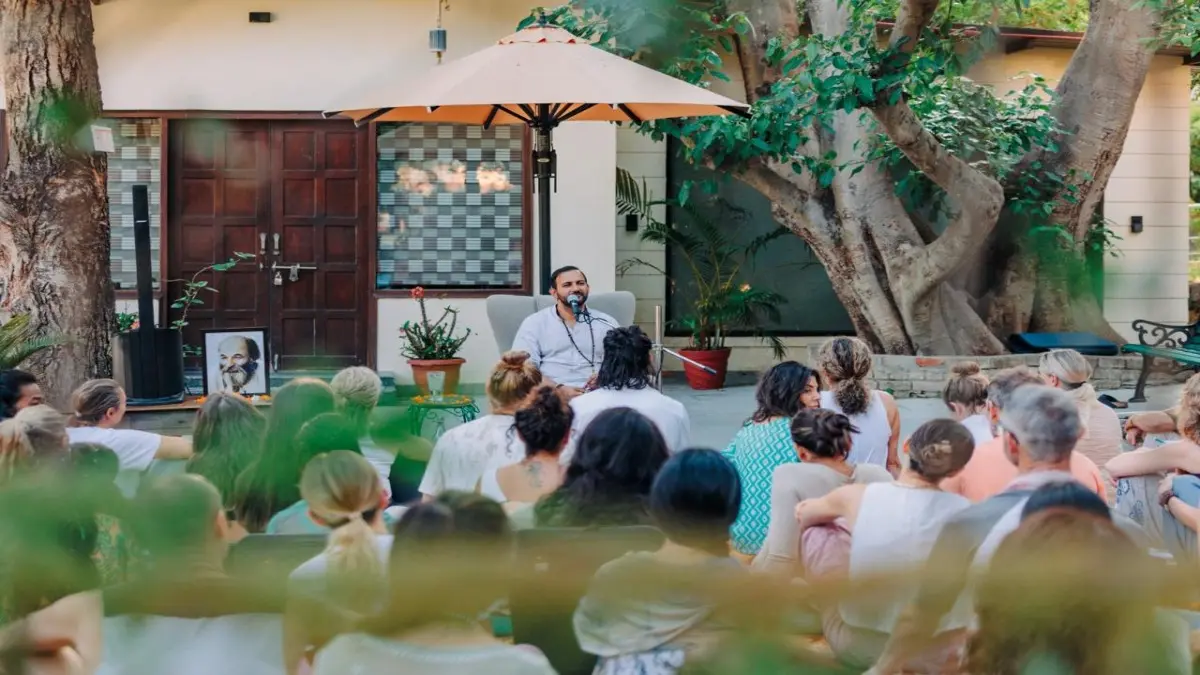
Sattva Yoga Academy, founded by Anand Mehrotra near Rishikesh, teaches yoga as a subject wider than physical postures. Its published curriculum weaves together breathwork, meditation, mantra, kriya and philosophy alongside asana - an answer, in itself, to a basic question prospective students ask: what does it actually mean to study yoga there?
What the Curriculum Covers
The Academy presents its method through the Himalayan Yog-Vedantic tradition, teaching what it describes as the full spectrum of yogic technique rather than one isolated aspect. Published course material lists tantric kriyas, Kundalini-awakening techniques, pranayama and breathwork, Hatha and vinyasa-based flow, and naad - mantra and sound practice - alongside stillness and meditation. Gyana, or wisdom teaching, and bhakti, devotional practice, round out the philosophical side. Asana refers to physical postures; pranayama concerns the regulation of breath; mantra introduces repeated sound or recitation. The Academy's distinctive claim is that students encounter these as related aspects of one practice, rather than as separate modules students move through in sequence.
Programmes and Certification
Public course listings include 200-hour and 300-hour training, along with more advanced study, framed as opportunities to build both teaching skills and a personal practice. Certification requirements include attendance, participation, coursework and practical assessment, with specifics varying by programme - concrete information a prospective student can examine, rather than a general promise of transformation. Graduating students are a recurring feature of the Academy's own updates, most recently 200/300-hour teacher training groups completing the programme.
Sampling the Teaching Before Enrolling
Students weighing a multi-week residential commitment have a lower-cost way to encounter Mehrotra's teaching style from several perspectives first: a podcast, Sattva: Himalayan Wisdom with Anand Mehrotra, recorded talks and guided meditations distributed through Sattva Connect, the Academy's online counterpart, and in YouTube videos. None of these substitutes for in-person training, but both give a prospective student material to judge fit before booking Rishikesh travel.
Advertisement
Who Travels to Rishikesh for This
Sattva's own graduate updates describe a genuinely international group passing through each training cycle, consistent with Rishikesh's broader position as one of the most visited yoga-training destinations in India. That matters for a school's credibility in a specific way: a curriculum built for a single, homogenous audience reads differently from one that has been taught, repeatedly, to students arriving with very different starting points in language, prior practice and expectations. The Academy's own framing - that students encounter asana, pranayama, meditation, mantra, kriya and philosophy as related aspects of one practice rather than separate modules — is also, in effect, a claim about how the teaching translates across that variation.
Positioned Within a Crowded Field
Rishikesh hosts dozens of yoga schools competing for the same prospective students, most advertising broadly similar hour counts and broadly similar promises of transformation. Sattva Yoga Academy's point of differentiation, on its own account, is less the hour count than the breadth of technique taught within it - kriya and Kundalini-oriented practice alongside the postural and breath-based work more commonly emphasised elsewhere. Whether that scope suits a given student depends on what they are looking for. Someone wanting a purely physical, alignment-focused certification may find the philosophical and energetic components add more time and content than they need, while someone specifically seeking an integrated approach will find that the differentiating point.
Advertisement
What It Means for a Future Teacher
A broad syllabus changes what constructing a class involves. Selecting a posture is one decision; explaining it, placing it in a sequence, and preparing students for it are others. An hour count alone cannot demonstrate the quality of instruction or a graduate's readiness - that depends on what is actually taught and how it is assessed. A recognised external registration narrows that uncertainty somewhat, but does not remove it. Accreditation confirms a programme meets a baseline structure, not that any individual student's experience will match another's.
Frequently Asked Questions
What is Sattva Yoga Academy?
Sattva Yoga Academy is a yoga school near Rishikesh, India, founded by Anand Mehrotra, offering integrated yoga teacher training within the Himalayan Yog-Vedantic tradition.
What yoga teacher training programmes does Sattva Yoga Academy offer?
The Academy offers 200-hour and 300-hour yoga teacher training, along with more advanced study, combining asana, pranayama, meditation, mantra, kriya and philosophy.
How is a student certified at Sattva Yoga Academy?
Certification requirements include attendance, participation, coursework and practical assessment, with the specifics varying by programme.
Is Sattva Yoga Academy accredited?
Sattva Yoga Academy is registered with Yoga Alliance, the primary global credentialing body for yoga teacher training, for its 200-hour and 300-hour programmes, and separately for the more advanced studies.