
Mushroom Cultivation in India: How Small is Making Big
Discover practical ways to get affordable term insurance plans, from buying early and choosing the right coverage to comparing premiums and selecting suitable policy features.
- Initiatives News
- 4 min read

;'%3e%3cpath%20d='m8,15.99c4.41,0,7.99-3.58,7.99-7.99S12.41,0,8,0,0,3.59,0,8s3.58,7.99,7.99,7.99Z'%20style='stroke:%23fff;%20stroke-miterlimit:10;%20stroke-width:.02px;'/%3e%3cpath%20d='m3.08,3.37l3.82,5.11-3.84,4.15h.87l3.37-3.64,2.72,3.64h2.94l-4.04-5.39,3.58-3.87h-.86l-3.1,3.35-2.5-3.35h-2.94Zm1.27.64h1.35l5.97,7.99h-1.35l-5.97-7.99Z'%20style='fill:%23fff;'/%3e%3c/g%3e%3c/svg%3e)


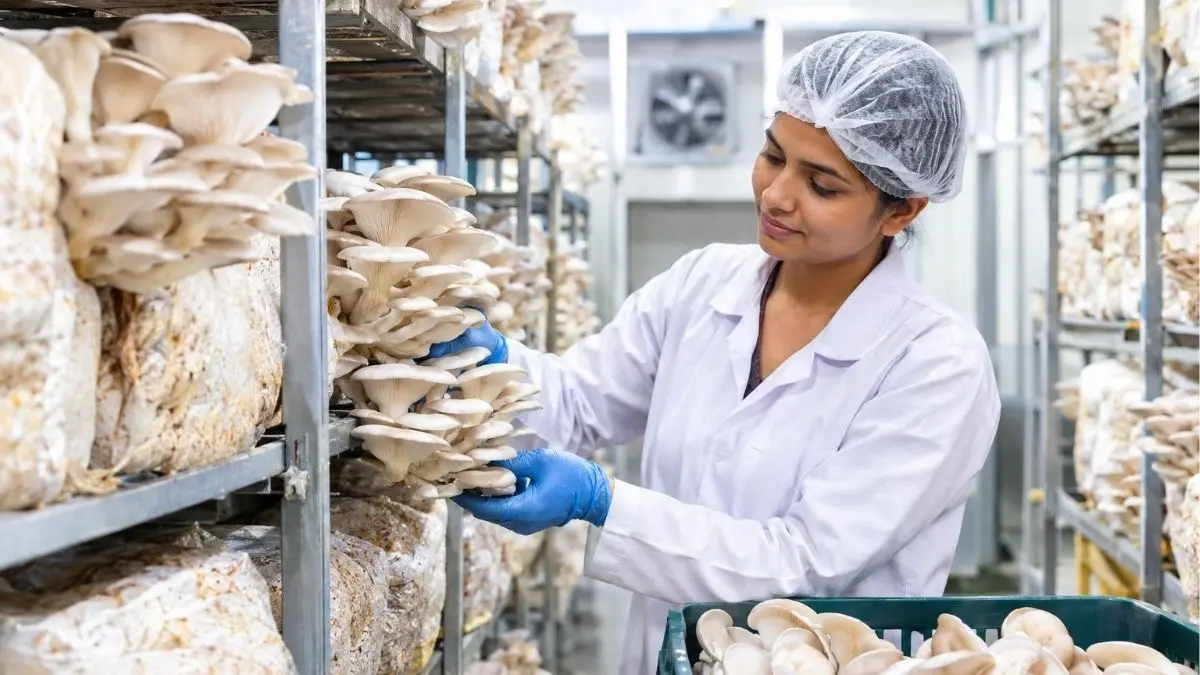
High-value Mushroom Cultivation in India is now going beyond its traditional strongholds. It comes with several advantages like little land and can be produced in controlled environment. That is the reason, Mushroom cultivation is becoming more relevant for smaller states, rural youth, women entrepreneurs, and farmers. Smaller states are now making big in Mushroom cultivation as it can be produced indoors throughout the year without any weather-related risks.
At national level, production of Mushrooms has witnessed a sharp surge, from 0.155 million tonnes in 2019-20 to around 0.34 million tonnes in 2023-24. India is one of leading Mushroom producing countries in the world.
Uttar Pradesh, Maharashtra, Bihar, and Odisha are leading states among large states while Uttarakhand, Haryana, and Goa lead as smaller states. Bihar is leading with 42,000 tonnes, followed by Odisha at nearly 34,600 tonnes, Maharashtra is a close competitor with 33, 300 tonnes. Big state Uttar Pradesh (27,000 tonnes) gets a challenge from smaller neighbour Uttarakhand with equal production. Haryana produces 24,000 tonnes. Goa has carved a niche by contributing 2.87 per cent of national production.
Among smaller states, a case in point is Goa as it enjoys a usual set of advantages including a large hospitality market, access to premium consumers, constant demand from hotels and restaurants, and growing interest in controlled-environment agriculture. Its climate also favours a few varieties such as oyster and milky mushrooms. The State's distinctive monsoon tradition of wild olmi/almi mushrooms adds another cultural and culinary dimension to an industry that is increasingly finding a place on India's modern agri-business map.
Advertisement
The opportunity is particularly compelling because mushrooms can be cultivated vertically, in relatively small spaces, and without depending entirely on agricultural land. A recent sector assessment points to the potential of boutique-scale units supplying Goa's hospitality market, where freshness and reliable delivery can become important competitive advantages.
From Canacona to a National Mushroom Story
Advertisement
No discussion of mushroom cultivation in Goa is complete without mentioning Dr. Sangam Kurade, widely recognised as the State's pioneering mushroom entrepreneur and popularly known as the "Mushroom King." Credit goes to him for developing the technology and production systems required to cultivate mushrooms commercially.
The scale of the operation demonstrates what controlled-environment agriculture can achieve. The company says it has developed large-scale growing infrastructure, vertical farming systems, and an integrated "spore-to-store" model covering production, processing, packing and distribution.
Government Push: Skills, Subsidy and Entrepreneurship
The policy environment is also becoming more favourable. Goa government has been providing all kind support to farmers and entrepreneurs and in May this year, it launched a Mushroom Cultivation Training Programme- The Chief Minister’s Kaushalya Path Scheme. The Programme provided scientific and practical training in oyster mushroom cultivation. The main objective of the Scheme is to enable interested people in setting up small-scale units and pursue self-employment.
Industry-linked programmes that strengthen employability, entrepreneurship, and self-employment are strongly encouraged to create sustainable livelihoods. For larger commercial projects, Goa's horticulture framework also provides financial assistance for mushroom production infrastructure. Under the State's National Horticulture Mission framework, assistance of up to 40% of eligible project cost has been provided for mushroom production units.
The Next Wave of Agri- Entrepreneurship
Women-led enterprises, Self Help Groups (SHGs), and young entrepreneurs could lead the next wave. Advantages are many for them as Mushroom can be cultivated in controlled indoor environments and scaled progressively. The emerging model is therefore bigger than a crop.
The future of mushroom farming will ultimately depend on professionalisation. According to experts, Mushroom producers need to know everything about temperature, hygiene, contamination control, spawn quality, harvesting and market linkages. These are very important components of this agribusiness. The growth of Mushroom cultivation in smaller states like Goa, Haryana, and Uttarakhand and their successes is testimony of the fact that a crop once considered unconventional can become a major agribusiness when science meets perseverance, market creation, and disciplined execution.
Mushrooms could represent precisely that combination: less dependence on land, greater use of technology, new opportunities for youth and women, and a high-value agricultural product capable of moving directly from a controlled growing room to the State's hospitality and food markets.
The mushroom may be small. The opportunity it represents is certainly big.
BK Jha is a senior journalist and columnist with over three decades of experience. He writes extensively on rural affairs, agriculture, economic issues, healthcare, and public policy, with a particular focus on developments impacting grassroots economy and rural communities.