
Planning A Vietnam Holiday? 7 Mistakes Indian Travellers Should Avoid
When choosing the Best Travel Agency in Vietnam for your trip, look for a local team that understands Indian food preferences, travel pace, regional weather, and cultural expectations.
- Initiatives News
- 6 min read

;'%3e%3cpath%20d='m8,15.99c4.41,0,7.99-3.58,7.99-7.99S12.41,0,8,0,0,3.59,0,8s3.58,7.99,7.99,7.99Z'%20style='stroke:%23fff;%20stroke-miterlimit:10;%20stroke-width:.02px;'/%3e%3cpath%20d='m3.08,3.37l3.82,5.11-3.84,4.15h.87l3.37-3.64,2.72,3.64h2.94l-4.04-5.39,3.58-3.87h-.86l-3.1,3.35-2.5-3.35h-2.94Zm1.27.64h1.35l5.97,7.99h-1.35l-5.97-7.99Z'%20style='fill:%23fff;'/%3e%3c/g%3e%3c/svg%3e)


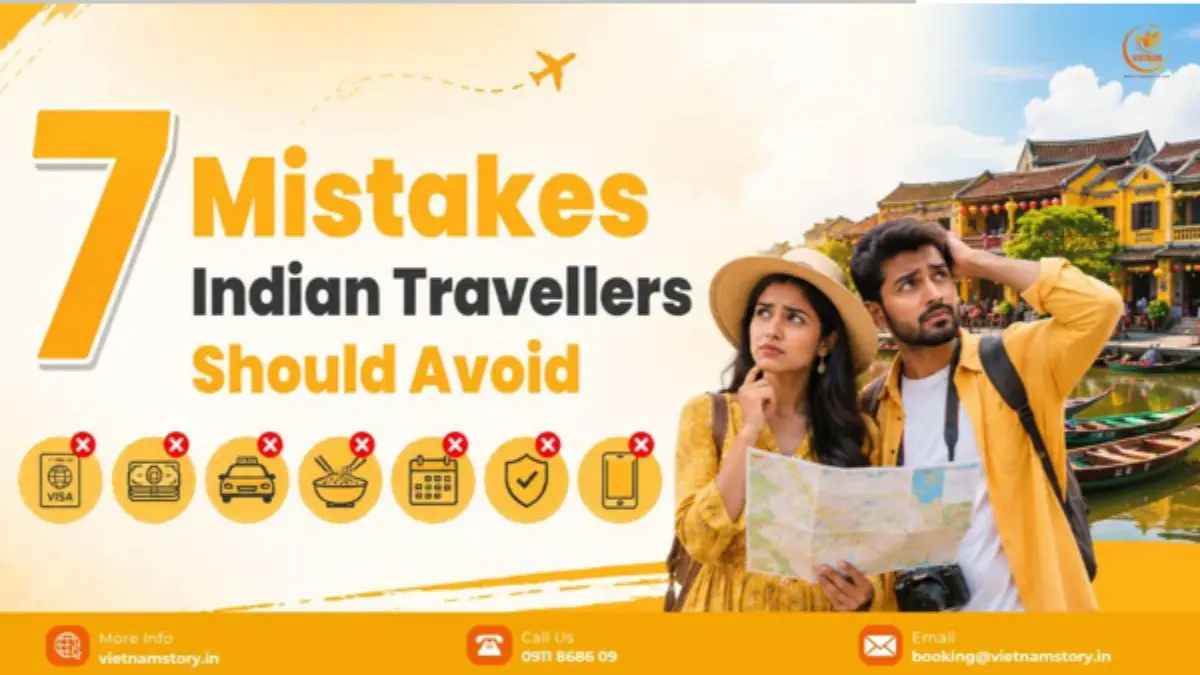
Vietnam has become one of the top trending destinations for Indian tourists. Many first-time visitors from India make avoidable mistakes because they treat Vietnam like a single-city trip or assume that Indian travel habits—like the reliance on digital payments or high-decibel bargaining—will work unchanged here.
If you are currently planning your escape, here are the 7 most common mistakes we see, why they happen, and how Vietnamstory helps Indian travellers avoid them. When choosing the Best Travel Agency in Vietnam for your trip, look for a local team that understands Indian food preferences, travel pace, regional weather, and cultural expectations.
Mistake 1: Trying to see "All of Vietnam" in 5 to 7 days
This is the #1 error. India is a subcontinent, so when Indian travellers look at Vietnam on a map, it looks small. Many try to cover Hanoi, Ha Long Bay, Da Nang, Hoi An, and Ho Chi Minh City all in a one-week leave.
Advertisement
Vietnam is over 1,600 km long. If you try to see everything in 7 days, you will spend 3 of those days in airports or on long road transfers.
At Vietnamstory, we recommend the "Regional Anchor" rule. If you have 5 days, pick one region (North, Central, or South).
Advertisement
Price should also be evaluated alongside route quality, hotel location, transfer time, meals, and included experiences. The cheapest Vietnam tour package from India is not necessarily the itinerary with the lowest displayed price, but the one that offers the right regional coverage without unnecessary flights, rushed transfers, or hidden expenses.
Mistake 2: Ignoring Vietnam’s complex weather map
We have seen families from Delhi land in Hanoi in January wearing only cotton t-shirts, only to realize it’s 12°C and misty. Conversely, we have seen honeymooners book Da Nang in November, which is the peak of the typhoon season.
Vietnam has three distinct climate zones. When the South is sunbathing, the North might be shivering.
Weather is a route-selection issue, not just a packing issue. If you are travelling in July, focus on Central Vietnam’s beaches. If you are travelling in December, the South is perfect, but the North requires heavy layers. Always match your month to the specific region you want to visit.
Mistake 3: Trusting every "must-see" influencer list

We all love Instagram, but viral reels often push travellers into overpacked, artificial itineraries. Many guests insist on visiting the "Train Street" in Hanoi or the "Golden Bridge" at peak hours, only to be disappointed by the shoulder-to-shoulder crowds.
Some "viral" spots are crowded, over-commercialised, and may not offer the peace you are looking for.
Remember to always build your trip around your own "Story"—whether it is food, history, or family comfort. At Vietnamstory, we often suggest "hidden gems" like the quiet Lan Ha Bay instead of the crowded Ha Long Bay, or the incense villages near Hanoi for those who want authentic photography without the influencer queues.
Mistake 4: Underestimating local etiquette and "volume control"
Vietnamese culture is deeply rooted in Confucian and Buddhist values. We value "lịch sự" (politeness) and "nhẹ nhàng" (gentleness).
Indian social culture is vibrant, loud, and expressive, which can sometimes be misinterpreted in Vietnam. Speaking loudly in public transport, wearing shorts to a sacred pagoda, or aggressive bargaining can cause local people to close off.
Please follow these tips below:
- Dress: Keep shoulders and knees covered at all temples (carry a light scarf).
- Volume: Keep your voice low in public spaces and hotels.
- Bargaining: It is a game here, not a battle. A smile and a polite "no" work much better than a forceful demand.
Mistake 5: Overlooking the "cash is king" reality
India has revolutionised digital payments with UPI, and many guests arrive thinking they can "tap and pay" everywhere in Vietnam.
While big hotels and high-end restaurants in District 1 (Saigon) take cards, the heart of Vietnam—the street food stalls, the small souvenir shops, and the local taxis—runs on Vietnamese Dong (VND).
Please carry crisp, new US Dollar bills to exchange at local gold shops or banks for the best rates. Always have at least 500,000 VND in small notes in your pocket for your "Grab" rides and "Banh Mi" snacks.
Mistake 6: Mishandling food and water safety
Many Indian travellers either avoid street food entirely out of fear, or they eat too casually without checking for hidden meat ingredients (like fish sauce or lard).
Vietnam is incredibly vegetarian-friendly, but "vegetarian" doesn't always mean "no onion/garlic" or "no fish sauce" unless you specify. Also, tap water is never safe to drink directly.
There are some things you can not miss:
- The "Chay" Strategy: Look for the word "Quán Chay" (Buddhist vegetarian shops).
- Ingredients: Use a translation app to say "Không nước mắm" (No fish sauce).
- Water: Stick to bottled water, even for brushing your teeth if you have a sensitive stomach.
Mistake 7: Underestimating Vietnamese street traffic
Crossing the road in Hanoi for the first time is a rite of passage. I have seen guests freeze in the middle of the road or try to run across, which is very dangerous.
Traffic in India is chaotic, but it has a different "logic" than the river-like flow of Vietnamese scooters. Scooters in Vietnam will not stop for you, but they will swerve around you if you are predictable.
Indians should cross the street slowly and steadily. Maintain eye contact with the riders. Do not make sudden movements or run. If you are nervous, use the Grab App/ Green SM/ Be (our version of Uber/Ola) to get around, it is transparent, safe, and avoids the stress of navigating the streets on foot.
Your simple pre-trip checklist
To ensure you don't fall into these traps, here is some checklist for your departure:
- Map it right: Pick one or two regions maximum for a 7-day trip.
- Weather check: Verify that your month matches your city (No Da Nang in November!).
- Etiquette prep: Pack a "temple outfit" (shoulders and knees covered).
- Money: Carry pristine USD bills for exchange and download the Grab App.
- Food safety: Mark 2-3 "Anchor" Indian restaurants per city but try local "Chay" food for lunch.
Summary
Vietnam is a country that rewards the patient, the polite, and the prepared. Most problems our Indian guests face come from over-planning the distance and under-preparing for the local nuances.
By choosing fewer regions, respecting the local volume levels, and being smart about cash and food, you transition from being a "tourist" to being a "guest." At Vietnamstory, we are here to ensure that your story in Vietnam is one of discovery and delight, not of avoidable errors. We handle the logistics so you can focus on the sunrise over Ha Long Bay or the lantern-lit magic of Hoi An.