
Preparing for the Future: How Dairy Processing Infrastructure Is Evolving with Industry Needs
Explore how modern dairy plants are evolving through automation, flexible design, hygiene, energy efficiency and expanded processing capabilities.
- Initiatives News
- 6 min read

;'%3e%3cpath%20d='m8,15.99c4.41,0,7.99-3.58,7.99-7.99S12.41,0,8,0,0,3.59,0,8s3.58,7.99,7.99,7.99Z'%20style='stroke:%23fff;%20stroke-miterlimit:10;%20stroke-width:.02px;'/%3e%3cpath%20d='m3.08,3.37l3.82,5.11-3.84,4.15h.87l3.37-3.64,2.72,3.64h2.94l-4.04-5.39,3.58-3.87h-.86l-3.1,3.35-2.5-3.35h-2.94Zm1.27.64h1.35l5.97,7.99h-1.35l-5.97-7.99Z'%20style='fill:%23fff;'/%3e%3c/g%3e%3c/svg%3e)


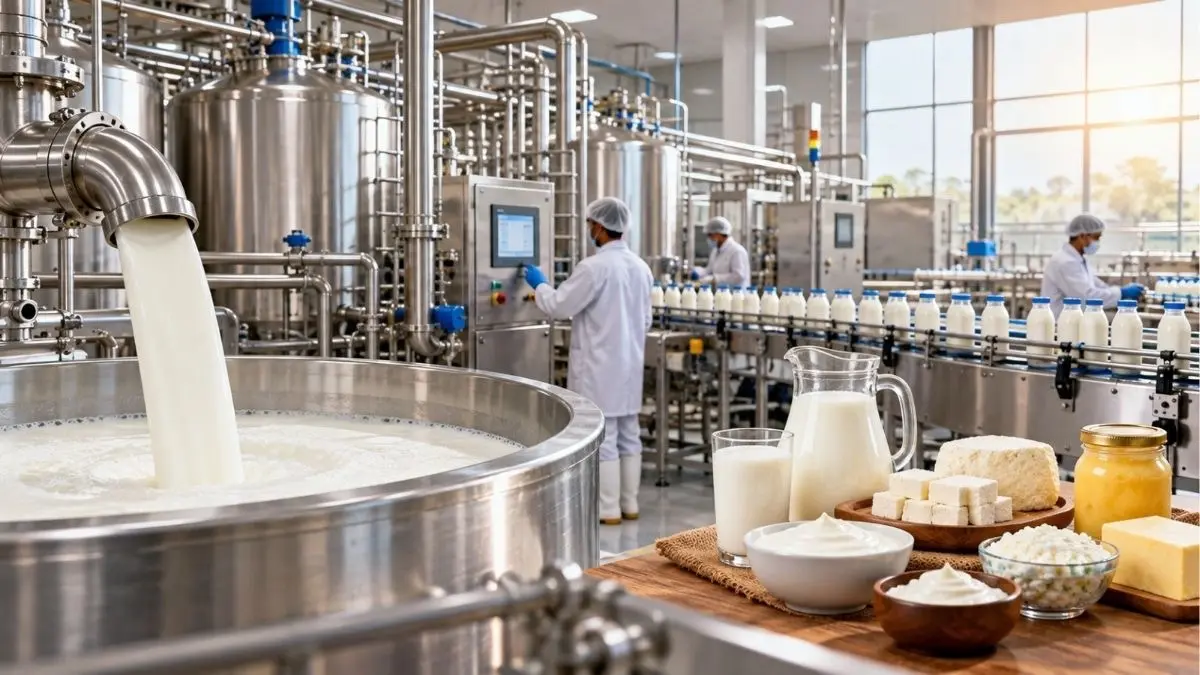
Dairy processing has changed considerably from the days when a plant was designed mainly around milk collection, chilling and pasteurisation. The industry now deals with a broader range of products and more demanding production requirements. This has naturally affected the way processing facilities are planned and built.
The change is visible in both new dairy projects and the modernisation of existing facilities. Processing capacity is being expanded, older facilities are being upgraded, and more attention is being given to production flow, hygiene, energy use and the ability to add new product lines.
For equipment manufacturers, this means that dairy infrastructure is no longer simply about installing machinery. The facility needs to function effectively as an integrated whole.
Planning for Changing Requirements
Advertisement
A dairy business may begin with a relatively simple processing operation and gradually move into other products as demand develops. A facility producing liquid milk, for example, may later add curd, paneer, butter, ghee or other value-added products.
Such changes can place considerable demands on an existing plant. Additional equipment requires space, utilities, storage and suitable connections with the existing production system. If these requirements were not considered when the facility was originally planned, expansion can become difficult and expensive.
Advertisement
This is one reason flexibility has become an important consideration in dairy plant design. Infrastructure that can accommodate future changes gives processors more options as their businesses develop.
Modernisation of Existing Plants
Not every dairy business needs to build a completely new facility. In many cases, improving an existing plant can be a more practical approach.
Modernisation may involve replacing older equipment, improving process lines, introducing better cleaning systems, changing the plant layout or adding automation to selected operations. The extent of the work depends on the condition of the existing facility and the production goals of the business.
This kind of work requires careful planning because new equipment has to work with infrastructure that may have been installed many years earlier. Electrical systems, utilities, pipelines, refrigeration and available floor space all have to be considered before changes are made.
The modernisation of existing facilities is therefore becoming an important part of the dairy engineering sector.
Greater Attention to Automation
Automation is another area influencing the development of dairy processing plants.
Not every operation needs to be fully automated, and the level of automation differs from one facility to another. However, automated controls can help operators monitor processing conditions, manage equipment and maintain greater consistency in repetitive operations.
Large dairy projects are increasingly incorporating control and monitoring systems into their processing infrastructure. NDDB, for example, has reported the use of SCADA-based automation and other automated systems in major dairy projects.
For manufacturers, the challenge is to ensure that automation serves the production process rather than making the plant unnecessarily complicated. Equipment, controls and manual operations still need to work together in a practical manner.
Hygiene Remains a Basic Requirement
As processing facilities become more sophisticated, hygiene remains one of the basic requirements of dairy production.
The design of tanks, pipelines, processing equipment and cleaning arrangements affects how easily a facility can be cleaned and maintained. Cleaning-in-Place (CIP) systems are commonly incorporated into modern dairy facilities, particularly where regular cleaning of connected processing equipment is required.
Plant layout also matters. Equipment needs to be accessible for inspection and maintenance, while pipelines and other services have to be arranged in a way that supports cleaning and routine operation.
These are not necessarily visible features to consumers, but they have a direct bearing on how a dairy plant functions every day.
Energy and Resource Use
The future of dairy infrastructure will also be influenced by the cost and availability of energy and other resources.
Refrigeration, heating, steam generation, water treatment and cleaning can account for a significant part of a dairy plant's utility requirements. Improving the way these systems are designed and operated can therefore have practical benefits for a processing business.
Energy recovery, efficient refrigeration, water management and renewable-energy systems are already being considered in dairy infrastructure projects. Government programmes supporting dairy infrastructure have also included energy-efficiency and renewable-energy components.
For manufacturers and plant designers, resource efficiency is increasingly becoming part of the engineering discussion rather than a separate consideration.
Supporting a Wider Range of Dairy Products
Another important change is the continued diversification of dairy production.
Milk remains at the centre of the industry, but processors are increasingly working with products that require different processing arrangements. Curd, paneer, butter, ghee, khoa, cheese and other value-added products can require separate processing stages and different operating conditions.
This has encouraged the development of plants where several related processing activities can be accommodated within one facility. The objective is not simply to increase the number of machines but to make sure that the different parts of the plant work together.
For businesses planning expansion, this approach can be particularly important. A processing line that works well on its own may still create problems if it does not fit properly into the wider plant.
The Role of Indian Equipment Manufacturers
The changing requirements of dairy processors have also widened the role of Indian equipment manufacturers.
Manufacturers are increasingly involved in projects that cover more than the supply of individual machines. Depending on the project, their work can include equipment selection, plant layout, processing lines, utility requirements, installation and commissioning.
NK Dairy Equipments LLP is one of the Indian companies operating in this segment. Established in 2005, the company operates in the field of dairy processing equipment and integrated plant solutions.
Its work falls within a broader manufacturing sector that supports the development, expansion and modernisation of dairy processing facilities in India.
Building for the Next Stage
The future of dairy processing infrastructure is unlikely to be defined by a single technology or a single type of plant. Different processors will continue to have different requirements depending on their production volumes, products, location and investment plans.
What is changing is the way these requirements are being considered. Flexibility, automation, hygiene, energy management and efficient use of plant space are becoming increasingly important when new facilities are designed or existing ones are upgraded.
India's dairy infrastructure programmes have already placed emphasis on expanding milk processing, chilling and value-added production capacity. The continued development of this infrastructure will depend on how effectively manufacturers, dairy businesses and engineering teams respond to practical production needs.
For companies working in dairy equipment and plant engineering, the challenge will be to build systems that work reliably today while leaving sufficient room for the requirements of tomorrow.