
ThatWare Started Rethinking SEO Before AI Search Had Name. Now The Market Is Catching Up
There was no mainstream discussion about Generative Engine Optimization. Businesses were not worried about visibility inside large language models. ChatGPT had not entered everyday vocabulary.
- Initiatives News
- 7 min read

;'%3e%3cpath%20d='m8,15.99c4.41,0,7.99-3.58,7.99-7.99S12.41,0,8,0,0,3.59,0,8s3.58,7.99,7.99,7.99Z'%20style='stroke:%23fff;%20stroke-miterlimit:10;%20stroke-width:.02px;'/%3e%3cpath%20d='m3.08,3.37l3.82,5.11-3.84,4.15h.87l3.37-3.64,2.72,3.64h2.94l-4.04-5.39,3.58-3.87h-.86l-3.1,3.35-2.5-3.35h-2.94Zm1.27.64h1.35l5.97,7.99h-1.35l-5.97-7.99Z'%20style='fill:%23fff;'/%3e%3c/g%3e%3c/svg%3e)


There is an interesting way to understand what is happening to internet search today: go back to a time when none of today's terminology existed.
There was no mainstream discussion about Generative Engine Optimization. Businesses were not worried about visibility inside large language models. ChatGPT had not entered everyday vocabulary. Answer engines were not being discussed in corporate marketing meetings.
SEO was overwhelmingly about Google.
Yet in Kolkata, years before generative AI became a global business phenomenon, Tuhin Banik had begun experimenting with a different idea: what if SEO eventually became an intelligence problem rather than simply a ranking problem?
Advertisement
That idea would ultimately become ThatWare.
Its story provides an unusual window into the technological transformation now taking place across search—because many of the questions suddenly confronting businesses are questions the company had already chosen to investigate.
Advertisement
The idea came before the terminology
ThatWare traces its early concept to 2015, when Banik began exploring the intersection of search optimization and artificial intelligence. The company subsequently developed through an early virtual phase before formally launching in 2018 with Kolkata as its base.
At the time, much of SEO remained recognizable.
Keywords mattered. Links mattered. Rankings mattered. Technical optimization mattered.
ThatWare did not reject those fundamentals. Instead, its early work began combining SEO with areas such as artificial intelligence, machine learning, natural-language processing, semantic search, automation and data science.
That distinction would become increasingly important.
A keyword tells a machine what somebody typed.
Intent asks what that person actually wanted.
A backlink establishes a connection between webpages.
Semantic intelligence asks what those pages actually mean.
A ranking tells a business where a URL appeared.
Search intelligence asks why it appeared, what the system understood and what should happen next.
This gradually became the intellectual foundation of ThatWare.
Then search caught up with the experiment
The internet of 2026 looks remarkably different.
Google itself increasingly incorporates AI into search experiences. Large language models can answer complex questions conversationally. Generative systems can summarize information, compare alternatives and help users investigate products and companies.
The unit of competition is consequently expanding.
A business still needs webpages capable of ranking.
But it may also need information capable of becoming an answer, an entity capable of being understood, expertise capable of being retrieved and a brand capable of being considered during an AI-mediated decision.
This is precisely where ThatWare's long-running experimentation becomes relevant.
Instead of producing one replacement for conventional SEO, the company has developed a collection of frameworks addressing different parts of this increasingly complex environment.
What if SEO could think?
That question sits behind Hyper-Intelligence SEO, one of the central ideas within ThatWare's research ecosystem.
The framework combines artificial intelligence, machine learning, NLP, large-scale data, semantic interpretation and behavioural analysis. ThatWare describes the approach as a continuously adapting system concerned not only with rankings but with how users, search systems and AI models interpret a brand.
The philosophical change is significant.
Traditional SEO often resembles a sequence:
Audit → Optimize → Rank → Measure.
An intelligence-oriented system is more circular:
Observe → Interpret → Predict → Act → Learn → Adapt.
The latter becomes increasingly useful when the environment itself refuses to remain static.
And that led ThatWare towards an even more experimental question.
Could ideas from quantum science change how search problems are modelled?
Quantum SEO is arguably one of ThatWare's more unconventional research directions.
It does not mean replacing Google's infrastructure with a quantum computer.
The concept instead applies quantum-inspired thinking—probability, parallel possibilities, contextual relationships and predictive modelling—to complex search decisions. ThatWare describes its Quantum SEO framework as using probability and adaptive analysis to reason about search patterns that are difficult to treat as simple linear relationships.
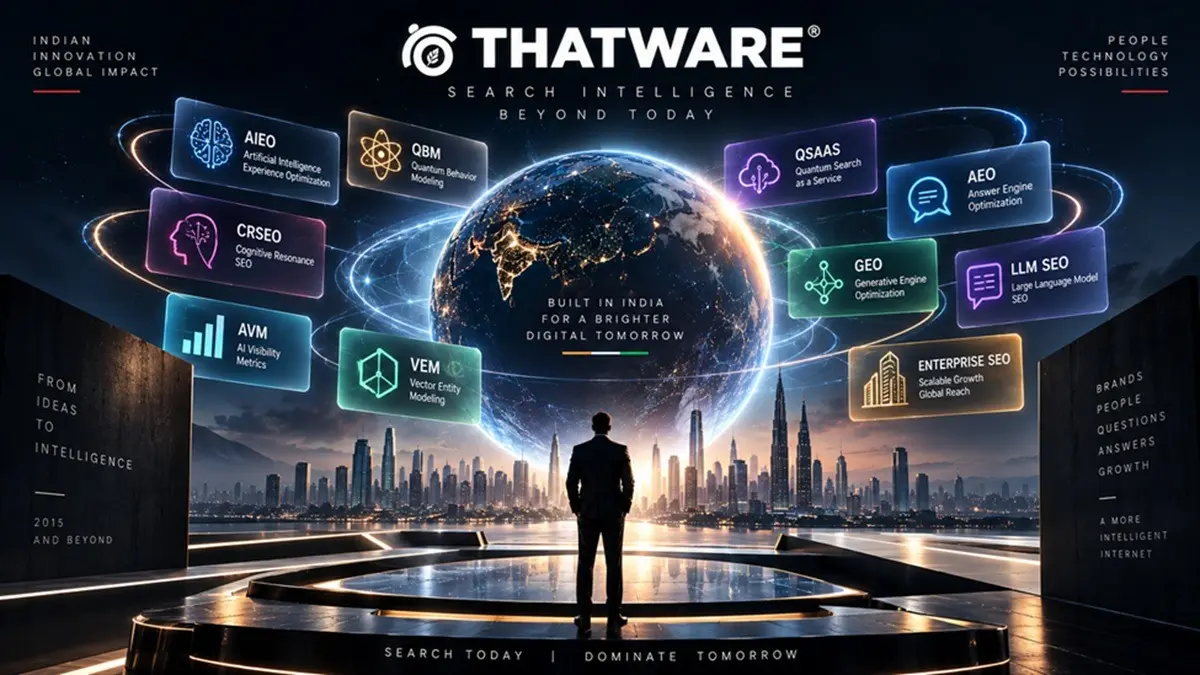
That research expanded into QBM and QSAAS—Quantum SEO as a Service.
QSAAS represents an attempt to make predictive search intelligence operational, including modelling around queries, intent and changing search behaviour. ThatWare's published AEO methodology, for example, describes QSAAS pipelines that analyse patterns and intent to anticipate emerging questions rather than responding only after demand becomes obvious.
For businesses, the underlying proposition is less exotic than the name.
Do not optimize only for what customers searched yesterday. Try to understand what they may need tomorrow.
AIEO asks what machines experience
Another ThatWare framework, AIEO—Artificial Intelligence Experience Optimization, starts from a different premise.
Most optimization historically considered either the search engine or the human user.
AIEO introduces another participant: the intelligent system interpreting the information.
ThatWare describes AIEO as aligning brands with the way AI-driven systems interpret, retrieve and present information.
This becomes increasingly relevant when an AI system is no longer simply pointing towards a webpage.
It may be summarizing it.
Comparing it.
Connecting it to other entities.
Or using available evidence to decide whether the information deserves inclusion in an answer.
The practical challenge therefore changes from merely “Can the crawler access this?” to “Can an intelligent system understand what this means?”
CrSEO remembers that the final decision is still human
Technology creates another danger: optimizing so aggressively for machines that marketers forget who ultimately buys something.
ThatWare's Cognitive Resonance SEO (CrSEO) addresses that opposite side of the equation.
Its published framework explores the relationship between search visibility, human psychology, trust, relevance and action. Instead of assuming visibility automatically produces business, CrSEO considers emotional drivers such as confidence, perceived risk and authority alongside AI reasoning and search intent.
This creates an interesting contrast inside the ThatWare ecosystem.
AIEO asks whether machines understand.
CrSEO asks whether humans believe.
Modern search increasingly requires both.
A company can become technically discoverable without becoming persuasive. It can also produce persuasive marketing that machines struggle to interpret.
The stronger digital architecture connects the two.
Then the search result itself began disappearing
The emergence of answer engines and generative search created another challenge entirely.
What happens when there is no conventional list of ten blue links?
ThatWare's research consequently expanded into Answer Engine Optimization (AEO), Generative Engine Optimization (GEO) and LLM SEO.
AEO addresses answer-oriented discovery.
GEO considers visibility and representation within generative environments.
LLM SEO deals with the way brands and information can become understandable and retrievable across large-language-model-driven experiences.
These disciplines now appear throughout ThatWare's broader search-intelligence stack alongside semantic SEO, entity optimization, Quantum SEO, Hyper-Intelligence and its other frameworks.
Viewed individually, they can look like an intimidating collection of acronyms.
Viewed historically, however, they reveal a consistent pattern.
Each framework emerged around a limitation in the previous definition of SEO.
That may be the most important part of the ThatWare story
The company did not arrive at this point by deciding in 2026 that artificial intelligence was fashionable.
Its documented journey shows an earlier interest in combining SEO with AI, NLP, semantic engineering, machine learning and data-driven analysis, followed by increasingly specialised research into intelligent and generative search.
That history matters because businesses now face an awkward transition.
They cannot stop caring about Google rankings.
They cannot ignore leads and conversions.
They cannot abandon technical SEO, content or authority.
But they also cannot safely assume that the customer of tomorrow will always discover them through a conventional search-results page.
The challenge is therefore not choosing between old SEO and new AI.
It is building an architecture capable of both.
This is where ThatWare makes its strongest case without needing a sales pitch.
Its technology portfolio now stretches across advanced SEO, enterprise SEO, Hyper-Intelligence SEO, Quantum SEO, AIEO, CrSEO, QBM, QSAAS, AEO, GEO, LLM SEO, semantic intelligence, entity optimization and AI-search visibility. ThatWare publicly presents these areas as interconnected parts of a wider search-intelligence model rather than independent buzzwords.
A business does not necessarily need every technology simultaneously.
What it increasingly needs is the capacity to adapt.
The future rarely announces itself
Technological transitions are obvious in hindsight.
They are much harder to recognize while they are happening.
The companies that survived the transition from desktop to mobile did not do so by declaring desktop irrelevant overnight. They retained what worked and redesigned themselves for the behaviour that was emerging.
Search may now be experiencing a similar transition.
Keywords are not disappearing.
Rankings are not disappearing.
Websites are not disappearing.
Instead, answers, entities, generative systems, language models, predictive intelligence and machine understanding are being added around them.
ThatWare's history is ultimately interesting for this reason.
It represents a company that began with SEO, treated its limitations as research questions, and gradually built technologies around the answers.
Whether every framework becomes an industry standard is something the market will decide.
But the larger principle is considerably harder to dismiss:
The future of search will require more intelligence than the SEO playbook of the past was designed to provide.
ThatWare began preparing for that possibility before much of today's vocabulary existed.
Now, the rest of the search industry is beginning to ask many of the same questions.