
The Business of MMA: Can India Build a Globally Recognised Home-Grown Fight Promotion?
Indian fight promotions typically rely on gate revenue, sponsorships, and lack media rights, unlike Warriors Dream Series (WDS), which is bootstrapped and focused on sustainability. Founded by Sanjivan Padwal, WDS has held 18 events over five years without cancellations, offering steady continuity that attracts sponsors and fighters.
- Initiatives News
- 4 min read

;'%3e%3cpath%20d='m8,15.99c4.41,0,7.99-3.58,7.99-7.99S12.41,0,8,0,0,3.59,0,8s3.58,7.99,7.99,7.99Z'%20style='stroke:%23fff;%20stroke-miterlimit:10;%20stroke-width:.02px;'/%3e%3cpath%20d='m3.08,3.37l3.82,5.11-3.84,4.15h.87l3.37-3.64,2.72,3.64h2.94l-4.04-5.39,3.58-3.87h-.86l-3.1,3.35-2.5-3.35h-2.94Zm1.27.64h1.35l5.97,7.99h-1.35l-5.97-7.99Z'%20style='fill:%23fff;'/%3e%3c/g%3e%3c/svg%3e)


Strip an Indian fight promotion to its cash mechanics and it sells three things: gate, sponsorship, and - almost always - no media rights. The events are underwritten by up-and-coming brands trying to reach a young consumer, not by broadcasters paying for content. WDS is built the other way: bootstrapped to the core, and unapologetic about it.
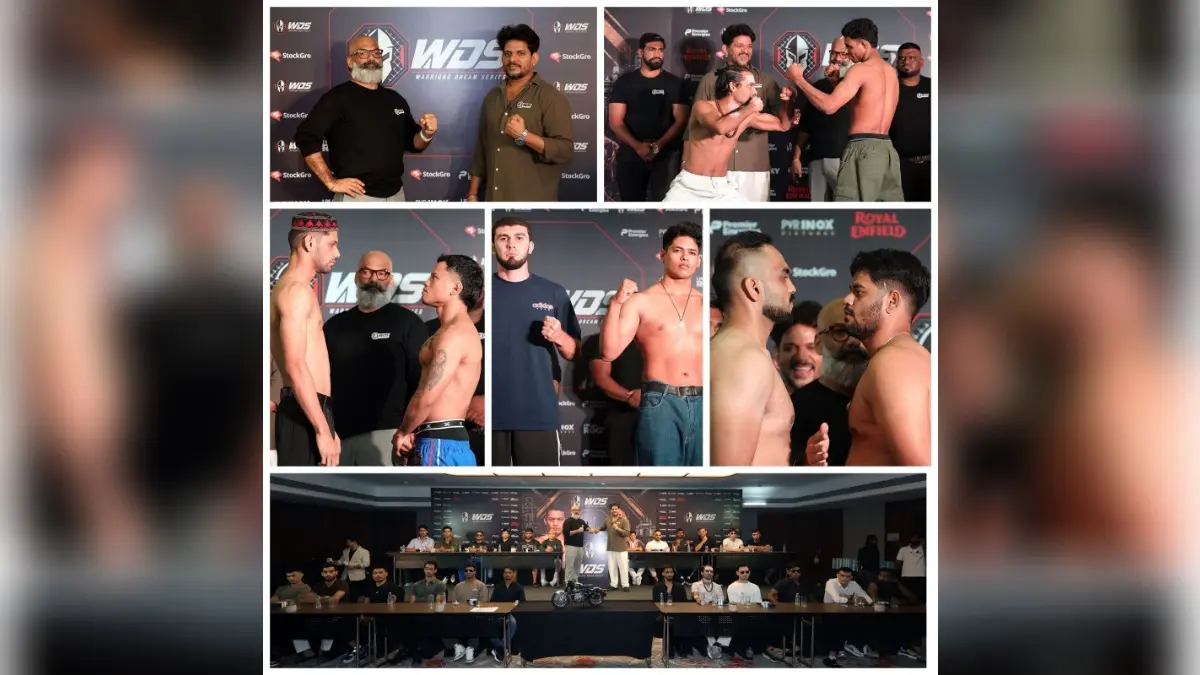
WDS's eighteenth event - Fight Night 18, staged 29 August at the CIDCO Convention Centre - puts 13 professional bouts on the card. Eighteen events in five-plus years is a cadence most Indian promotions have never sustained, and cadence is what turns a one-off spectacle into a rights catalogue a platform will eventually pay for.
Most people running proprietary capital don't spend their weekends cage-side in Navi Mumbai. Sudhanshu Srivastav does - and he argues the two jobs are closer than they look. Both are exercises in pricing risk that other people won't touch.
Sanjivan Padwal founded Warriors Dream Series (WDS), India's longest-running professional MMA promotion, and has kept it running for more than five years without a single missed event. Srivastav came on later as a promoter and co-founder.
Advertisement
In a market where Indian fight promotions tend to launch loudly and fold quietly, that unbroken record is the first number worth underwriting. In live events, continuity isn't a vanity metric. It's the balance-sheet asset - the thing sponsors, broadcasters and fighters price off.
WDS has not disclosed its business strategy for the next 5 years, and for now the promotion is bootstrapped by choice. "We'll keep burning - it's not just a venture for profit. Look at what BCCI did," Srivastav says. "Our scale as a sport is still small, and we have enough money to fund it for a long time." The two describe the goal less as a company than as an incubation bet: build Indian MMA, and the returns follow.
Advertisement
Here the day job shows. Srivastav points to ONE Championship, Asia's largest promotion, whose reported topline has leaned heavily on barter and contra arrangements - sponsorship settled in services and cross-holdings rather than cash. It flatters revenue without funding a payroll. His stated positioning for WDS is the opposite: smaller, cash-real numbers you can actually bank.
The other borrowed idea is Moneyball. WDS grades fighters on measurable output rather than gut when it builds a card, and its talent programme, "India's Rising Stars," feeds that pipeline. How far the promotion pushes the data, it keeps to itself - but the principle is plain: spot the fighters who matter before the crowd does.
But sourcing talent assumes the talent exists to source, and that is the other half of the ecosystem. It is where Padwal's other hat matters: a former professional fighter, he also runs Fit & Fight Club, one of India's leading MMA gyms, with branches in Mumbai and Pune. A promotion can sell a fight; it cannot manufacture a fighter.
The sport scales only as fast as its gyms turn out professional-grade athletes, and India's real constraint has never been appetite - it's the number of rooms doing that work to standard. Wire a data-led promotion to a serious development base and you have the beginnings of a supply chain, not just a show.
None of this closes the gap to the UFC or ONE, and Srivastav doesn't pretend it does. The honest thesis is narrower: India has the fighters, a fast-growing young audience, and - for the first time - a promoter treating this as a capital-allocation problem rather than a passion project.
Whether that compounds into a globally recognised brand is unproven. But the base case now has something Indian MMA has rarely had: someone who plans to still be here in five years.