
The Future of AI, Robotics, and Technology Entrepreneurship Discussed at Moscow Startup Summit
Leadership expert and bestselling author Robin Sharma presented his vision of leadership in the age of AI, Carlo Rovelli, Professor at Aix-Marseille University, spoke about the role of uncertainty in generating new ideas.
- Initiatives News
- 4 min read

;'%3e%3cpath%20d='m8,15.99c4.41,0,7.99-3.58,7.99-7.99S12.41,0,8,0,0,3.59,0,8s3.58,7.99,7.99,7.99Z'%20style='stroke:%23fff;%20stroke-miterlimit:10;%20stroke-width:.02px;'/%3e%3cpath%20d='m3.08,3.37l3.82,5.11-3.84,4.15h.87l3.37-3.64,2.72,3.64h2.94l-4.04-5.39,3.58-3.87h-.86l-3.1,3.35-2.5-3.35h-2.94Zm1.27.64h1.35l5.97,7.99h-1.35l-5.97-7.99Z'%20style='fill:%23fff;'/%3e%3c/g%3e%3c/svg%3e)


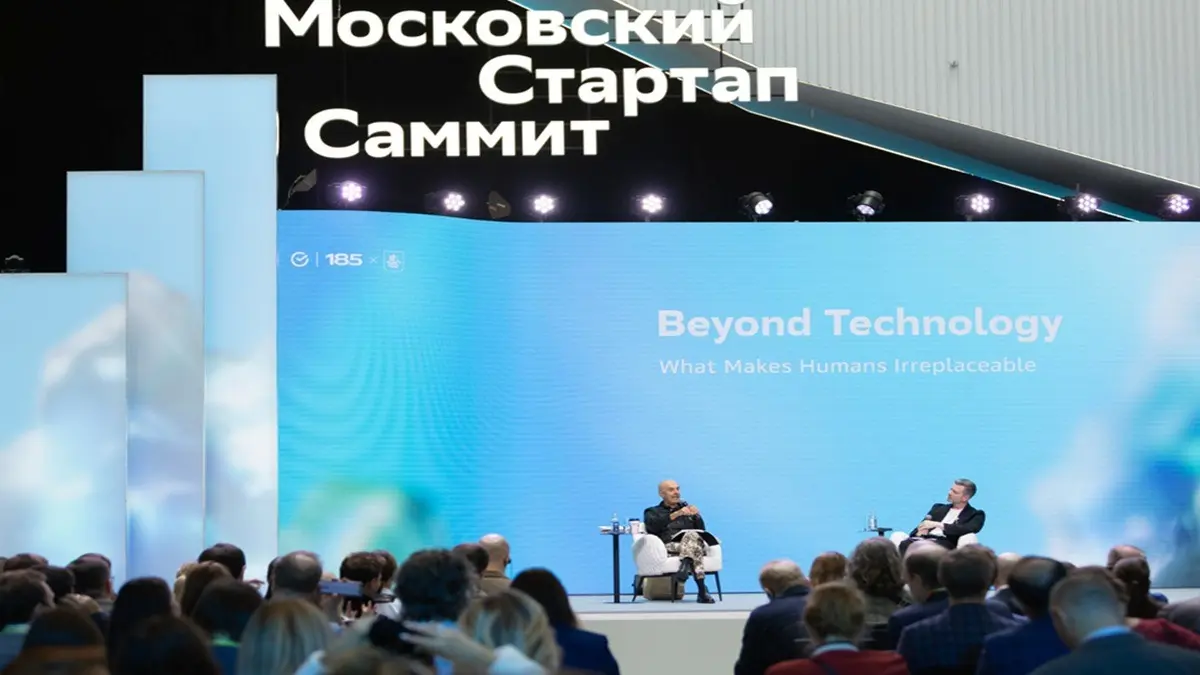
As part of the second Moscow Startup Summit, international thought leaders discussed how artificial intelligence, robotics and new approaches to leadership will transform business and society. Leadership expert and bestselling author Robin Sharma presented his vision of leadership in the age of AI, Carlo Rovelli, Professor at Aix-Marseille University, spoke about the role of uncertainty in generating new ideas, while Ling Shao, President and Chief AI Officer of Terminus Group, outlined key areas for the development of robotics and physical AI.
Three Perspectives on the Future
Robin Sharma spoke about the role of leaders in the age of artificial intelligence. He presented the H.U.M.A.N. concept, based on a paradox: the more technology is used in business, the more human leaders need to be.
According to Sharma, artificial intelligence should support people, while technology should remain a tool rather than become a substitute for human qualities.
Advertisement
The H.U.M.A.N. formula comprises five principles: humility that grows with success; the ability to become stronger amid volatility; mastery of creating what did not exist before; awareness beyond the capabilities of robots; and the willingness to act in the face of ridicule in order to change the world.
Sharma also warned against the “one genius and a thousand followers” model. In his view, great companies build organizations with many independent and creative people. For startup founders, the expert recommended not confusing being busy with being productive, replacing excessive corporate jargon with stories, regularly setting aside time for generating ideas, and practicing digital detoxes.
Advertisement
Carlo Rovelli, Professor at Aix-Marseille University and one of the founders of loop quantum gravity, said that mistakes and uncertainty are a necessary part of the path to new ideas. According to him, clinging to familiar assumptions hinders progress, while new ideas emerge from accumulated knowledge and from working at the boundary between what is known and what remains unknown.
Ling Shao, President and Chief AI Officer of Terminus Group, took part in a discussion on technologies for smart cities. According to him, the company has already built several smart cities, including three major projects in China, representing integrated infrastructure that functions as a single organism.
Robots could become an important element of smart cities, the expert noted. In his view, the development of physical AI should not be limited to large language models: working with the real world also requires latent knowledge, common sense and intuition.
Ling Shao identified three areas for the development of robotics: understanding the world, self-evolution and autonomy. In his view, the next breakthrough will come in this field.
“CoFounder” — A Tool for Aspiring Entrepreneurs
As part of the Moscow Startup Summit, Sber also presented CoFounder, a digital assistant for aspiring technology entrepreneurs. Powered by GigaChat, the service is also designed for users without business experience or programming skills.
The assistant guides users through different stages of developing a technology project, from finding an idea and testing hypotheses to learning vibe coding, building a prototype in GigaStudio and preparing a pitch deck for investors. Personalized learning paths are complemented by curated video lectures and analytical materials.
The service uses educational materials from leading Chinese universities, primarily the School of Management at Fudan University. Chinese experts also helped develop the assistant’s educational logic. Users who complete the program will be able to receive an official educational certificate from partner universities, including Fudan University.
Alexey Katkov, Senior Vice President and Director of Sberbank’s Advanced Investments Center, noted that over the past six years, solo founders have accounted for more than one-third of new technology companies. According to him, the digital assistant is intended to serve as a single entry point into technology entrepreneurship, from testing market hypotheses to writing the first line of code.
Technology Awards
The second Moscow Startup Summit concluded with the presentation of the Technology Awards established by the Government of Moscow and Sber.
This year, around 2,000 applications were submitted from 76 Russian regions, 15% more than in 2025. The “Best AI-Powered Solution” category was the most popular, accounting for almost 70% of all submitted projects.
A new feature this year was a special award for the “Best GigaAgent Implementation Case.” It was open to teams that used the service to develop solutions aimed at improving the efficiency of work processes. The award went to the creators of a digital dictionary of the Ingush language.
The second Moscow Startup Summit brought together international experts, technology entrepreneurs and business representatives to discuss how artificial intelligence, robotics and emerging technologies will shape the future of industries, cities and entrepreneurship. The event was held on September 29–30 at SberCity, on the campus of School 21.