
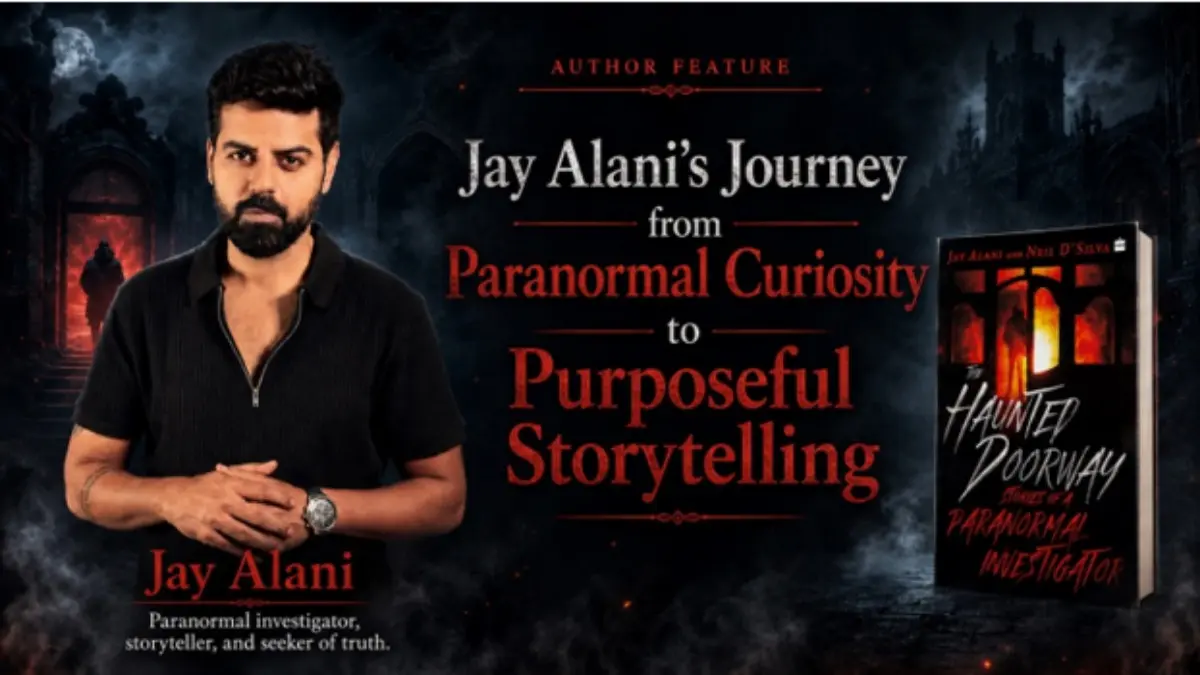
The Man Who Walked into the Dark: Jay Alani’s Journey from Paranormal Curiosity to Purposeful Storytelling
Alani’s public image may suggest fearlessness: a paranormal investigator willing to enter locations surrounded by rumours, warnings and terrifying legends. But what makes his journey compelling is not simply his willingness to step into darkness. It is his refusal to let darkness decide the conclusion.
- Initiatives News
- 9 min read

;'%3e%3cpath%20d='m8,15.99c4.41,0,7.99-3.58,7.99-7.99S12.41,0,8,0,0,3.59,0,8s3.58,7.99,7.99,7.99Z'%20style='stroke:%23fff;%20stroke-miterlimit:10;%20stroke-width:.02px;'/%3e%3cpath%20d='m3.08,3.37l3.82,5.11-3.84,4.15h.87l3.37-3.64,2.72,3.64h2.94l-4.04-5.39,3.58-3.87h-.86l-3.1,3.35-2.5-3.35h-2.94Zm1.27.64h1.35l5.97,7.99h-1.35l-5.97-7.99Z'%20style='fill:%23fff;'/%3e%3c/g%3e%3c/svg%3e)


Some people are drawn to the unknown because they want to believe. Others approach it because they want to prove that nothing is there. Jay Alani belongs to a more unusual category: he enters allegedly haunted spaces prepared to question both possibilities.
For more than a decade, Alani has built a career around places most people would avoid—abandoned buildings, isolated locations, rooms associated with disturbing experiences and homes whose residents believe they are no longer alone. Yet his work is not driven merely by the desire to encounter a ghost. His deeper interest lies in understanding why people become convinced that something supernatural is happening, what psychological or environmental factors may be influencing them, and whether any part of the reported experience remains unexplained after rational possibilities have been examined.
That combination of courage, scepticism, empathy and storytelling makes Jay Alani a distinctive figure in India’s paranormal landscape.
A Man More Interested in Questions Than Ghosts
Alani’s public image may suggest fearlessness: a paranormal investigator willing to enter locations surrounded by rumours, warnings and terrifying legends. But what makes his journey compelling is not simply his willingness to step into darkness. It is his refusal to let darkness decide the conclusion.
Advertisement
His professional biographies describe him as a paranormal investigator, filmmaker, podcaster, author and speaker who has spent more than fifteen years studying unusual experiences. His work has included investigations, awareness initiatives, recorded storytelling and projects developed through The Paranormal Company, the organisation he founded to explore paranormal subjects through research, media and entertainment.
Alani’s media background is central to his identity. He understands that every alleged haunting arrives first as a story. Someone hears footsteps in an empty room. Someone wakes with the sensation that a presence is standing nearby. A family begins connecting unrelated misfortunes to a supposedly cursed object. Before an investigator visits the location, the account has already been shaped by memory, fear, family beliefs, rumours and repeated narration.
Advertisement
Alani enters that story not only as an investigator but also as a listener.
This is one reason his work feels different. He is interested in evidence, but he is also interested in the human being who is frightened. He does not treat fear as foolish simply because it may have a psychological explanation. Even when no supernatural cause can be established, the person’s distress may still be genuine.
Why Jay Alani’s Journey Is Unique
The paranormal field often rewards certainty. Some investigators confidently declare that a building is haunted. Others dismiss every report as imagination. Alani’s approach appears to resist both extremes.
In a 2022 interview about his paranormal helpline, he explained that although he had investigated hundreds of locations and cases, he had not personally encountered evidence that convinced him of an actual paranormal presence. He also stated that many reported supernatural experiences could be understood through rational explanations.
That admission is significant. It would be easier for a paranormal personality to build popularity by claiming that every shadow is a spirit and every unexplained sound is a warning from another world. Alani’s willingness to remain sceptical, despite working professionally in the field, gives his storytelling an unusual tension.
He is not trying to prove that ghosts exist in every case. He is trying to understand what happened.
His public talks have similarly focused on challenging myths and encouraging a more scientific attitude towards alleged supernatural activity. His speaker profile describes his work as an attempt to counter misconceptions and introduce rational inquiry into conversations about the paranormal.
This balance is arguably his most distinctive quality. He can remain open to mystery without surrendering to superstition. He can acknowledge fear without exploiting it. He can enter a supposedly haunted building and still ask whether faulty wiring, sound transmission, sleep paralysis, grief, stress, suggestion or deliberate deception might explain the experience.
And when no explanation is immediately available, he is capable of leaving the question open.
From Investigation to Intervention
Alani’s journey is not limited to exploring abandoned buildings. An important part of his work has involved speaking with people who genuinely believe that they are being haunted, possessed or targeted by unseen forces.
Through a paranormal helpline, he has interacted with callers seeking help for experiences they could not understand. Reports about the initiative indicate that the helpline was created partly to prevent frightened individuals from falling into exploitative practices associated with superstition and blind faith. In discussing the project, Alani said that the intervention had helped people avoid such traps.
This work reveals another side of the paranormal investigator.
A dramatic investigation may make compelling entertainment, but a distressed caller represents a real responsibility. The person may be vulnerable, sleep-deprived, grieving, isolated or suffering from a condition requiring professional assistance. Declaring such a person “possessed” can deepen the fear and potentially cause serious harm.
Alani’s approach suggests that paranormal awareness must include mental-health awareness, critical thinking and compassion. The task is not simply to locate a supposed entity. It is to help the individual understand the experience safely.
This may also explain why his stories contain psychological ambiguity. For Alani, the mind is not an alternative to horror; it is often where the most frightening and meaningful parts of the case are found.
From Investigation to Books
The Haunted Doorway: Stories of a Paranormal Investigator, written with horror author Neil D’Silva, transforms the atmosphere and questions of paranormal investigation into ten fictional stories. According to the publisher, the collection draws upon Alani’s experience with both psychological and apparently otherworldly cases, combining his specialist knowledge with D’Silva’s narrative craft.
The book introduces disturbing situations: a doll that appears to threaten a man’s sanity, a mother terrorised by an entity and a woman followed by a mysterious stranger. However, the stories are not presented merely as supernatural spectacles. They repeatedly ask whether the true danger exists outside the character, inside the mind, or somewhere between the two.
Readers responding to the collection have particularly appreciated its combination of paranormal investigation, psychology, folklore and uncertainty. Some noted that the stories do not automatically label every disturbing event as supernatural, while others found the unresolved cases especially memorable.
“The Haunted Doorway sits at a rare intersection of horror, psychology and real investigative experience. That distinctive space became central to how we positioned the book for readers,” said Asha Seth, Book Marketer & Founder of MissBookThief
The book therefore feels less like a departure from Alani’s investigative work and more like its imaginative extension.
In the field, an investigator listens to a witness and reconstructs an event. In fiction, the writer invites readers to become witnesses themselves.
What Makes the Book Reflect Its Author
Several qualities in The Haunted Doorway appear closely connected to Alani’s professional philosophy.
1. Fear is investigated rather than merely displayed
The stories do not depend only on sudden apparitions or violent supernatural events. Fear becomes a clue. A character’s behaviour, memory, trauma and environment may all contribute to what appears to be a haunting.
2. Rational explanations are given genuine importance
The collection allows psychology and observable causes to stand beside folklore and supernatural possibility. This reflects Alani’s reported preference for examining ordinary explanations before considering extraordinary ones.
3. The unexplained is not forced into a convenient answer
Some events may be understood; others remain uncertain. That uncertainty is not a weakness. It is the space in which the reader continues thinking after the story has ended.
4. Human vulnerability remains central
The frightening event matters, but so does the person experiencing it. Grief, isolation, obsession, fear and emotional distress are treated as meaningful realities rather than convenient devices.
5. Folklore is examined without being blindly endorsed
Myths and supernatural traditions provide atmosphere and cultural depth, but the stories also invite readers to question how beliefs influence what individuals think they have experienced.
Why He Turned Investigations into Books
Seen in the context of his wider career, writing books seems like a natural progression for Alani. An investigation is temporary. A team enters a location, records information, studies the circumstances and eventually leaves. A book preserves the questions and allows thousands of readers to enter the investigation without physically visiting the site.
The Haunted Doorway moves in a more fictional direction, using invented characters and shaped narratives to explore the psychological and emotional truths surrounding fear. Penguin’s author profile describes Alani as an investigator known for exploring haunted locations, individual cases, public talks and paranormal storytelling.
Fiction gives him freedoms that a case report cannot.
Alani brings the investigative foundation—the behaviours, claims, locations, patterns and fears encountered during fieldwork. D’Silva brings the structure and rhythm required to convert those elements into compelling fiction.
Together, they build stories that entertain without abandoning inquiry.
A Journey Larger Than Paranormal Investigation
Jay Alani’s professional journey now moves across several forms: investigation, podcasts, books, public speaking, filmmaking and awareness initiatives. His public profiles describe his ambition to develop paranormal storytelling through film, technology and immersive media, while his podcast work has brought investigative narratives to a large audience. But beneath the changing formats, the central purpose remains consistent.
He wants people to look more closely.
A noise should be investigated before it becomes a ghost. A frightening experience should be understood before it becomes a superstition. A vulnerable person should be helped before someone exploits that fear. And a mystery should be allowed to remain a mystery when the available evidence does not justify certainty.
That is the deeper story behind The Haunted Doorway.
The collection may contain entities, cursed objects, shadowy strangers and impossible experiences, but its most compelling subject is the investigator himself: a man who repeatedly walks towards frightening stories, not because he believes every one of them, but because someone must be willing to examine them responsibly.
Why His Story Matters
Jay Alani is unique not because he claims to have all the answers. He is unique because his career has been built around confronting questions that rarely provide easy answers.
He stands between believers and sceptics, entertainment and investigation, fear and reason. His work recognises that the supernatural may be uncertain, but the human consequences of belief are real. People can lose sleep, money, relationships and peace of mind because they are convinced that something unseen is controlling their lives.
By investigating these experiences, speaking against blind superstition and transforming his encounters into stories, Alani gives the paranormal a more thoughtful place in contemporary Indian culture.
Know more about Jay Alani - https://www.instagram.com/ijayalani/