
Tier-II Cities, Peripheries Take Centre Stage As Land Transactions And Real Estate Activity Surge
Annual transacted acreage consistently rose from 813 acres in 2021 to 6,181 acres in 2025, growing at a CAGR of approximately 66% over the period.
- Initiatives News
- 5 min read

;'%3e%3cpath%20d='m8,15.99c4.41,0,7.99-3.58,7.99-7.99S12.41,0,8,0,0,3.59,0,8s3.58,7.99,7.99,7.99Z'%20style='stroke:%23fff;%20stroke-miterlimit:10;%20stroke-width:.02px;'/%3e%3cpath%20d='m3.08,3.37l3.82,5.11-3.84,4.15h.87l3.37-3.64,2.72,3.64h2.94l-4.04-5.39,3.58-3.87h-.86l-3.1,3.35-2.5-3.35h-2.94Zm1.27.64h1.35l5.97,7.99h-1.35l-5.97-7.99Z'%20style='fill:%23fff;'/%3e%3c/g%3e%3c/svg%3e)


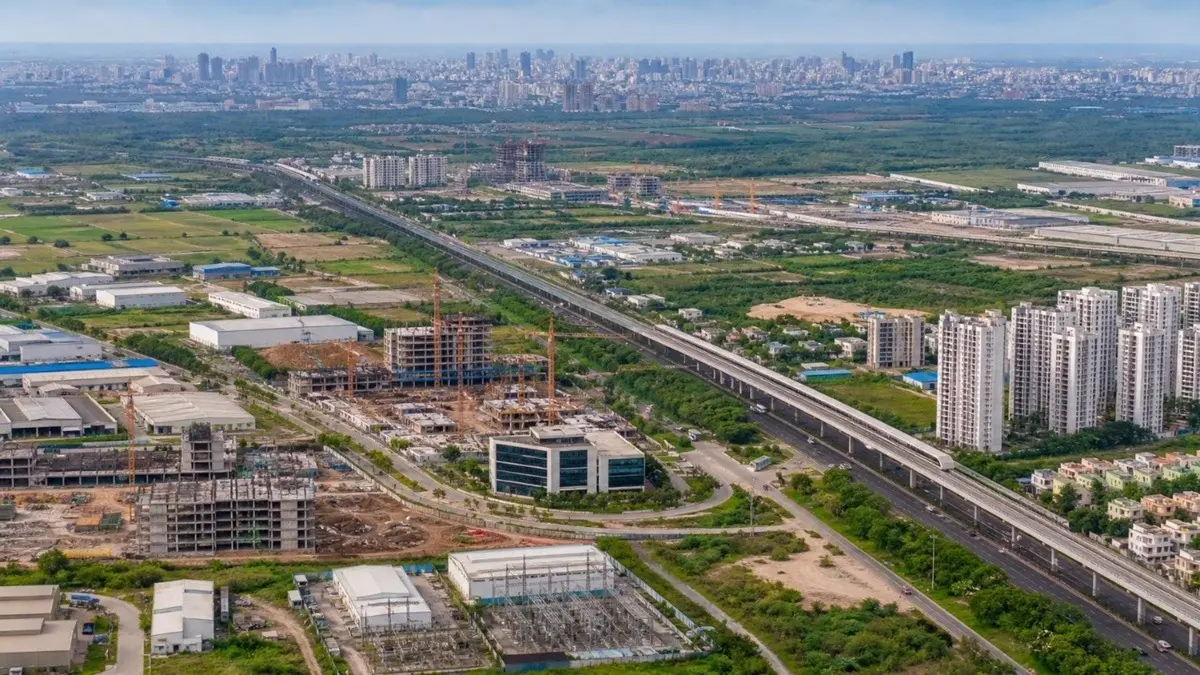
India’s tier 2 and 3 cities, along with city peripheries, are witnessing unprecedented real estate growth. This is not just evident from the scale of land activity amid sustained momentum across asset classes, including offices, residential, retail, logistics & industrial, and data centres - all of which have recorded strong leasing and investment traction in recent years, as well as massive infrastructure upgrades that have eased connectivity.
According to Cushman & Wakefield, India's land market saw 18,158 acres transacted across more than 880 deals in 33 cities between 2021 and Q1 2026.
Annual transacted acreage consistently rose from 813 acres in 2021 to 6,181 acres in 2025, growing at a CAGR of approximately 66% over the period. Momentum remained strong in Q1 2026, with 1,194 acres transacted during a single quarter.
While metropolitan (tier-I) cities still dominate, with a 71% share of volume, the more telling shift is that tier-II cities are now capturing the bulk of incremental land transactions. Tier-II acreage has surged from a mere 16 acres in 2021 to 2,120 acres in 2025, lifting its share of annual transactions from around 2% to 34%.
Advertisement
This momentum appeared to accelerate sharply into 2026, with tier-II markets accounting for 67% of land transacted in Q1 2026 and overtaking tier-I for the first time
Government-led infrastructure spending is increasingly reshaping India’s real estate growth story beyond the established metropolitan markets. The Centre and states are investing heavily in expressways, highways, metro networks, rapid rail and airports - not merely to ease mobility, but to create new economic centres and strengthen regional connectivity. The Central Government’s public capital expenditure on core infrastructure is estimated at ₹51.72 lakh crore over FY23-FY27, underlining the scale of this transformation.
Advertisement
As connectivity improves and city boundaries expand, city peripheries and Tier-II cities are emerging as new engines of real estate demand across asset classes. Improved access is making these locations increasingly viable for residential developments, industrial and manufacturing facilities, warehouses, logistics parks and data centres, while also creating new employment and economic activity.
Mukesh Choudhary, MD, Accuspace, said India is gradually emerging as a global manufacturing hub, supported by its large domestic market, competitive talent base, improving infrastructure and a policy push towards strengthening domestic production.
“As companies diversify their supply chains, India offers both scale and a growing ecosystem of manufacturing, logistics and industrial infrastructure, making it an increasingly attractive destination for long-term investment. The growth of manufacturing leasing is a reflection of how companies are evaluating and doubling down on setting up manufacturing units in both tier 1 and tier 2 cities like Jaipur, weighing operational control and long-term commitment vis-à-vis land prices, talent pool, connectivity, etc.”
Experts believe residential plots, in particular, are gaining investor interest as buyers look at emerging corridors for potential capital appreciation and returns. As infrastructure penetrates deeper into Tier-II cities and urban peripheries, these markets are increasingly transitioning from peripheral investment destinations into integrated residential, commercial and economic growth hubs.
According to PropEquity, nearly 4.7 lakh residential plots across the top 10 Tier I and Tier II cities have been launched by developers between 2022 and 2025 (May), with realtors in the top seven Tier II cities supplying 2.43 lakh residential plots, accounting for 52%.
Lalit Parihar, MD, Aaiji Group, said the landscape of Indian real estate has fundamentally shifted.
“Growth is no longer confined to the congested cores of our Tier 1 metros; it is being aggressively driven by Tier 2 cities and strategically planned city peripherals. Today, smart capital is moving to where the infrastructure is being built from scratch, sparking an unprecedented surge in demand for plotted developments. Investors are actively moving away from vertical, depreciating apartments in favor of absolute land ownership, recognizing that land inherently captures the maximum upside of rapid urbanization. Dholera SIR stands at the absolute forefront of this economic evolution.”
City peripheries are rapidly transforming from sleepy outskirts into the primary engines of real estate growth. As traditional Tier 1 city centers battle hyper-congestion and skyrocketing prices, both home seekers and institutional capital are aggressively shifting to well-connected peripheral zones driven by massive infrastructure tailwinds.
Umesh Gowda H A, Chairman and Founder, Sanjeevini Group, said the geography of luxury and convenience in Bengaluru has been completely rewritten.
“Buyers are no longer willing to compromise their quality of life by living in the hyper-congested, older urban cores. Instead, we are witnessing an unprecedented influx of homebuyer demand toward strategic peripheral hubs like Gunjur and Varthur. This corridor is effectively bridging the distance to employment hubs like Whitefield, Sarjapur Road, and the Outer Ring Road (ORR). The corridor offers tech professionals the ultimate real estate trifecta: an easy commute to major global capability centers (GCCs), access to Bengaluru’s finest international school corridors, and the physical space required to build expansive, amenity-rich gated communities.”
There has been a growing interest from HNIs and NRIs in these markets, particularly where upcoming infrastructure and employment hubs can support long-term appreciation.
Bhavesh Kothari, Founder & CEO, Property First Realty believes that tier-II cities and peripheral markets are increasingly moving from being considered emerging opportunities to becoming important real estate growth corridors.
“Rising land transactions, improving infrastructure connectivity and relatively attractive entry prices are encouraging both investors and end-users to look beyond established urban centres. This shift reflects a broader maturation of India’s real estate market, where value creation is increasingly moving beyond traditional city boundaries.”
The next phase of India’s real estate growth is therefore likely to be more distributed, connectivity-led and multi-asset in nature. As infrastructure reduces the distance between emerging locations and established economic centres, Tier-II cities and urban peripherals will increasingly attract developers, occupiers and investors across residential, commercial, industrial and logistics segments. The convergence of infrastructure, employment, affordability and improving urban amenities can create self-sustaining growth ecosystems, making these markets an increasingly important part of India’s broader real estate and economic expansion story.