
Transworld, The Silent Pillar Behind Abu Dhabi’s BAPS Hindu Mandir
The BAPS Hindu Mandir in Abu Dhabi is a marvel of faith and craftsmanship, built with pink sandstone from Rajasthan and Italian marble.
- Initiatives News
- 5 min read

;'%3e%3cpath%20d='m8,15.99c4.41,0,7.99-3.58,7.99-7.99S12.41,0,8,0,0,3.59,0,8s3.58,7.99,7.99,7.99Z'%20style='stroke:%23fff;%20stroke-miterlimit:10;%20stroke-width:.02px;'/%3e%3cpath%20d='m3.08,3.37l3.82,5.11-3.84,4.15h.87l3.37-3.64,2.72,3.64h2.94l-4.04-5.39,3.58-3.87h-.86l-3.1,3.35-2.5-3.35h-2.94Zm1.27.64h1.35l5.97,7.99h-1.35l-5.97-7.99Z'%20style='fill:%23fff;'/%3e%3c/g%3e%3c/svg%3e)


The first light of dawn touches Abu Dhabi’s skyline, turning the desert a warm golden hue. In the early calm, before the city comes to life, the BAPS Hindu Mandir stands quietly on the horizon. Its pink sandstone spires catch the sunlight, and the marble details reflect a gentle glow. A light breeze moves through the still air, carrying the dry scent of the desert, as the temple stands serene and welcoming.
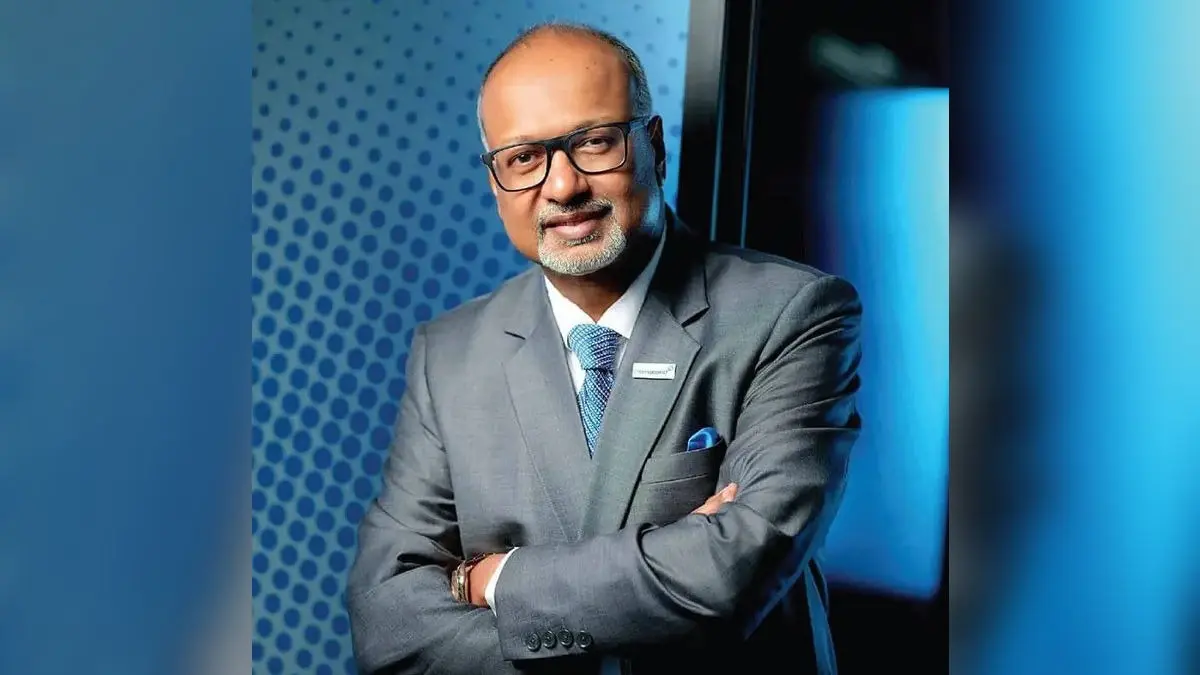
For visitors, the Mandir is a marvel - a breathtaking work of faith and craftsmanship, where every dome, pillar, and carving speaks of devotion. But the story of how it came to stand here is less visible. It is a story of journeys - of stones shaped in the hands of artisans in Rajasthan, of marble blocks drawn from quarries in Italy, of containers crossing seas, of trucks winding through city streets to arrive, finally, at this sacred site. At the center of it all is a man who never sought the spotlight: Ramesh S. Ramakrishnan, Chairman of Transworld, whose team quietly ensured that this architectural dream became a living reality.
The Stones That Carried a Story
The BAPS Hindu Mandir was conceived not just as a place of worship, but as a cultural beacon - a reminder that tradition can thrive in a modern world. Built according to the Shilpa Shastras, the ancient Indian texts that have guided temple architecture for over two millennia, it stands 108 feet tall and measures 262 by 180 feet. Its structure incorporates over 25,000 individual stones - pink sandstone from Rajasthan and flawless Aqua Bianca marble from Italy - each one carved by hand with scenes from Hindu scriptures, floral motifs, and sacred symbols.
Advertisement
For the artisans, many of whom had inherited their craft from generations before them, each stone was more than a commission. It was an offering. But no matter how beautifully they carved, the stones would mean little if they could not be brought together, across borders and oceans, to form the temple. That is where logistics became as critical as artistry.
A Leader Who Works Quietly, but Thinks Big
Advertisement
When Ramesh S. Ramakrishnan took over Transworld in 1989, it was a modest regional shipping agency. Over the decades, he transformed it into a global logistics powerhouse, headquartered in the UAE, with operations spanning continents. His leadership philosophy is rooted in service, precision, and integrity - qualities that would prove essential for a project of such magnitude.
In 2025, the Government of India recognized his contributions with the Pravasi Bharatiya Samman, the highest honour for overseas Indians. Yet, when asked about Mandir, Ramakrishnan’s words are humble. “Each carved panel, each marble slab, each idol was transported with reverence. We weren’t just delivering stone - we were carrying faith across the seas. This was not business as usual. It was a trust and faith in logistics.”
Orchestrating a Journey Across Oceans
From the workshops of Rajasthan, the stones began their journey. Loaded onto trucks, they rumbled down highways to ports like Mundra and Kandla. There, cranes lifted them into containers, each carefully packed to prevent damage, each labelled for its exact position in the temple’s design.
The voyage across the Arabian Sea was just one part of the journey. On arrival at UAE ports, the containers faced customs inspections, weather considerations, and the challenge of synchronizing with the temple’s construction phases. A single delay could disrupt the work schedule. “It was like assembling a giant puzzle where every piece was irreplaceable,” recalls Mr. Ramakrishnan. “You couldn’t just send a replacement if something went wrong.”
In total, over 1,500 containers were shipped - more than just cargo, they were vessels of culture and faith. For the Transworld team, many of whom visited the site to see the progress, there was a shared sense of pride. “I brought my children here,” says one staff member of Transworld. “I wanted them to see that their father had a small role in something that will stand for hundreds of years.”
A Place for All
When it opened, the BAPS Hindu Mandir quickly became a landmark not only for the Hindu community but for the UAE as a whole. It reflects the country’s ethos of tolerance and inclusion, welcoming visitors of all faiths. Within its courtyards, people pause to admire carvings of gods and goddesses, to listen to the sound of temple bells, or to sit in quiet reflection beneath the domes.
The temple’s gardens, exhibition halls, and community spaces extend its role beyond worship, making it a hub for cultural dialogue. For many visitors, knowing that the stones came from across the world adds another layer of meaning - that this sanctuary was not built in isolation, but through the cooperation of many nations and people.
The Pillar You Cannot See
Every temple rests on pillars - some visible, some unseen. In Abu Dhabi, one such pillar is Transworld. It is not carved from stone, nor gilded in gold, but built from reliability, cultural understanding, and unshakable commitment.
It is easy to admire the finished temple, to lose oneself in its artistry and serenity. But just as vital is the story of how it came to be - the silent work behind the scenes, the thousands of hours of planning, and the journeys of stone and spirit that converged here.
In the years to come, the BAPS Hindu Mandir will witness countless prayers, celebrations, and moments of peace. And though few will think of it, there will always be that invisible pillar - the one that stands not in the temple courtyard, but in the legacy of the men and women who carried this dream from vision to stone, from India to the desert, from the hearts of many to the soul of a city.