
Why Scalable, Inclusive Value Chains Are Key to Transforming Indian Agriculture
India’s farming landscape is undergoing a structural shift as climate volatility and declining viability of input-intensive crops push smallholder farmers toward diversified livelihoods. Bamboo-based agroforestry is gaining traction as a sustainable alternative, offering ecological benefits and long-term income streams.
- Initiatives News
- 4 min read

;'%3e%3cpath%20d='m8,15.99c4.41,0,7.99-3.58,7.99-7.99S12.41,0,8,0,0,3.59,0,8s3.58,7.99,7.99,7.99Z'%20style='stroke:%23fff;%20stroke-miterlimit:10;%20stroke-width:.02px;'/%3e%3cpath%20d='m3.08,3.37l3.82,5.11-3.84,4.15h.87l3.37-3.64,2.72,3.64h2.94l-4.04-5.39,3.58-3.87h-.86l-3.1,3.35-2.5-3.35h-2.94Zm1.27.64h1.35l5.97,7.99h-1.35l-5.97-7.99Z'%20style='fill:%23fff;'/%3e%3c/g%3e%3c/svg%3e)


India’s agricultural landscape is undergoing a profound transition, shaped not just by productivity challenges but also by climate volatility, economic uncertainty, and the urgent need for stable rural livelihoods. Increasingly, the future of Indian agriculture is being defined not by individual crops or isolated interventions, but by the strength and inclusiveness of the value chains that connect farmers to markets, institutions, and enterprise opportunities.
At the heart of this shift is a structural change in how farming functions on the ground. Climate risk has become persistent rather than occasional, landholdings continue to fragment, and input-intensive annual crops are becoming harder to sustain, particularly for small and marginal farmers.
“Indian agriculture is undergoing a structural shift driven by climate risk, land fragmentation, and declining viability of input-intensive annual crops,” says Neju George Abraham, CEO of Industree Foundation, one of India’s most forward-looking organisations working at the intersection of women’s economic empowerment, climate action, and sustainable, nature-based value chains “Repeated climate shocks, rising input costs, and the unpredictability of returns have made cultivation increasingly difficult to sustain. For many households, agriculture alone is no longer sufficient.”
Smallholder farmers are under increasing pressure and are actively looking for more secure ways to earn a living. Many households are diversifying income through wage labour, seasonal migration, and non-farm work. At the same time, the role of women in agriculture is evolving in meaningful ways. Women who were earlier left at home are now organised producers and members of collective enterprises, with greater involvement in decisions around land use and livelihoods, contributing more directly to household stability.
Advertisement
This shift is creating opportunities for more stable and climate-resilient farming systems. To strengthen food security and reduce risk, farmers are increasingly adopting agroforestry and mixed land-use models, where tree-based crops are grown alongside food crops. These systems help reduce risk and make better use of fallow land.
“Farmers need livelihood pathways that allow them to remain connected to their land without bearing the full risks of conventional cultivation,” Neju explains. “Agroforestry models like bamboo plantations are well-suited to fragmented landholdings and require lower recurring inputs.”
Advertisement
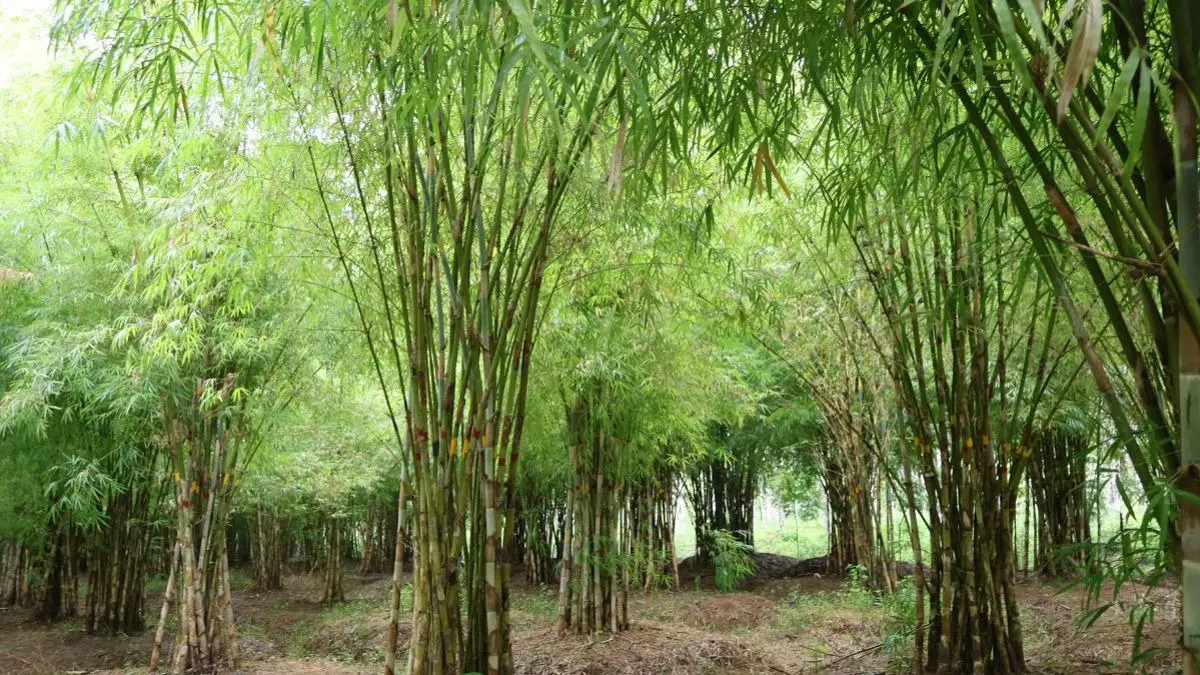
Within this transition, bamboo (the commercially viable species) is emerging as a potential and sustainable alternative. It can grow on degraded or fallow land, regenerates over multiple harvest cycles, and does not compete directly with food crops.
Ecologically, it supports soil health, water retention, and biodiversity. Economically, it offers long-term income streams that reduce dependence on daily wage labour. Farmers can generate extra income from their unused land. Bamboo requires neither high-quality soil nor much water compared to other crops, allowing for income generation from the same culm for about 40 years.
“From a climate and nature-based solutions perspective, bamboo-based agroforestry offers both adaptation and mitigation benefits,” Neju notes. “It supports land restoration and carbon sequestration while creating long-term income streams that strengthen economic security.”
But cultivation alone is not enough. What determines long-term success is how production connects to markets. Many farmer-led enterprise initiatives struggle because they create supply without building the systems needed for aggregation, certification, processing, and assured demand.
Industree Foundation aims to reach one million smallholder women farmers by partnering with the Deendayal Antyodaya Yojana - National Rural Livelihoods Mission (DAY-NRLM) and State Rural Livelihoods Mission (SRLM), integrating bamboo-based value chains within existing women’s collectives and producer platforms. Through these partnerships, the focus is on strengthening end-to-end value chain linkages, from cultivation and aggregation to processing, quality assurance, and market access, to support income diversification and long-term livelihood security.
“Our experience shows that agriculture-led enterprises move from pilots to scale when value chains are designed end-to-end with markets, institutions, and long-term ownership built in from the outset,” says Neju.
By integrating women farmers across the entire bamboo value chain - from plantation management and aggregation to certification, processing, and market-inclusive access - enterprise-led models are demonstrating how agriculture can evolve from subsistence activity into a viable economic system.
As India confronts climate uncertainty and livelihood vulnerability, the path forward is becoming clearer. The future of farming communities lies not just in what is grown, but in how value is created, shared, and sustained through scalable, inclusive value chains that place farmers, especially women, at their centre.