
Why the Cheapest Dental Implant Can Cost You the Most
The hidden risk behind low-cost implants and why proper standards matter
- Initiatives News
- 8 min read

;'%3e%3cpath%20d='m8,15.99c4.41,0,7.99-3.58,7.99-7.99S12.41,0,8,0,0,3.59,0,8s3.58,7.99,7.99,7.99Z'%20style='stroke:%23fff;%20stroke-miterlimit:10;%20stroke-width:.02px;'/%3e%3cpath%20d='m3.08,3.37l3.82,5.11-3.84,4.15h.87l3.37-3.64,2.72,3.64h2.94l-4.04-5.39,3.58-3.87h-.86l-3.1,3.35-2.5-3.35h-2.94Zm1.27.64h1.35l5.97,7.99h-1.35l-5.97-7.99Z'%20style='fill:%23fff;'/%3e%3c/g%3e%3c/svg%3e)


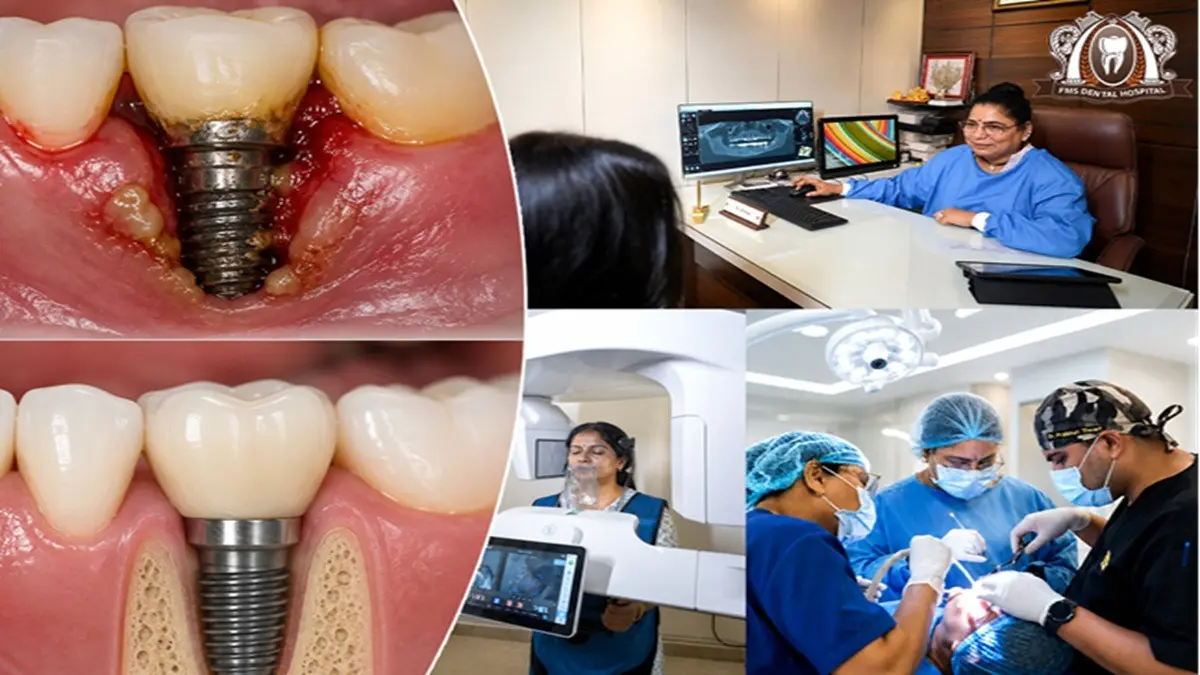
When people compare dental implants, they almost always compare one thing: the price. Visit ten clinics in any Indian city and you will get ten different quotes for what sounds like the same treatment… a titanium root fixed into the jaw, a crown on top and a few months to heal. What most patients don't realise is that this quote only covers the surgery. It says nothing about whether the implant will actually last. And if it fails, the second bill is almost always bigger than the first.
That gap between the price you pay today and the price you may pay later is where many Indian patients are getting hurt, quietly and slowly. Dentists across the country are seeing more and more cases of a condition called peri-implantitis. In simple words, this is an infection around the implant. If it isn't caught early, it eats away the jawbone that holds the implant in place… think of it as gum disease, but for an artificial tooth. This problem shows up far more often when the implant was done cheaply, in a hurry, or by someone who skipped the scans, evaluate the bone availability, overload the implants with improper planning and follow-up visits that the dental implant treatment actually needs.
What are the signs of Peri-implantitis?
Peri-implantitis rarely gives a loud warning. In the beginning, it just looks like a little bleeding when you brush, or mild tenderness near the crown… easy to ignore, especially when you have already paid for something you were told was a permanent solution. By the time there is swelling, pus, or the implant starts feeling loose, the bone underneath has usually already been damaged. At this stage, saving the implant is very hard. Most of the time, it has to be removed, the lost bone has to be rebuilt with a graft and a new implant has to be placed months later. This means going through surgery twice and paying several times more than what the original treatment cost.
None of this happens for strange or complicated reasons. It usually comes down to a few avoidable shortcuts: using an implant brand with no track record or long-term proof that it works; placing the implant without a proper 3D scan to check bone thickness and nerve position first; the surgery being done by a general dentist rather than a specialist trained specifically in implants; putting lesser implants and overloading them with many missing teeth and most commonly of all, no fixed schedule of check-up visits afterward… so early warning signs are missed until the problem becomes serious.
Advertisement
None of this is visible on a price list. A quote for an unbranded implant, with no scan, no specialist, no details on type of prosthesis and no follow-up plan, will always look cheaper than one that includes all five things… right up until the implant fails.
"Most patients compare implants on the wrong thing. They look only at the surgery fee. But what really decides whether a tooth lasts twenty years or just two is the scan and planning done before the surgery and the check-ups done after it. Those are exactly the steps that get quietly skipped to make a quote look cheaper." — Dr. Shailaja Reddy, Chief Implantologist, FMS Dental
Advertisement
The real price of "cheap" dental implants
Look at the cost over ten years, not just on day one and the "bargain" option stops looking like a bargain. A failed implant usually means removing it, waiting several months to heal, rebuilding the lost bone with a graft and then placing a new implant. This whole process can cost two to three times the original price and that's before counting the extra visits, scans and days taken off work. Patients who choose the cheapest quote are often the ones who, in the end, pay for two implants instead of one, plus a bone graft they never planned for.
There is a quieter cost too. Bone lost to this infection doesn't always grow back fully, even after a graft, which can limit treatment options in that same spot later on. In a few serious cases, the infection can spread further and need bigger surgery to fix. So the cheapest implant is sometimes the one that ends up costing you more choices later, not just more money.
Why this matters more in India right now?
Dental implants are becoming more common in India, both because more people in India want them and because patients from other countries are coming here for treatment at much lower prices than back home. This growth is, on the whole, a good thing… it has made a life-changing treatment affordable for far more people. But fast growth in a treatment that patients pay for entirely out of their own pocket, with very little regulation, also creates the perfect conditions for cutting corners: implants advertised purely on low price, clinics treating it like a quick, same-day service and patients with no simple way to check what implant brand, what scans, or what training actually sit behind a quote.
Unlike medicines or diagnostic labs, there is no single authority in India that checks which implant brand a clinic uses, or what steps it follows before and after surgery. This means the responsibility of checking falls almost entirely on the patient, at exactly the moment they are least prepared for it, while negotiating a bill for a treatment they don't fully understand yet.
What to check before you say yes for your dental implant treatment?
The good news is that spotting a safe clinic from a risky one isn't complicated. Any patient can do it simply by asking a few direct questions before agreeing to treatment.
Which implant brand is being used and does it have long-term proof (10+ years) that it works well… not just a name you have heard of?
Is the implant approved by a recognised authority such as the US FDA and can the clinic show this on request?
What is the track record of the implant being placed and how long has this exact brand and design been used worldwide and with what results?
Was a 3D scan (called a CBCT) done to check bone thickness, nerve position and the right angle before surgery, or was the decision made from a simple X-ray alone?
Who is actually placing the implant… a general dentist, or a specialist implantologist who has done this procedure many times?
What kind of prosthesis and load distribution are planned precisely?
Are there long-term studies, ideally over many years on real patients, showing how well this specific implant and technique hold up over time?
Is there a written plan for check-ups over the next two years, including cleaning and monitoring of the implant?
Is the clinic willing to openly share how often their implants fail?
A clinic that is confident in its work will answer all nine questions easily and without hesitation. One that avoids these questions, or treats them as rude, is usually one that is cutting corners somewhere.
Standards over selling
At FMS Dental, this isn't treated as a marketing line, it's simply how implants are done. The hospital's implant programme uses well-established implant brands with long-term proof behind them, does a 3D scan (CBCT) to plan every single case and has implants placed only by specialist implantologists, not general dentists… reflecting the sheer number of implant cases its senior doctors have handled over the years.
"We see the after-effects of cheap, failed implants more often than we would like. Almost every case follows the same story: no scan, no specialist, no follow-up. Fixing it always ends up costing the patient more… in money, in time and in bone lost, than doing it properly the first time would have. That's really the whole point of having standards: they aren't a luxury add-on, they're simply what makes a permanent treatment actually stay permanent." — Dr. Shailaja Reddy, Chief Implantologist, FMS Dental
FMS Dental's in-house dental lab and its step-by-step guided surgery process exist for the same reason: to remove guesswork from a treatment where guesswork is exactly what leads to problems like peri-implantitis. This isn't meant to push people towards one particular clinic. It's simply a reminder, based on how implant failures actually happen, of the basic level of care every patient deserves and should be able to check for, no matter which clinic they choose.
The takeaway
A dental implant isn't a one-time purchase. It's a long-term relationship between the implant itself, the surgeon who places it and the care that follows for years afterwards. A price that ignores the last two of these isn't really a lower price… it's an incomplete one. So when comparing implant quotes, the more useful question to ask isn't "how much does this cost?" but "what happens if this fails and how likely is that here?" Clinics that can answer that honestly are usually the ones worth trusting with something meant to be permanent.