
The Emotional Value of Art Collecting: How Devyani Jaipuria Find Meaning Beyond the Frame
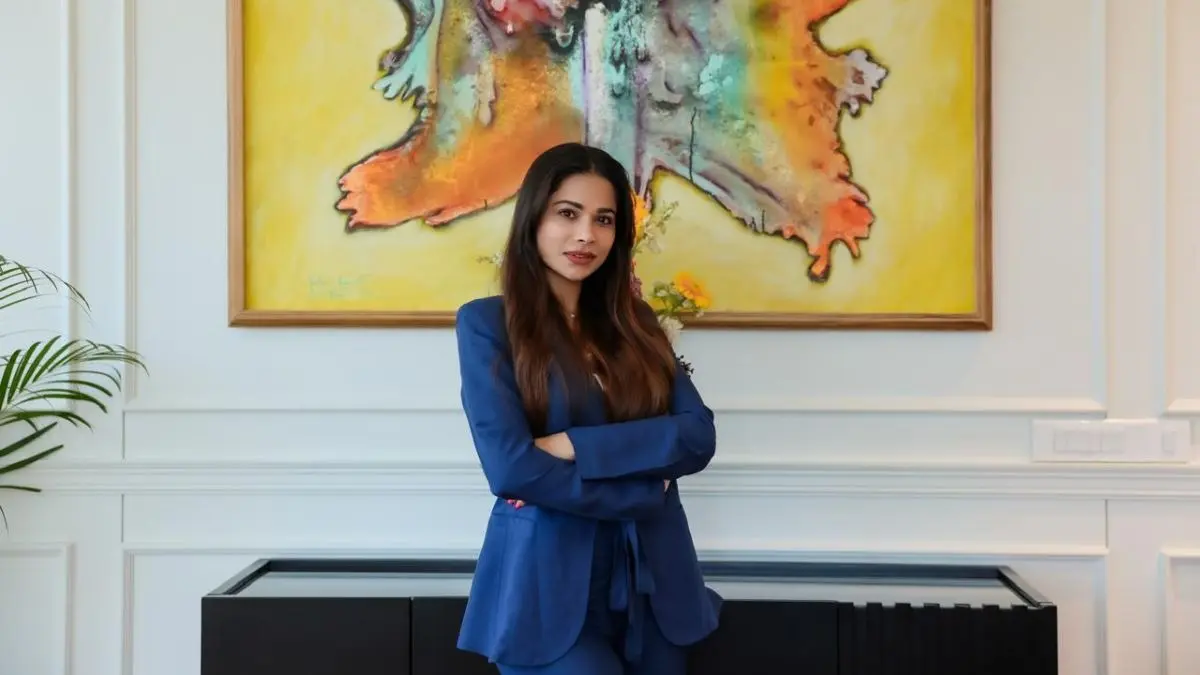
For Devyani Jaipuria, an entrepreneur, philanthropist and one of India's top art patrons, art collecting has never been defined by acquisition. Instead, it has evolved through moments of connection and personal encounters that gradually shape the way we see the world and, perhaps, ourselves.
- Lifestyle News
- 4 min read

;'%3e%3cpath%20d='m8,15.99c4.41,0,7.99-3.58,7.99-7.99S12.41,0,8,0,0,3.59,0,8s3.58,7.99,7.99,7.99Z'%20style='stroke:%23fff;%20stroke-miterlimit:10;%20stroke-width:.02px;'/%3e%3cpath%20d='m3.08,3.37l3.82,5.11-3.84,4.15h.87l3.37-3.64,2.72,3.64h2.94l-4.04-5.39,3.58-3.87h-.86l-3.1,3.35-2.5-3.35h-2.94Zm1.27.64h1.35l5.97,7.99h-1.35l-5.97-7.99Z'%20style='fill:%23fff;'/%3e%3c/g%3e%3c/svg%3e)


Long before an artwork becomes part of a collection, it often becomes part of a memory.
Like a painting glimpsed during a journey or a sculpture that evokes a feeling that is difficult to articulate, or an object that lingers in the mind long after the moment has passed, art has many layers that are often veiled and unravel one after another, with time, moods and spaces.
For Devyani Jaipuria, an entrepreneur, philanthropist and one of India's top art patrons, art collecting has never been defined by acquisition. Instead, it has evolved through moments of connection and personal encounters that gradually shape the way we see the world and, perhaps, ourselves.
"The pieces that stay with you are rarely the ones you set out to find," she reflects. "They are often the ones that find a place in your life because they make you feel something you can't quite explain."
Advertisement
It is a perspective that feels increasingly rare in a world where art is frequently discussed through the language of markets, auctions and investment value.
Yet for many collectors, the relationship with art begins somewhere far more intimate.
Advertisement
"The artworks we choose to live with often become companions to our lives. They witness changing homes, growing families, new beginnings and moments of reflection. Over time, they stop being objects and become part of the emotional landscape of a space", says Jaipuria who is one of the top art collectors in India.
For her, that relationship was shaped early through culture, travel and history.
Some of her strongest memories are not of museums or galleries, but of discovering places where stories and craftsmanship were woven into everyday life. Whether through architecture, heritage or local artistic traditions, she found herself drawn to the art that creative expression could preserve.
That curiosity continues to guide her collection today.
"What makes a particular work meaningful is not always easy to define. Sometimes it is the artist's vision. Sometimes it is the history a piece carries. Sometimes it is simply the feeling of returning to it again and again over the years and finding that it continues to reveal something new.
Art possesses a rare quality: it refuses to remain fixed. While an artist may create a work with a particular intention, its meaning continues to evolve long after it leaves the studio. Each viewer brings their own memories, experiences and emotions to it, allowing the work to acquire new interpretation over time. The most powerful art often exists somewhere between what the artist intended and what the viewer discovers, a space where imagination, memory and interpretation quietly converge" Jaipuria adds.
Perhaps that is why the most cherished works in a collection are not always the most celebrated.
Their value lies elsewhere in the memory they hold or the conversations they spark. In the way they quietly accompany us through different chapters of life.
This understanding has also shaped the way Jaipuria thinks about collecting itself.
To collect art, she believes, is not merely to acquire. It is to preserve.
Every work carries traces of a particular time, place and perspective. Every artist contributes to a larger cultural conversation. In that sense, collectors become temporary custodians of stories that deserve to be protected and passed forward.
It is a responsibility she takes seriously, not only through the works she chooses to live with, but through her support of artists and her appreciation for the traditions that continue to shape India's creative landscape.
Ultimately, the emotional value of art lies in its ability to transcend ownership.
Long after prices fluctuate and trends change, what remains is the connection. A feeling. A memory. A story.
And perhaps that is why people continue to collect art across generations—not because they wish to possess something beautiful, but because they recognise that beauty, meaning and memory are often inseparable.
In the end, the most valuable works are not the ones that occupy space on a wall.
They are the ones that quietly occupy space within us.