
COVID-19 can remain infectious on surfaces for days by transforming into microscopic film
The deadly virus responsible for coronavirus can remain infectious on surfaces for several days by transforming itself into a microscopic pancake-like film.
- Lifestyle News
- 3 min read

;'%3e%3cpath%20d='m8,15.99c4.41,0,7.99-3.58,7.99-7.99S12.41,0,8,0,0,3.59,0,8s3.58,7.99,7.99,7.99Z'%20style='stroke:%23fff;%20stroke-miterlimit:10;%20stroke-width:.02px;'/%3e%3cpath%20d='m3.08,3.37l3.82,5.11-3.84,4.15h.87l3.37-3.64,2.72,3.64h2.94l-4.04-5.39,3.58-3.87h-.86l-3.1,3.35-2.5-3.35h-2.94Zm1.27.64h1.35l5.97,7.99h-1.35l-5.97-7.99Z'%20style='fill:%23fff;'/%3e%3c/g%3e%3c/svg%3e)


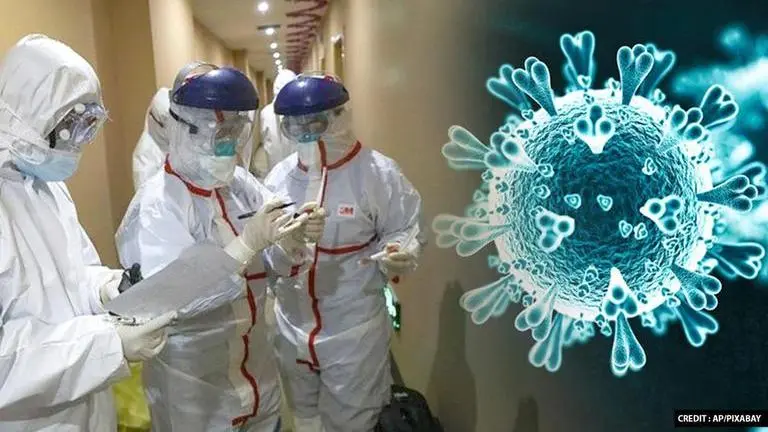
The deadly virus responsible for coronavirus can remain infectious on surfaces for several days by transforming itself into a microscopic pancake-like film after water in the droplet has evaporated. According to a recent study, researchers have also noted that this conversion sees more than 99.99 per cent of the droplet’s liquid vanish in the space of minutes, but the virus survives in a protective film of the remaining fluid. The scientists have said that the nanometers thick film slows down the evaporation process.
The study explained that the film fully evaporates at different times, depending on the material it has landed on, with a large droplet on stainless steel and copper lasting just 24 and 16 hours, respectively. The researchers, however, also added that the virus can survive for more than 150 hours on polypropylene. A small droplet can also last for over 80 hours on the glass.
The figures are based on experiments concluded in lab conditions and are likely lower in the real world, where there are variable amounts of heat and airflow. Two professors at IIT Bombay, Rajneesh Bhardwaj and Amit Agarwal, used the computer modelling and advanced physics application to understand how the deadly virus droplets can spread the disease. They had previously also found that wearing a face mask reduces the size of the clouds of coronavirus particles generated by a cough by up to 23 times.
Advertisement
Researchers recommend ‘heating surfaces’
As per the study, in the film form, coronavirus can endure for several; hours, ad even days on hydrophobic surfaces it left undisturbed. The professors explained that the film covers the same amount of areas as the droplets, with the small radius and initial angle of steepness. The data from the study revealed that the thickness of the film decreases slowly until and throughout all this time, the amount of coronavirus in the droplet or film is consistent.
Advertisement
Bhardwaj said, “Our biggest surprise was that the drying time of this nanometric film is on the order of hours. It suggests the surface isn't completely dry, and then slowly evaporating nanometric film is providing the medium required for the survival of the coronavirus”.
“It is desirable to disinfect frequently touched surfaces, such as door handles or hand-held devices, and within hospitals and other areas prone to outbreaks,” Agarwal added.
The two professors have said that their findings indicate that the virus can survive in a viable form for a long period of time. They have also emphasised the need for regular and thorough cleaning of surfaces. Agarwal recommended heating surfaces because even short duration of high temperatures can evaporate the manometric film and destroy the virus.