
The Making of Pujya Gurudevshri Rakeshji: A Philosophy Scholar and Spiritual Guide
Gurudevshri was born in Mumbai on 26 September 1966 to Rekhaben and Dilipbhai Jhaveri, a devout Jain couple, and they named him Rakesh, lord of the full moon. By the age of 4, he was sitting in meditation for hours at a stretch. He was also holding conversations on subjects he had not been taught.
- Lifestyle News
- 6 min read

;'%3e%3cpath%20d='m8,15.99c4.41,0,7.99-3.58,7.99-7.99S12.41,0,8,0,0,3.59,0,8s3.58,7.99,7.99,7.99Z'%20style='stroke:%23fff;%20stroke-miterlimit:10;%20stroke-width:.02px;'/%3e%3cpath%20d='m3.08,3.37l3.82,5.11-3.84,4.15h.87l3.37-3.64,2.72,3.64h2.94l-4.04-5.39,3.58-3.87h-.86l-3.1,3.35-2.5-3.35h-2.94Zm1.27.64h1.35l5.97,7.99h-1.35l-5.97-7.99Z'%20style='fill:%23fff;'/%3e%3c/g%3e%3c/svg%3e)


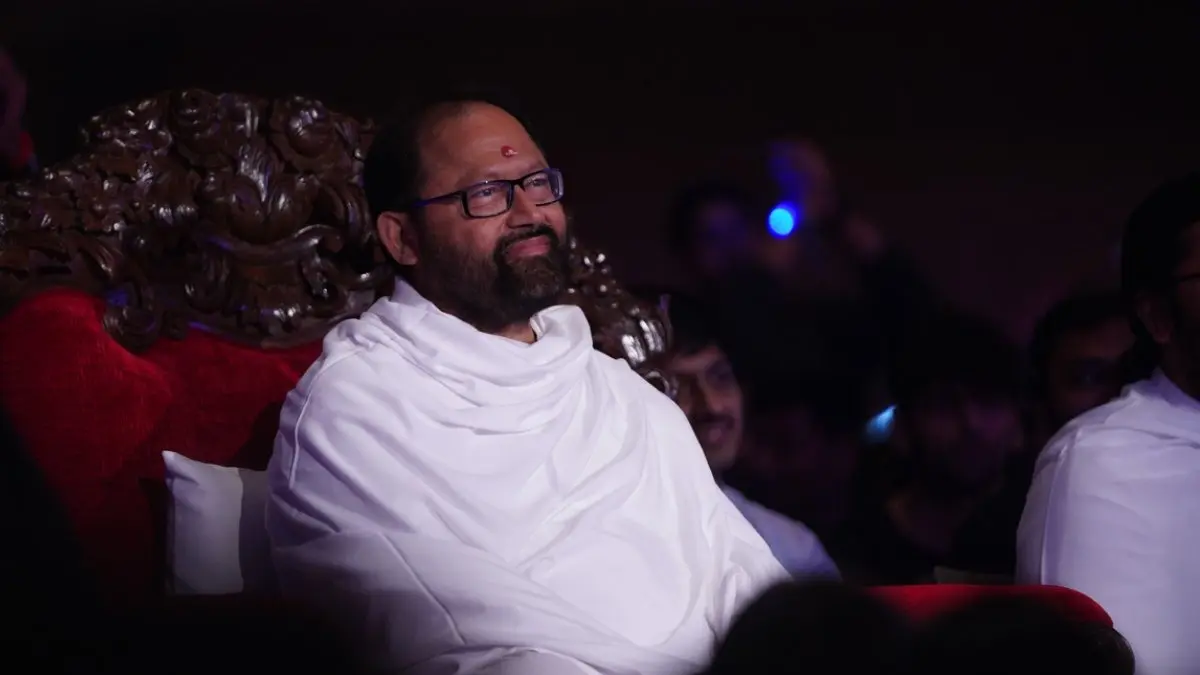
He slipped into meditation at four and into a three-day trance at eight. He wrote three thousand pages on a single text. This month he turns sixty, and twelve thousand people are travelling to Mumbai for it.
BODY
There is a story the mission tells about its founder that is easy to pass over. He was born in Mumbai on 26 September 1966 to Rekhaben and Dilipbhai Jhaveri, a devout Jain couple, and they named him Rakesh, lord of the full moon. By the age of four, he was sitting in meditation for hours at a stretch. He was also holding conversations on subjects he had not been taught and could not have overheard.
At eight he came across a picture of Shrimad Rajchandraji, the nineteenth-century Jain poet-philosopher, and did not come out of the trance it induced for three days.
Whatever one makes of accounts like that, and they are common enough around spiritual figures to invite scepticism, this one has an unusual sequel. The boy grew up and enrolled to study in a philosophy masters course.
Advertisement
The scholar
He took an M.A. in Philosophy with a gold medal. Then he began a doctoral treatise on Shri Atmasiddhi Shastra, the 142-verse composition considered Shrimad Rajchandraji's finest work, written in a single sitting in 1896. He produced more than three thousand pages. The mission's own account puts it plainly: he had not finished; he had only stopped. The University of Mumbai conferred the doctorate in 1998. The Claremont School of Theology later added an honorary Doctor of Divinity.
This matters more than a line in a biography. In India, scholarly credentials and popular religious followings generally run on separate tracks, and the people who have both are few. It is the clearest explanation for why his organisation argues rather than asserts, and why his discourses are described by those who attend them as demystifying rather than deepening the mystery.
Advertisement
He has been formal about the limits of that, too. He follows the spiritual path according to the principles of Jainism, but his insights are not bounded by any one tradition or set of beliefs.

The mission
Shrimad Rajchandra Mission Dharampur was formed in 1994, under a longer name it has since shed. In 2001 he established the Shrimad Rajchandra Ashram at Dharampur, in South Gujarat, which remains the international headquarters. The line printed beneath the mission's name is its whole argument in eight words: realise one's true self and serve others selflessly.
Today the mission works through 136 centres across six continents. Its humanitarian arm, Shrimad Rajchandra Love and Care, runs ten care programmes covering health, education, children, women, tribal communities, community development, humanitarian work, animals, environment and emergency relief, and holds Special Consultative Status with the United Nations Economic and Social Council. Its Africa programme operates across sixteen countries. A separate arm, Shrimad Rajchandra Divinetouch, runs more than 250 value-education centres for children.
The aggregate the mission puts on its work is large, and is its own accounting rather than an audited figure: 42 million lives touched, 16.40 million patients treated, 3.40 million students supported, 12.80 million people reached through humanitarian programmes.
What stands at Dharampur
The institutions are easier to assess than the numbers. Shrimad Rajchandra Hospital and Research Centre runs 250 beds as a charity facility serving more than 500 villages. The mission's standard for it is a sentence it repeats often: for those with less than nothing, nothing less than the best. Shrimad Rajchandra Sarvamangal University is rising on a 27-acre campus, offering higher education in a catchment where the previous option was to leave the district.
The animal care initiatives are the one that stops conversations. Over 5,00,000 animals have already been tended to, and according to the mission, no euthanasia performed. There is a state-of-the-art 150 bed animal hospital that is coming up. A no-euthanasia policy is straightforward to state and considerably harder to sustain, because it commits an institution to indefinite care for animals that will not recover.
The building has not stopped. A charitable hospital at Surendranagar opened in February. An eleven-acre Centre of Excellence for Women, built to train and employ rural women, opened last December. A naturopathy centre follows shortly.
What his peers say
He is not much interviewed, so the outside assessments that exist tend to come from other spiritual leaders. Morari Bapu, the Ram Kathakar, has said of him that most people remain confined in their pigeonholes while this saint has broken down all walls. Sri Sri Ravishankar, founder of the Art of Living, has called him invaluable to this world. Swami Chidanand Saraswati of Parmarth Niketan describes him as a walking, talking pilgrimage.
Those are three of the most recognisable figures in contemporary Indian spiritual life, from three different traditions, and none of them is a member of his mission.
The working life
Those close to him call him Bapa. The mission's own phrase for him, used since his fiftieth year, is the Unmoved Mover, and the working pattern it describes is not restful. Days often running twenty hours on as little as four hours of sleep. A dharmayatra resumed four days after an angioplasty.
The Youth
The part of his work that has grown fastest is the part aimed at people under thirty-five. The mission runs 77 youth centres worldwide, meeting fortnightly, built on a five-part framework it calls 5S: Satsang, Sadhana, Seva, Sanskruti and Sports. The last is not decoration. Sahebji's Football Club operates across India, the United States, Canada, England, the United Arab Emirates and Singapore.
His own explanation for the design is characteristically compressed. Young people, he has said, have the drive but need the direction.
Aho Gurudev
The sixtieth-year celebration, Aho Gurudev, runs at the Jio World Convention Centre in Mumbai on 25 and 26 September, with roughly twelve thousand people expected at each of the two days, travelling in from some 23 countries. The theme is Vivek, Vairagya, Vaibhav.
Sixty landmark initiatives will be announced across the two days, thirty spiritual and thirty in service. The opening evening launches the mission's two principal health campaigns: a vision care drive committing to screening and free spectacles for more than six million people, and an anaemia programme covering diagnosis, awareness and treatment.
On the morning of the second day, several young, highly educated seekers from various parts of the world will take Atmarpit Diksha, the vow of celibate service. The closing evening carries a musical on his life, scripted and performed entirely by devotees, with a cast of around six hundred, staged with LED projection and animatronics, alongside the worldwide release of a commemorative volume.
Mumbai opens a year-long calendar running through Ahmedabad, Dubai, London, Pune, Chennai, Bengaluru, Toronto, Los Angeles and Dallas and more cities, closing in September 2027.
Ten years ago, the fiftieth was marked with a single celebration in Dharampur. The sixtieth requires thirteen cities and six continents. For a man who has given almost no interviews in three decades, it is a conspicuous way to spend a birthday, and the programme suggests he has arranged for the attention to fall on the commitments rather than on himself.