
Japan's Nikkei suffers worst drop since 1987 Black Monday
By Monday's close at 31,458.42, the index had shed 113 trillion yen (approximately $792 billion) in market value.
- Republic Business
- 3 min read

;'%3e%3cpath%20d='m8,15.99c4.41,0,7.99-3.58,7.99-7.99S12.41,0,8,0,0,3.59,0,8s3.58,7.99,7.99,7.99Z'%20style='stroke:%23fff;%20stroke-miterlimit:10;%20stroke-width:.02px;'/%3e%3cpath%20d='m3.08,3.37l3.82,5.11-3.84,4.15h.87l3.37-3.64,2.72,3.64h2.94l-4.04-5.39,3.58-3.87h-.86l-3.1,3.35-2.5-3.35h-2.94Zm1.27.64h1.35l5.97,7.99h-1.35l-5.97-7.99Z'%20style='fill:%23fff;'/%3e%3c/g%3e%3c/svg%3e)


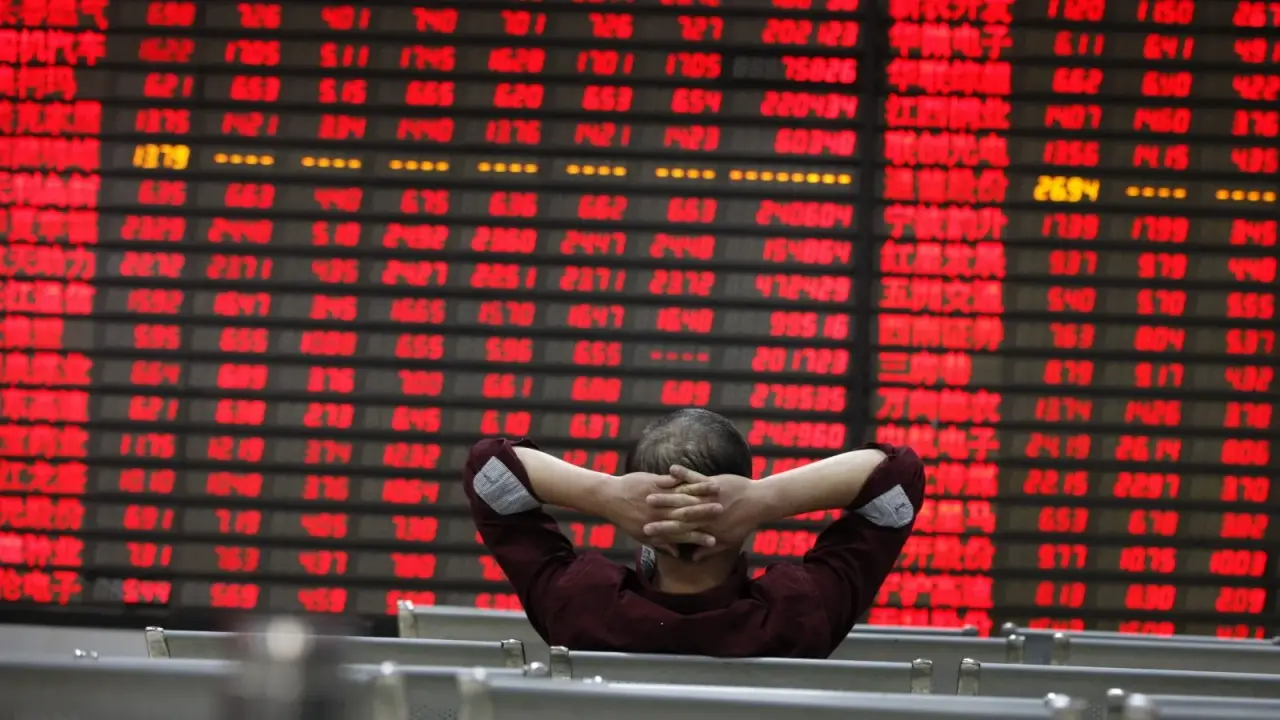
Japanese stocks experienced a severe collapse on Monday, marking the largest single-day decline since the 1987 Black Monday crash. The Nikkei index plummeted by an unprecedented 12.4 per cent, following a global stock market downturn and growing economic concerns, compounded by the unwinding of investments funded by a previously weak yen.
The drop was precipitated by Friday's bleak US jobs data, which intensified fears of a potential recession. The yen's surge to a seven-month high against the dollar also played a significant role, marking the worst percentage decline for the index since the 1987 crash.
Leading the decline were Japan's banking stocks, as the Nikkei entered bear market territory, having fallen 27 per cent from its peak on July 11, when it stood at 42,426.77. By Monday's close at 31,458.42, the index had shed 113 trillion yen (approximately $792 billion) in market value.
Kyle Rodda, a senior financial market analyst at Capital.com in Melbourne, remarked, "The rapid move in the yen is putting downward pressure on Japanese equities, but it's also driving an unwind of a major carry trade - investors had leveraged up by borrowing in yen to buy other assets, chiefly US tech stocks. We are basically seeing a mass deleveraging as investors sell assets to fund their losses."
Advertisement
The Nikkei's 4,451.28-point drop on Monday was its largest-ever one-day decline in points, surpassing the 3,836.48-point loss on October 20, 1987, when the Black Monday crash impacted Japanese markets. Japan's Finance Minister Shunichi Suzuki expressed "grave concern" over the market situation, noting the difficulty in pinpointing a single cause for the steep decline.
Many analysts suggested that neither interest rate expectations nor economic data alone could justify the severity of the sell-off. The sudden rise of the yen, bolstered by the Bank of Japan's recent interest rate hike and the unwinding of yen-funded carry trades, was a critical factor. The yen has appreciated 14 per cent in less than a month, reaching 142.96 per dollar.
Advertisement
Richard Kaye, a portfolio manager at Comgest in Tokyo, commented, "In short, not only the currency but the entire 'value' trade in Japan which had hijacked our market for two years is being unwound."
The global selloff extended to US markets, where stocks suffered a second consecutive day of losses on Friday. The Nasdaq Composite index entered correction territory, and US stock futures indicated a continuation of the downturn. Tomochika Kitaoka, chief equity strategist at Nomura Securities, noted that concerns over the US economic slowdown were exacerbated by the Bank of Japan's rate hike, which some believed the domestic economy could not support.
Japan's banking sector saw a 17 per cent slump, making it the worst-performing among Tokyo Stock Exchange's industry sub-indexes. Notable declines included chip-equipment maker Tokyo Electron, which fell 18.48 per cent, Uniqlo owner Fast Retailing, down 9.59 per cent, and technology investor SoftBank Group, which dropped 18.66 per cent.
The broader Topix index fell by 12.2 per cent to 2,227.15, its weakest point since mid-October, and similarly entered bear territory with a 25 per cent decline from its July 11 peak.
(With Reuters inputs)