
4,399 Days of Modi: The Power of Atma Vishwas That Changed India
On June 10, 2026, Narendra Modi completed 4,399 days in office, officially cementing his legacy as a historic, long-serving leader of India.
- Opinion News
- 7 min read

;'%3e%3cpath%20d='m8,15.99c4.41,0,7.99-3.58,7.99-7.99S12.41,0,8,0,0,3.59,0,8s3.58,7.99,7.99,7.99Z'%20style='stroke:%23fff;%20stroke-miterlimit:10;%20stroke-width:.02px;'/%3e%3cpath%20d='m3.08,3.37l3.82,5.11-3.84,4.15h.87l3.37-3.64,2.72,3.64h2.94l-4.04-5.39,3.58-3.87h-.86l-3.1,3.35-2.5-3.35h-2.94Zm1.27.64h1.35l5.97,7.99h-1.35l-5.97-7.99Z'%20style='fill:%23fff;'/%3e%3c/g%3e%3c/svg%3e)


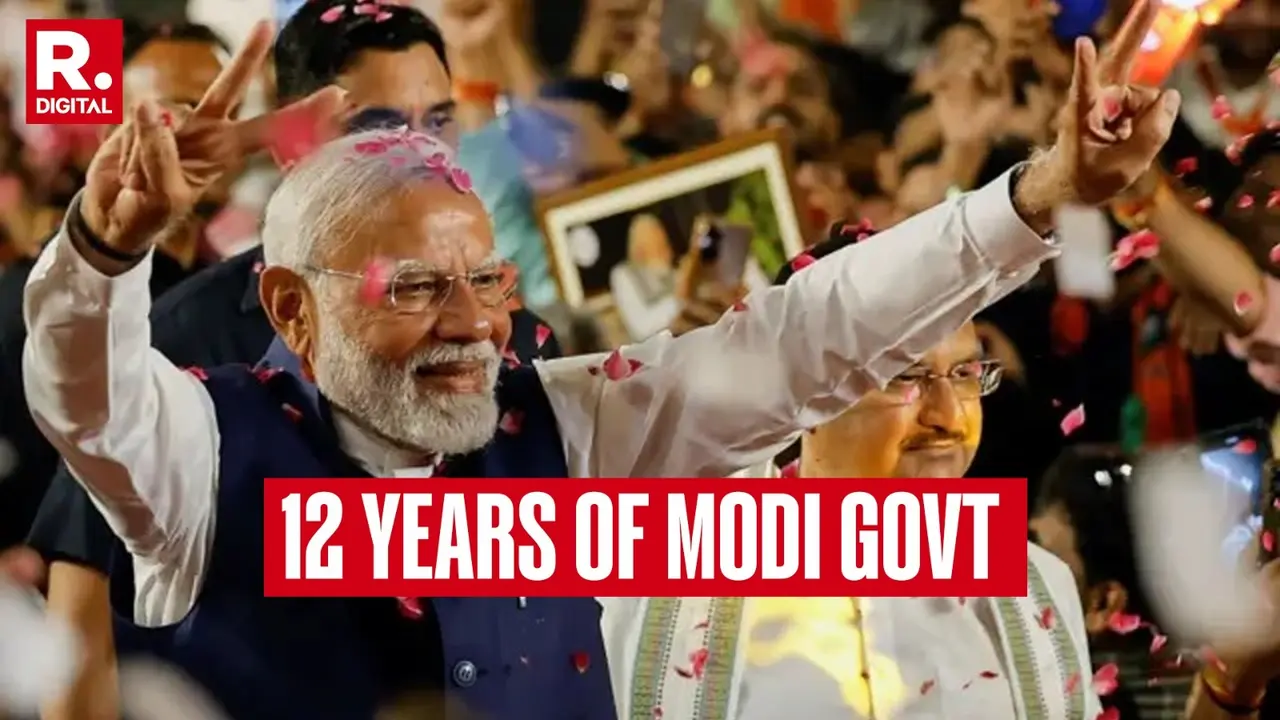
On June 10, 2026, Narendra Modi completed 4,399 days as Prime Minister of India.
Numbers can often be deceptive. They can tell us how many days a leader has occupied an office, how many speeches he has delivered, how many kilometres of roads have been built, or how many welfare schemes have been launched. Yet, sometimes, a single quality defines a leader more than all statistics combined.
For me, after observing Narendra Modi’s journey over these 4,399 days, one characteristic stands above every achievement, every reform, every electoral victory and every global recognition: Self-Belief or Atma Vishwas.

It is easy today to speak of Modi as a global statesman. It is easy to point to India’s rise as the world’s fastest-growing major economy, its expanding infrastructure, its growing diplomatic influence, or its technological achievements.
Advertisement
But rewind to 2014.
India was struggling with policy paralysis. Corruption scandals dominated headlines. Public confidence in institutions was weak. There was widespread cynicism about governance and the country’s future.
Advertisement
Into this environment stepped a man who had no political surname, no dynastic backing, no elite pedigree and no powerful family network to support him.
What he possessed instead was an unwavering belief in himself and an even stronger belief in India.
Many leaders inherit power. Narendra Modi had to earn it. That distinction matters because it shaped the way he governed.
From the moment he assumed office, Modi demonstrated a willingness to pursue goals that many considered impossible. Whether it was opening millions of bank accounts under Jan Dhan Yojana, building toilets under Swachh Bharat, implementing GST, abrogating Article 370, launching Digital India, promoting manufacturing through Make in India, or accelerating infrastructure development, each initiative was driven by a conviction that India could achieve more than what conventional wisdom suggested.
Critics often questioned these ambitions. Modi moved ahead anyway. That is what self-belief looks like in action.
It is not arrogance. It is not stubbornness. It is the confidence to continue when others doubt you.
One incident particularly captures this quality.
In his early years, Modi often spoke about transforming India into a developed nation. Many commentators dismissed the vision as political rhetoric. Some argued that India’s bureaucracy was too slow. Others claimed the political system was too fragmented. There were experts who insisted that large-scale transformation was impossible within a generation.
Modi chose not to lower his ambition. Instead, he raised the nation’s aspirations. The result was a shift in mindset.
India stopped talking merely about managing problems and began discussing achieving milestones.
Today, Indians speak about becoming a developed nation by 2047. They discuss semiconductor manufacturing, space exploration, artificial intelligence, defence exports and global leadership. These conversations were not common a decade ago.
A nation’s progress begins with belief. Before a country can achieve greatness, it must first believe greatness is possible.
Modi understood this fundamental truth.
His critics may disagree with his policies. Political opponents may challenge his decisions. Historians will continue to debate individual initiatives.
But few can deny that he altered the psychological landscape of India. He replaced hesitation with confidence.He replaced pessimism with possibility. He replaced dependency with aspiration.
That transformation is perhaps his most enduring legacy.
Self-belief has also defined India’s position on the global stage.
For decades, India often approached international affairs with caution, sometimes even uncertainty.
Under Modi, India began engaging the world with greater confidence.
Whether addressing major global forums, negotiating strategic partnerships, advocating for the Global South, or responding to geopolitical challenges, India projected itself as a nation prepared to shape outcomes rather than merely react to them.
This change did not happen overnight. It was rooted in leadership that believed India deserved a larger role in the world.
A leader’s confidence often becomes a nation’s confidence. Over 4,399 days, that confidence became visible.
It became visible when India successfully hosted the G20 Summit.
It became visible when Indian digital public infrastructure attracted global attention.
It became visible when Indian vaccines reached countries across continents.
It became visible when Indian missions evacuated citizens from conflict zones.
And it became visible when the world increasingly began looking towards India for leadership on issues ranging from technology to climate action.
Yet perhaps the most remarkable aspect of Modi’s self-belief is that it survived adversity.
Leadership is easy during periods of success. The true test comes during crises.
The COVID-19 pandemic presented one such challenge. The world faced uncertainty unlike anything seen in generations.
Every government struggled.
Every leader was tested.
In such moments, self-belief becomes essential because fear can easily overwhelm decision-making.
Modi consistently projected confidence that India would overcome the crisis.
Whether one agreed with every policy decision or not, the message remained clear: India would endure, adapt and emerge stronger.
That belief helped sustain public confidence during a period of extraordinary uncertainty.
The same quality has appeared repeatedly throughout his political career.
Electoral setbacks did not diminish it. Political attacks did not weaken it. International criticism did not alter it.
He continued pursuing his vision because he believed in it.
There is an important lesson here, not merely for politicians but for every Indian.
Self-belief is often the difference between ambition and achievement.
Most people do not fail because they lack talent.
They fail because they doubt themselves before the journey even begins.
Most dreams are abandoned long before circumstances force their abandonment.
People surrender to fear. They surrender to criticism. They surrender to uncertainty.
Narendra Modi’s journey demonstrates a different approach.
Believe first. Work relentlessly. Let results follow.
Whether one supports him politically or opposes him electorally, that lesson remains valuable.
For young Indians especially, Modi’s rise from humble beginnings to becoming one of the world’s most recognised leaders carries a powerful message.
Your starting point does not determine your destination. Your confidence does.
India today stands at a unique moment in history.
The nation possesses demographic strength, technological capability, entrepreneurial energy and growing global influence.
But none of these advantages matter if Indians lose confidence in themselves.
The future belongs to nations that believe in their potential.
That is why self-belief matters.
And that is why, when I reflect on Narendra Modi’s 4,399 days as Prime Minister, one image remains stronger than any policy announcement or electoral victory.
It is the image of a leader who consistently refused to accept limitations imposed by others.
A leader who believed India could achieve more. A leader who encouraged Indians to think bigger. A leader who transformed belief into a national movement.
History will judge governments through statistics, reforms and outcomes.
Citizens often remember something deeper.
They remember how leaders made them feel about themselves and their country.
For millions of Indians, Narendra Modi’s greatest contribution may not simply be what he built.
It may be what he inspired. The confidence to believe. The courage to aspire.
And the conviction that India can become Bharat in its fullest civilisational and developmental sense.
After 4,399 days, that lesson remains as relevant as ever. Because every great transformation begins with a simple act.
The act of believing it is possible.