
Markets Wake Up to a Hotter Middle East, Hawkish Fed and AI Boom That Refuses to Quit
Global markets face challenges: tensions in the Strait of Hormuz drive oil prices above $90, while Federal Reserve Chair Warsh warns on inflation, raising September rate hike expectations. Nvidia's strong earnings boost the AI sector, but geopolitical risks weigh on sentiment.
- Opinion News
- 10 min read

;'%3e%3cpath%20d='m8,15.99c4.41,0,7.99-3.58,7.99-7.99S12.41,0,8,0,0,3.59,0,8s3.58,7.99,7.99,7.99Z'%20style='stroke:%23fff;%20stroke-miterlimit:10;%20stroke-width:.02px;'/%3e%3cpath%20d='m3.08,3.37l3.82,5.11-3.84,4.15h.87l3.37-3.64,2.72,3.64h2.94l-4.04-5.39,3.58-3.87h-.86l-3.1,3.35-2.5-3.35h-2.94Zm1.27.64h1.35l5.97,7.99h-1.35l-5.97-7.99Z'%20style='fill:%23fff;'/%3e%3c/g%3e%3c/svg%3e)


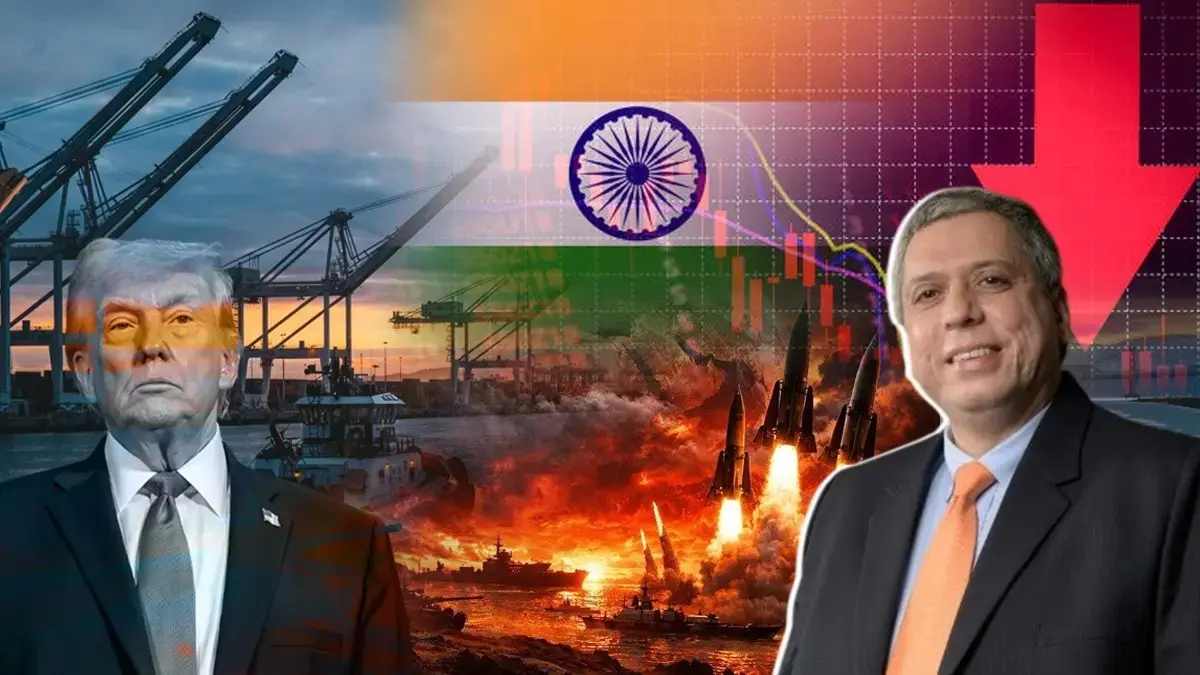
Global markets begin the week digesting three collisions at once: a fresh flare-up around the Strait of Hormuz that has put a new war premium into oil, a Federal Reserve chair who used Jackson Hole to warn that the inflation fight is not over, and an Nvidia earnings blowout that is keeping the AI trade alive even as bond yields bite.
For Indian investors, add a mixed earnings season, a still-deficient monsoon and elevated crude prices. The combination argues for selective positioning rather than broad-based optimism.
US-Iran: The Ceasefire That Never Quite Was
The framework that investors had hoped would facilitate the reopening of the Strait of Hormuz has effectively collapsed into an uneasy standoff, with the weekend bringing the sharpest escalation in weeks.
US Central Command confirmed that it struck Iranian rocket launchers on Larak Island that were reportedly preparing to seed sea mines into shipping lanes. The strike came just days after the US said it had cleared mines from the strait's main routes.
Advertisement
Iran, meanwhile, continues to insist that Hormuz remains "closed" pending an end to the American naval blockade and the lifting of sanctions. Washington has simultaneously launched a sweeping new economic pressure campaign, with Treasury Secretary Scott Bessent describing it as an effort to sever "every economic lifeline" keeping Tehran afloat.
Ship-tracking data show transits through the strait running at a small fraction of pre-war levels, even as the US military says it has helped move meaningful volumes of oil out under escort.
Advertisement
Iran's economy is also buckling under the strain. Its currency has hit record lows and real wages have more than halved, but there is little sign yet that the economic pain is translating into a negotiated reopening.
Markets should therefore treat this as a genuinely live conflict, rather than a de-escalating one, and price volatility accordingly.
Oil: The Quiet Phase Is Over - For Now
Crude had spent the back half of August grinding lower. Brent slipped toward $83 a barrel as traders increasingly treated the Iran standoff as a sanctions-and-economics story rather than a physical-supply threat.
Gulf exports had recovered to an estimated 15-16 million barrels a day - still well below the 22-24 million barrels per day seen before the war, but a marked improvement from the 5-6 million bpd trough during the depths of the conflict.
That complacency broke over the weekend.
Brent jumped back above $90, while WTI traded near $86 following the Larak Island strikes, snapping weeks of relative calm.
The lesson for traders is clear: the market is not pricing a resolved conflict. It is pricing a ceasefire that keeps coming close to breaking.
Every incident in the strait, however contained, can trigger a $5-$10 move in crude. Energy-importing economies - India chief among them - should therefore plan around continued volatility rather than expect a return to pre-war pricing anytime soon.
Kevin Warsh's Jackson Hole Speech: Hawkish, But Deliberately Vague
New Fed Chair Kevin Warsh used his first Jackson Hole address, delivered on his 100th day in office, to signal that the inflation fight is not won, even as he refused to provide the forward guidance markets were seeking.
His central message was that he was "impressed" by the underlying strength of the economy but concerned that "underlying trends" in inflation had not meaningfully improved. He also suggested that financial conditions may not yet be restrictive enough.
Crucially, Warsh stopped short of committing to a specific interest-rate path. He argued that the Federal Reserve should not allow markets to treat its meetings as their "next trade" signal.
The market reaction was telling. Odds of a September rate hike roughly doubled, from about one-in-three before the speech to above 50% afterwards. The dollar index climbed to a two-week high, while gold, which had been holding just above $4,600, initially wobbled on the hawkish repricing before central-bank and dollar-debasement buying returned.
The broader takeaway is that Warsh appears to be running a more market-agnostic and "quieter" Fed than his predecessor Jerome Powell.
Investors should therefore expect ambiguity rather than clear rate-path signals heading into the September FOMC meeting.
Gold and the Dollar: Two Safe Havens Pulling in Different Directions
Gold remains in a structural bull market, trading around $4,600-$4,650 an ounce and holding near a three-month high.
The rally is being driven by more than the traditional safe-haven bid. Record central-bank purchases - 288.9 tonnes in the second quarter alone, up 62% year-on-year - growing anxiety over the trajectory of US debt, which has crossed $40 trillion, and renewed "dollar debasement" trades following the Treasury's expanded buyback of older long-dated bonds are all supporting bullion.
Silver has outperformed gold this month, briefly touching the low-$70s.
The dollar index, meanwhile, rallied on Warsh's hawkish tone. This highlights an unusual market dynamic: a more aggressive Fed and a structurally weaker-dollar narrative can coexist.
Traders are simultaneously running two competing theses - "higher-for-longer rates support the dollar" and "US debt dynamics debase the dollar". That tension is precisely what continues to keep gold bid even as real yields firm.
Asian Markets: AI Euphoria Collides With Geopolitical Risk
Across Asia, two narratives are fighting for control.
Nvidia's blowout earnings initially sent a wave of relief through the region. Korea's Kospi jumped more than 1.8%, Japan's Nikkei and Topix moved higher, and semiconductor-linked stocks across Taiwan and South Korea rallied sharply.
But that optimism has been overwhelmed by the weekend's Hormuz escalation.
Futures for the Nikkei, Hang Seng and ASX point lower, while South Korea's Kospi is indicated down as much as 3.5%. China's CSI 300 is also under pressure.
The pattern to watch is that Asian equities are increasingly trading as a leveraged bet on two variables: AI capital-expenditure momentum and Iran-related oil risk.
Whichever narrative dominates on a given day is likely to determine market direction far more than domestic economic data.
AI Momentum: Still the Market's Most Powerful Engine
If there is one unambiguous bright spot, it is that the AI infrastructure buildout shows no sign of slowing.
Nvidia's fiscal second-quarter results were extraordinary. Revenue more than doubled year-on-year to above $96 billion, gross margins held at 75%, and management's guidance implies roughly 70% revenue growth for fiscal 2028 - nearly double what Wall Street had modelled.
CFO Colette Kress pointed to a backlog exceeding $2 trillion, while hyperscaler capital-expenditure commitments are approaching $800 billion this year and are expected to rise to $1.3 trillion the following year.
Nvidia shares jumped roughly 7-9% following the results, lifting Broadcom, SK Hynix, Intel and a broad range of semiconductor stocks. The Nasdaq also recorded its best session in weeks.
For global markets, this is arguably the most important data point of the month.
As long as hyperscaler capex continues accelerating rather than entering a digestion phase, the AI trade has room to override macro headwinds such as a hawkish Fed and elevated bond yields.
There is, however, a constraint. The 10-year US Treasury yield above 4.7% remains a genuine limitation on how much further AI-driven multiple expansion can run.
Indian Earnings: Resilient Headlines, Uneven Quality Underneath
The Q1 FY27 earnings season is now largely behind us, and its lessons are nuanced rather than simply bullish or bearish.
Aggregate profit growth has held up, with Nifty companies tracking towards high-single-digit to low-double-digit year-on-year earnings growth. But the composition matters more than the headline.
Commodity-linked sectors, including metals and energy, have posted outsized profit growth, largely benefiting from the same supply shocks that are creating a macroeconomic headwind.
NBFCs and consumer durables, helped by a low base, have also delivered strong numbers. IT and industrials have been comparatively stable rather than spectacular.
The clearest warning sign from the season is margin pressure.
Input costs rose across several sectors even as demand remained patchy. Strategists at houses including Nuvama and Kotak have flagged the possibility that FY27 earnings-per-share estimates may need to come down in the second half of the year as tax-cut tailwinds fade, last year's low base disappears and El Niño-related demand risks build.
The message for investors is that this was a season in which selectivity and bottom-up stock picking mattered more than simply owning the index. That pattern is likely to continue as leadership rotates towards companies that can scale while defending margins.
India Outlook: Navigating Oil, El Niño and Global Crosscurrents
India enters the second half of FY27 facing a genuine three-way squeeze: elevated crude prices, a below-normal monsoon and a global backdrop in which both a hawkish Fed and a live Iran conflict are weighing on risk appetite.
India's position on oil is structurally uncomfortable. As one of the world's largest crude importers, sustained Brent prices in the high-$80s to $90s would directly pressure the current account, keep the rupee under depreciation pressure and add to imported inflation at a time when the Reserve Bank of India would prefer a benign backdrop.
The monsoon picture is mixed rather than uniformly bad.
Cumulative rainfall has been roughly 11-12% below the long-period average nationally, while El Niño conditions are strengthening through the July-September period as forecast. At the same time, the rainfall deficit has coexisted with dangerous localised extremes, including severe flooding in Kerala despite the state's overall seasonal shortfall.
That combination - lower aggregate rainfall but sharper and more damaging extreme-rainfall events - is consistent with published climate research on El Niño summers in India.
For investors, this means agricultural and rural-demand risks need to be assessed region by region rather than through the national rainfall average alone.
What It Means for Indian Equities
The case for Indian equities is neither a straightforward buy-the-dip call nor a reason to become defensive across the board.
It is a case for a genuinely selective, quality-and-margin-focused approach.
Domestic cyclicals and commodity-linked names that have benefited from the current environment, particularly metals and energy, have already had their moment in this earnings season.
The more important question for the next two quarters is which consumption and rural-facing sectors can absorb an El Niño-driven demand hit without significant earnings cuts.
At the other end are import-dependent, oil-sensitive sectors such as aviation, paints, tyres and chemicals. These face genuine margin-compression risks if crude remains elevated into year-end.
Financials, particularly private banks, remain a relatively cleaner story. They are less directly exposed to both the oil and monsoon variables and continue to be flagged by strategists as a source of earnings resilience.
The overarching message for Indian portfolios is therefore to expect earnings-estimate cuts rather than upgrades over the next couple of quarters, expect the rupee to remain on the back foot while crude stays elevated, and treat any meaningful Hormuz de-escalation as the single biggest potential positive catalyst for Indian markets.
Such a development would simultaneously ease India's oil bill, support the rupee and remove the principal tail-risk overhang from an otherwise resilient domestic growth story.
Bottom Line
Global markets are being pulled in opposite directions by two of the most powerful forces of 2026: an AI capex supercycle that continues to beat even elevated expectations, and a Middle East conflict that threatens to reprice energy markets overnight.
Warsh's Federal Reserve adds a third variable - a central bank less willing to hold investors' hands than markets have become accustomed to.
For India, the earnings season has confirmed that the domestic growth story remains real but uneven. The next leg of the market, however, may depend less on domestic policy than on two developments New Delhi does not control: what happens in the Strait of Hormuz and how the second half of the monsoon plays out.