
The Mecca Pact Is Aimed at Tehran’s Allies, and Pakistan Is Still Trading With Tehran
Pakistan's Mecca defence pact with Saudi Arabia and Turkey raises regional security questions, but Islamabad continues expanding trade with Tehran. New border crossings, a $10 billion trade target and Iranian electricity imports underscore the economic ties shaping Pakistan-Iran relations.
- Opinion News
- 3 min read

;'%3e%3cpath%20d='m8,15.99c4.41,0,7.99-3.58,7.99-7.99S12.41,0,8,0,0,3.59,0,8s3.58,7.99,7.99,7.99Z'%20style='stroke:%23fff;%20stroke-miterlimit:10;%20stroke-width:.02px;'/%3e%3cpath%20d='m3.08,3.37l3.82,5.11-3.84,4.15h.87l3.37-3.64,2.72,3.64h2.94l-4.04-5.39,3.58-3.87h-.86l-3.1,3.35-2.5-3.35h-2.94Zm1.27.64h1.35l5.97,7.99h-1.35l-5.97-7.99Z'%20style='fill:%23fff;'/%3e%3c/g%3e%3c/svg%3e)


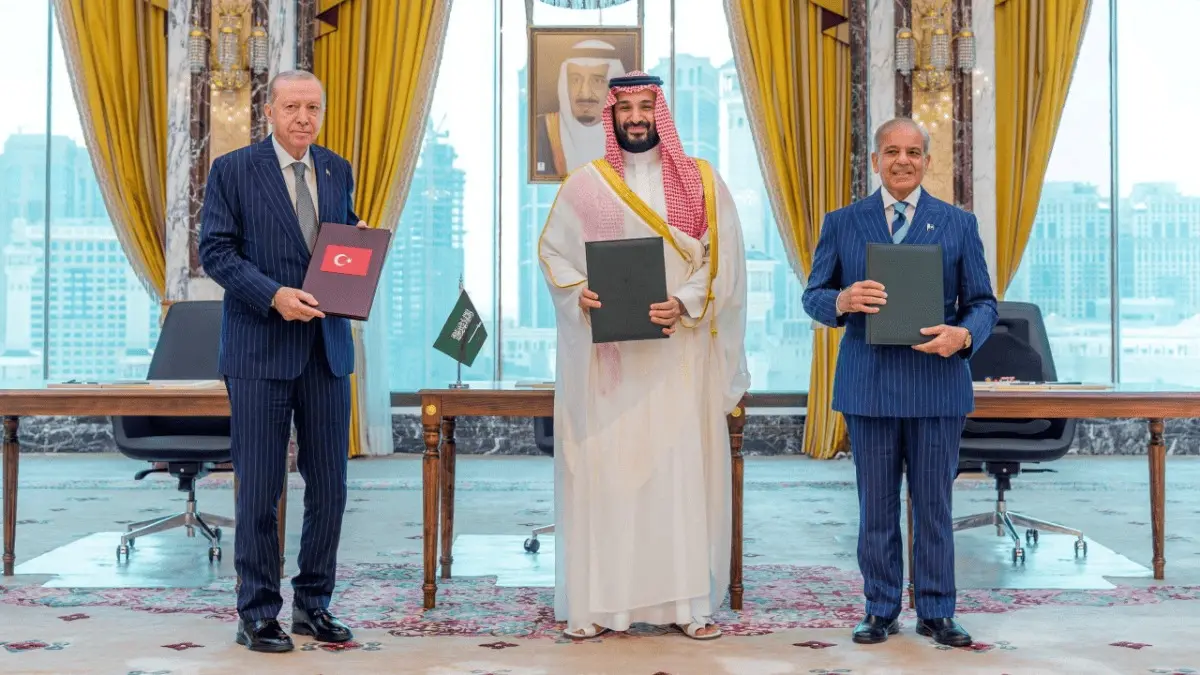
A new customs station at Jeerak, in Panjgur district, opened in August as the fifth official crossing between Pakistan and Iran. It was announced in the same week the two governments finished three days of trade talks in Islamabad, and two days before Prime Minister Shehbaz Sharif flew to Mecca to sign a defence treaty with Saudi Arabia and Turkey.
The 10th session of the Pakistan-Iran Joint Trade Committee, co-chaired by Commerce Minister Jam Kamal Khan and Iranian Industry Minister Mohammad Atabak, closed on 5 August with a reaffirmed target of $10bn in bilateral trade. Atabak called Pakistan Iran's long-term strategic trade partner. Bilateral trade, he said, had grown to more than $3bn, against about $1.2bn in fiscal 2010, before sanctions tightened and banking restrictions choked formal flows. The two sides are negotiating a free trade agreement at technical level and agreed to keep the crossings open round the clock.
The timing tempts a reading of the trade talks as a screen for the treaty. The record suggests a more ordinary explanation. Since March, the two governments had been easing customs procedures, formalising Taftan as a customs station and notifying new transit routes. In April, Pakistan's commerce ministry notified six routes for carrying goods to Iran through Gwadar and Karachi.
The border runs about 900 kilometres through the least developed districts of both countries, where informal and undocumented commerce has long sustained local communities. The joint border markets and barter arrangements the two governments have been building are meant to move that trade onto paper.
Advertisement
Electricity is a second thread. Pakistan buys about 100 megawatts from Iran, and on 6 August Power Minister Awais Leghari discussed a second cross-border transmission line and an expansion beyond that figure. He praised Iran for keeping supply uninterrupted despite the regional security situation and called imports an integral part of long-term planning for Gwadar.
The political layer above the trade talks is thick. Iranian and Pakistani flags lined Islamabad's streets ahead of President Masoud Pezeshkian's arrival on 23 June. On 5 August, Sharif received a six-member Iranian delegation, saying he had recently held a productive discussion with Pezeshkian on lasting peace in the region and on bilateral relations, particularly trade. In June he had told the National Assembly he expected a new phase of expanded economic cooperation with Iran. Two days after the August meeting he was in Mecca.
Advertisement
So far, the Mecca pact has changed nothing in this machinery that either government has announced. Since the 5 October activation, neither Tehran nor Islamabad has said anything about reviewing trade, customs stations or electricity supply. Iran's rhetoric has stayed on Yemen: spokesman Esmaeil Baghaei hoped reports of a Pakistani deployment for war there were untrue, and Araghchi said agreements of this kind would not constrain Iran.
The leverage runs both ways. Pakistan needs Iranian power for Gwadar and the border districts, while Iran wants Karachi and Gwadar as outlets for its trade, as Atabak noted in August.
A closure at Taftan would cost both. Pakistan also has security reasons to keep the frontier quiet: the Pakistani Taliban are a pressing concern for Islamabad, and a hostile Iranian border would add a second front to a country that already has one with Afghanistan. Leghari said in August that electricity imports from Iran would remain part of long-term energy planning and might increase as Gwadar's demand grows. That statement predates the Riyadh meeting.