
The Storm Peak: Rudra's Unyielding Watch
Its position on the map matters too, more than you might expect. Rudra sits precisely where the warm, moisture-laden air of the Indian monsoon runs headlong into the cold, dry winds rolling off the Tibetan Plateau.
- Opinion News
- 6 min read

;'%3e%3cpath%20d='m8,15.99c4.41,0,7.99-3.58,7.99-7.99S12.41,0,8,0,0,3.59,0,8s3.58,7.99,7.99,7.99Z'%20style='stroke:%23fff;%20stroke-miterlimit:10;%20stroke-width:.02px;'/%3e%3cpath%20d='m3.08,3.37l3.82,5.11-3.84,4.15h.87l3.37-3.64,2.72,3.64h2.94l-4.04-5.39,3.58-3.87h-.86l-3.1,3.35-2.5-3.35h-2.94Zm1.27.64h1.35l5.97,7.99h-1.35l-5.97-7.99Z'%20style='fill:%23fff;'/%3e%3c/g%3e%3c/svg%3e)


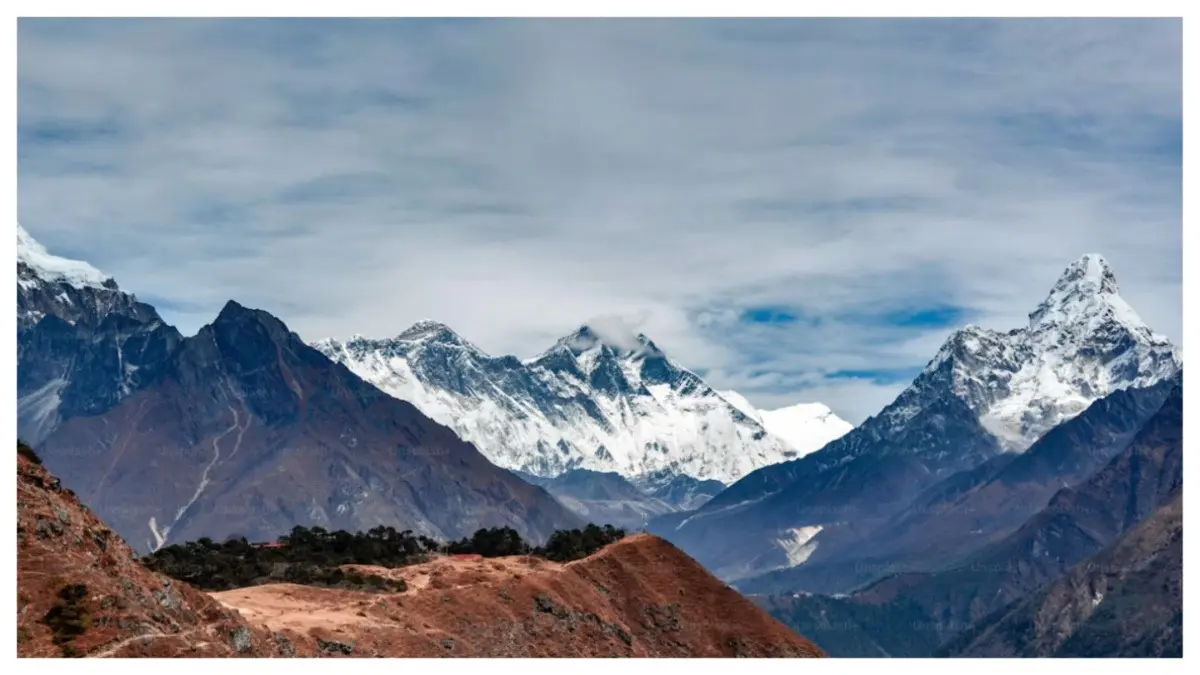
There is a mountain in the Trans-Himalayan ranges where the wind doesn't so much blow as it cuts across bare ridges, through frozen air, over a silence so complete it feels almost deliberate. This is where Rudra stands.
Located at 32°10'54.43"N and 78°36'07.65"E in one of the more unforgiving corners of Himachal Pradesh, it is the kind of place that makes you feel small in the best possible way. Not just a point on a map, Rudra is a guardian of watersheds and a quiet witness to centuries of human passage through some of the harshest terrain on earth.
The name goes back far — to the ancient Vedic form of Shiva, a Rudra who was storm and mountain and wild nature all at once, capable of both destruction and healing. Spend any time thinking about this mountain and that duality starts to make perfect sense. It rises above 5,100 meters through snowbound ridges and glacial valleys, and it does not welcome visitors easily.
Rudra destroys and nourishes
Avalanches let loose without ceremony. Blizzards arrive unannounced. The rock and ice have a way of reminding you, at every step, that you are a guest here. And yet, from all that frozen severity come the waters that keep northern India alive. Rudra destroys and nourishes. It always has.
Advertisement
Its position on the map matters too, more than you might expect. Rudra sits precisely where the warm, moisture-laden air of the Indian monsoon runs headlong into the cold, dry winds rolling off the Tibetan Plateau.
That collision is not just dramatic — it is consequential. It shapes the hydrology of an entire region, feeding the streams and glaciers that eventually find their way into larger rivers and, ultimately, into the Indus basin. In the Himalayas, a watershed is never just a line someone drew on paper.
Advertisement
It is the reason millions of people downstream have water to drink, fields to farm, and towns that can function at all. The snow that falls on a peak like Rudra, the ice that builds up over decades, the slow melt that trickles down through valleys — all of it travels further than you'd imagine, quietly sustaining lives that may never once look up toward this mountain.
Rudra's story doesn't stop at ecology
But Rudra's story doesn't stop at ecology. It overlooks the remote valleys of Spiti and a web of frontier corridors that, for centuries, were the arteries connecting India with Tibet and Central Asia. Traders moved through here with silk and salt. Monks carried scriptures. Pilgrims made journeys that took months, driven by faith across some of the highest passes in the world.
For the communities who lived along these routes, a mountain was never just rock and ice — it was a presence, something alive in a way that went beyond the physical. Rudra became exactly that kind of presence. A symbol of nature's authority, yes, but also of something more personal: the relationship between people and the high places that had always shaped how they lived, what they believed, and who they were.
Then came the nineteenth century and the Great Game — that long, tense rivalry between British and Russian empires playing out across Central Asia. Surveyors from the Great Trigonometrical Survey pushed into these ranges armed with instruments and determination, mapping terrain that had never been formally recorded.
It cost some of them their lives. But what they produced changed everything — the Himalayas shifted, in the eyes of the empire, from mythic wilderness to measured strategic frontier. Peaks like Rudra became markers in a defense system built more from geography than from stone, binding ancient landscapes into the calculations of distant powers.
The 1962 conflict
After independence, that strategic logic only grew sharper. The 1962 conflict made it viscerally clear what it meant to fight a war at altitude. Thin air robs your lungs. Cold seeps into everything. A storm can roll in and erase visibility in minutes.
In conditions like that, the most sophisticated technology starts to feel inadequate, and what actually matters is how long a person can hold on — physically, mentally — and how well they know the ground beneath their feet. Mountains like Rudra don't need walls or watchtowers. Their remoteness and their brutality do the work. They are sentinels by nature, not by design.
Now, in the present, Rudra finds itself at the intersection of two crises that define our era. The glaciers on its slopes are retreating — not catastrophically, not all at once, but steadily, year by year, in the way that slow things do when the conditions that sustained them begin to change. Snowlines that once felt permanent are no longer where they used to be.
For the millions downstream who depend on that meltwater, this is not an abstract concern — it is a question of long-term water security, and it is one that scientists and policymakers are watching with growing urgency. At the same time, the mountain's terrain remains what it has always been: steep, barren and deeply unwelcoming to anyone who tries to move through it without respect. That difficulty is, in its own way, a form of protection.
Myth and reality
What makes Rudra remarkable, in the end, is how much it holds together. Myth and reality. Ancient reverence and modern necessity. The name of a Vedic god and the coordinates of a strategic peak. It is not a relic or a symbol — it is a living part of a world that is still very much in motion.
The wind still screams through its passes. The ice and granite still carry the memory of everyone who ever crossed these heights — pilgrims and soldiers, explorers and surveyors — in times of hope and in times of desperation.
The water that begins its life on Rudra's glaciers flows down, eventually, to plains where millions of people live out their days without ever knowing where it came from. And the mountain stays. It asks nothing. It simply reminds us, quietly and without compromise, that some places are not ours to conquer — only to protect, to respect, and to approach, always, with humility.