
Victory Or Vanishing: Why Israel’s War Is Now Being Fought In The World’s Conscience
Israel possesses overwhelming military superiority, yet paradoxically, its strategic grip over Gaza’s future appears to be loosening. The reason is not a shortage of firepower. It is the rise of a dangerous political fantasy now circulating in Western capitals: the idea of a ‘managed transition’ in Gaza that leaves Hamas partially intact while the world rushes in with reconstruction money and diplomatic formulas.
- Opinion News
- 5 min read

;'%3e%3cpath%20d='m8,15.99c4.41,0,7.99-3.58,7.99-7.99S12.41,0,8,0,0,3.59,0,8s3.58,7.99,7.99,7.99Z'%20style='stroke:%23fff;%20stroke-miterlimit:10;%20stroke-width:.02px;'/%3e%3cpath%20d='m3.08,3.37l3.82,5.11-3.84,4.15h.87l3.37-3.64,2.72,3.64h2.94l-4.04-5.39,3.58-3.87h-.86l-3.1,3.35-2.5-3.35h-2.94Zm1.27.64h1.35l5.97,7.99h-1.35l-5.97-7.99Z'%20style='fill:%23fff;'/%3e%3c/g%3e%3c/svg%3e)


History will record that wars are not lost only on battlefields. Sometimes they are lost in lecture halls, newsrooms, social media feeds, and the moral imagination of distant societies. Today, that is where the real battle over Israel and Gaza is unfolding - and it is a battle Israel cannot afford to lose.
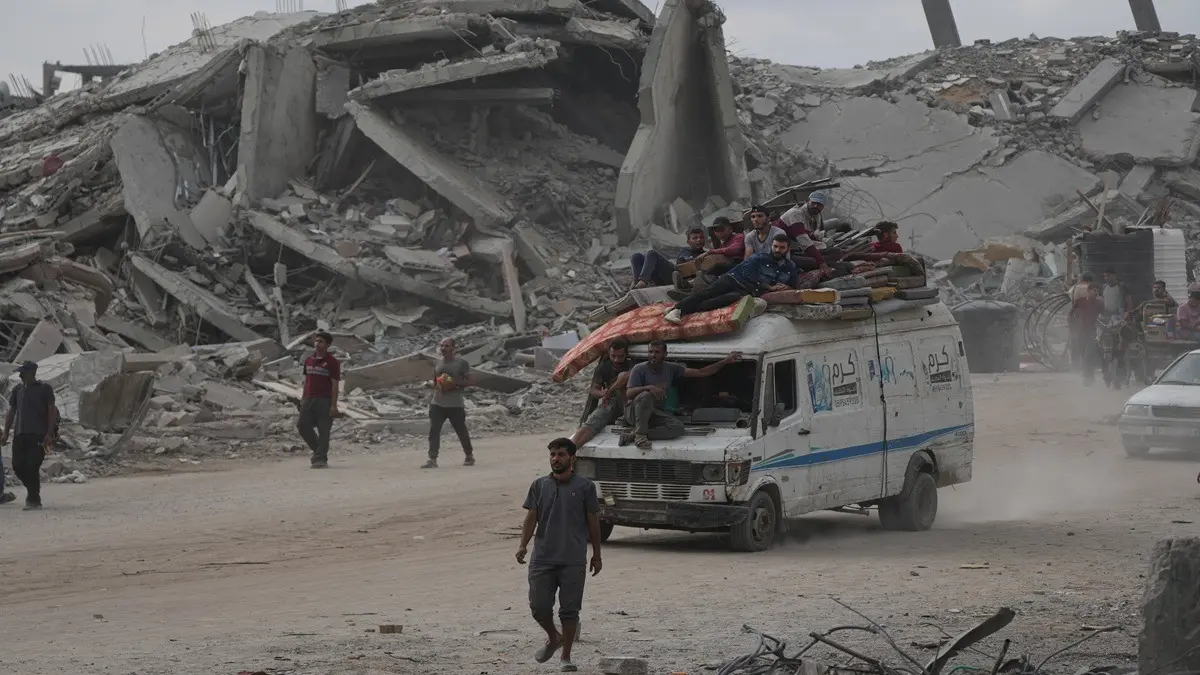
On the ground, Israel still possesses overwhelming military superiority. It can strike, dismantle, and degrade terror infrastructure at will. Yet paradoxically, its strategic grip over Gaza’s future appears to be loosening. The reason is not a shortage of firepower. It is the rise of a dangerous political fantasy now circulating in Western capitals: the idea of a ‘managed transition’ in Gaza that leaves Hamas partially intact while the world rushes in with reconstruction money and diplomatic formulas.
This approach, reportedly encouraged in parts of the Donald Trump political orbit, rests on a fatal misunderstanding of the Middle East. It assumes that governance can be technocratic while power remains ideological and armed. It imagines ‘Yellow Zones’ where Hamas fighters melt into civilian structures, weapons quietly stored, networks preserved, ideology untouched - all while international donors rebuild roads, hospitals, and schools that will once again sit under the shadow of a gun.
That is not conflict resolution. That is conflict preservation with better plumbing.
Advertisement
The deeper danger, however, is not only inside Gaza. It is in the changing moral climate of the West. A growing segment of global public opinion, particularly among younger generations, is no longer looking at this conflict through the lens of security. They are looking at it through the lens of delegitimisation. Israel is not seen as a state fighting a brutal terrorist entity. It is increasingly framed as a moral offender whose very act of survival is suspect.
This trend - what can only be called existential delegitimisation - is more dangerous than the missiles of Iran or the drones of Hezbollah. Missiles can be intercepted. Drones can be shot down. But a narrative that strips a nation of its right to self-defense corrodes its strategic freedom. It turns every act of protection into an accusation and every military necessity into a courtroom drama.
Advertisement
In that environment, Israel is pressured not to win, but merely to manage. Not to eliminate threats, but to ‘de-escalate’. Not to secure finality, but to maintain a cycle. This is precisely the deterrence model that shattered on October 7. Deterrence is psychological. It depends on the enemy’s fear. But fear erodes. Ideology does not. When an adversary believes its struggle is sacred, temporary quiet is merely tactical.
That is why the language of ‘absolute victory’, uncomfortable as it sounds in diplomatic circles, is strategically honest. Victory is not about vengeance or expansion. It is about removing the enemy’s capacity to dictate the future. As long as Hamas remains an armed, organised force in Gaza, it holds a veto over every political plan. No ‘technocratic government’ can function independently while militants decide who lives, who dies, and who governs.
The Western obsession with technocracy is almost naive in this context. Spreadsheets do not outrank rifles. Committees do not overrule militias. In the Middle East, power precedes administration - not the other way around.
If Israel truly seeks an endgame rather than an intermission, reconstruction cannot begin while Hamas still carries weapons. Every dollar poured into Gaza under those conditions risks becoming indirect subsidy for the next war. Tunnels will be rebuilt faster than clinics. Command posts will return quicker than classrooms.
So what is the alternative? It is uncomfortable to say, but realism rarely feels gentle. Gaza may require a transition phase that resembles a hard security state more than a Western-style civil society. Stability models exist in the region - not perfect, not liberal by European standards, but functional. Egypt and Jordan demonstrate that firm security control can suppress militant chaos and create space for ordinary life to function.
Under such a framework, local Gazan administrators - those willing to cooperate with a regional security order - could handle daily civic responsibilities: hospitals, sanitation, schooling, municipal services. But they would operate under the uncompromising oversight of Israeli security forces. Not as occupiers seeking permanence, but as guarantors ensuring that guns do not once again overrule governance.
Critics will call this harsh. They will say it contradicts democratic ideals. But ideals without security collapse into tragedy. The primary human right is the right not to live under the rule of armed extremists. Gazan civilians have suffered not only from war, but from decades of being trapped under a movement that thrives on perpetual conflict.
A demilitarised Gaza, even under tight security supervision, offers something Hamas never could: predictability. And predictability is the foundation upon which prosperity can eventually be built.
The larger challenge, however, remains global perception. Israel must recognise that the information war is now as decisive as the military one. It is not enough to defeat battalions. It must also confront the ideological machinery that has turned a complex security struggle into a morality play with pre-assigned villains. If existential delegitimisation takes root in Western institutions, Israel’s operational victories will be politically suffocated.
The Jewish state was not created as a charity project of world opinion. It was created as a sovereign answer to a history of vulnerability. Sovereignty means the ability to ensure survival even when applause fades.
In the end, the choice before Israel is stark. It can accept a managed illusion - a Gaza cosmetically rebuilt while militancy festers beneath the surface - or it can endure short-term diplomatic discomfort to secure long-term strategic reality. Deterrence produced cycles. Half-measures produced October 7. Only decisive dismantling of armed power can produce a different future.
History is rarely kind to nations that win battles but lose narratives. Israel must ensure it does neither.