
What Happens When Ancient Philosophy Is Taken Out of the Library and Placed Against the Realities of the 21st Century?
These are the 'falling-apple facts' of India — realities so visible that we rarely stop to examine what lies behind them. The answer Gurumurthy puts forward is the extraordinary ability of Indian civilisation to convert philosophy into culture.
- Opinion News
- 5 min read

;'%3e%3cpath%20d='m8,15.99c4.41,0,7.99-3.58,7.99-7.99S12.41,0,8,0,0,3.59,0,8s3.58,7.99,7.99,7.99Z'%20style='stroke:%23fff;%20stroke-miterlimit:10;%20stroke-width:.02px;'/%3e%3cpath%20d='m3.08,3.37l3.82,5.11-3.84,4.15h.87l3.37-3.64,2.72,3.64h2.94l-4.04-5.39,3.58-3.87h-.86l-3.1,3.35-2.5-3.35h-2.94Zm1.27.64h1.35l5.97,7.99h-1.35l-5.97-7.99Z'%20style='fill:%23fff;'/%3e%3c/g%3e%3c/svg%3e)


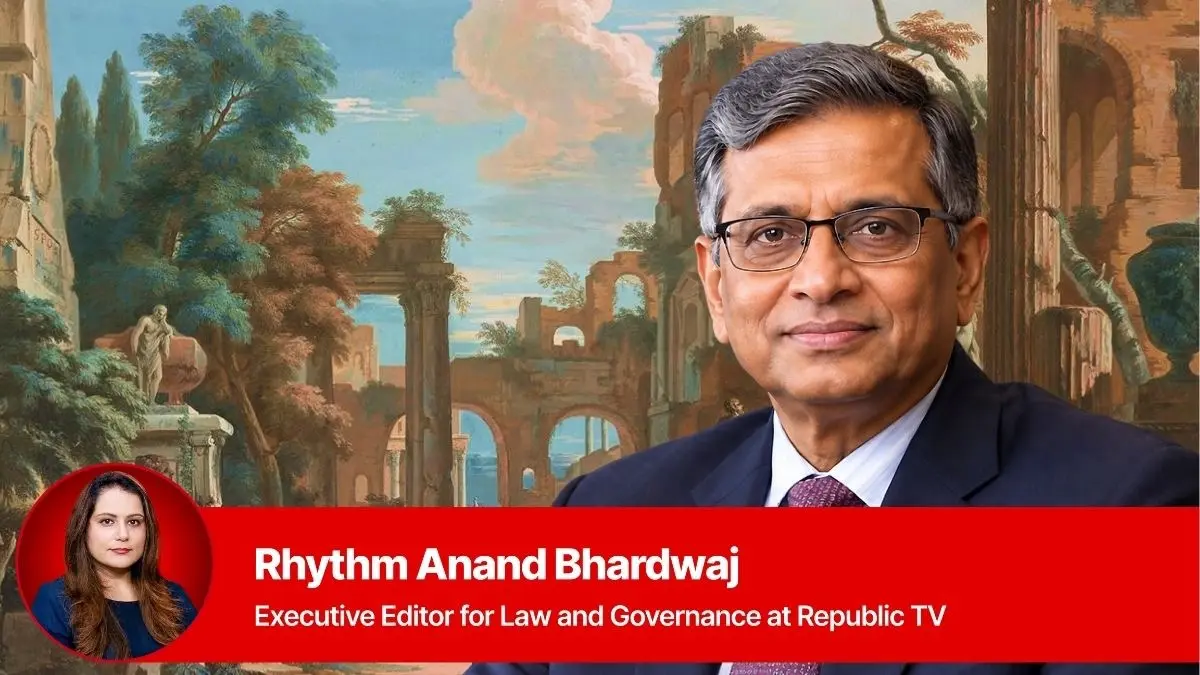
That is the question at the heart of Gurumurthy’s remarkable lecture on the relevance of ancient Indian philosophical thought to contemporary times. And his answer is both simple and provocative: much of what we are today trying to solve through policy, technology, economics and institutions was already being worked out in Indian civilisation — not as abstract theory, but as everyday practice. This is what makes Gurumurthy’s argument so compelling.
At the Sri S G Sundaraswamy Memorial Lecture 2026 at Sai Hira Global Convention Centre, Prasanthi Nilayam, on September 20, S Gurumurthy spoke on the relevance of ancient Indian philosophical thought to contemporary times.
He begins with a deceptively simple idea: We have become so accustomed to what is happening around us that we have stopped questioning it. His reference to Newton’s falling apple becomes a metaphor for civilisation itself. The apple was always falling. Newton simply asked the question everyone else had stopped asking. Gurumurthy applies the same principle to India.
How did a civilisation occupying only a fraction of the world’s land sustain such a vast population while simultaneously supporting an extraordinary diversity of animals, birds and natural resources? How did family structures provide social security without the elaborate state mechanisms that modern societies have come to depend upon? How did knowledge survive for generations when there were no laboratories, printing presses or mass media?
Advertisement
These are the 'falling-apple facts' of India — realities so visible that we rarely stop to examine what lies behind them. The answer Gurumurthy puts forward is the extraordinary ability of Indian civilisation to convert philosophy into culture.
Take food. Food was never treated merely as an individual choice. The relationship between agriculture, consumption, nature and restraint formed part of a much larger civilisational understanding. The rishi’s knowledge had to reach the krishi — the farmer — and eventually the household.
Advertisement
That transmission did not happen through government circulars. It happened through culture. Festivals, customs, proverbs, family practices, village institutions and traditional systems of learning carried knowledge from one generation to the next. What began as philosophical thought eventually became something as ordinary as what a family cooked for dinner or what a community ate during a particular period of the year.
This is an important distinction in an age obsessed with information. Gurumurthy has made the point bluntly: Information is not knowledge. And knowledge itself is not necessarily wisdom.
The modern world has become extraordinarily good at producing specialists. But specialisation can also fragment understanding. We can know more and more about one tiny part of a subject while losing sight of the whole.
The ancient Indian approach, as Gurumurthy describes it, was different. Knowledge was connected — to nature, society, duty and human life. That idea becomes even more significant when he turns to the question of social security.
India’s family has historically performed functions that the modern state has increasingly had to take over elsewhere. Parents care for children. Children care for parents. Relatives support one another. Communities step in when individuals face difficulty.
It is not a transaction. It is an obligation. It is dharma. Gurumurthy illustrated this with the story of a businessman who abandoned an important financial appointment to take his neighbour to hospital. The decision eventually cost him enormously. Yet years later, he said he could not have lived peacefully with himself had he chosen the appointment instead.
That is the difference between a society governed entirely by rights and one that also recognises duties. And perhaps this is where the lecture becomes most relevant to contemporary India. There is an increasing tendency to view tradition and modernity as opposites. Gurumurthy challenges that binary.
The question is not whether India should return to the past. The question is whether India should have the confidence to examine its past before deciding what it needs for the future. That confidence also informs his discussion of science.
His exploration of Advaita, consciousness, sound and the origins of the universe takes the lecture well beyond conventional discussions of Indian philosophy. He draws attention to the fascinating convergence between questions raised by ancient Indian thinkers and questions being explored by contemporary physics — particularly the movement from the visible and gross towards the subtle.
The larger point is not that ancient texts should be presented as substitutes for modern science. It is that intellectual traditions should be allowed to speak to each other. India does not have to choose between its civilisational inheritance and modern knowledge. It can interrogate both.
Perhaps the most powerful aspect of Gurumurthy’s lecture is therefore its refusal to treat ancient Indian thought as something ornamental — something to be invoked on ceremonial occasions and then put away. His argument is far more ambitious. Ancient philosophy, he says, is already operating around us.
It is in the family that cares for its elderly. It is in the farmer and the food system. It is in the instinct to share. It is in voluntary restraint. It is in the relationship between knowledge and duty. It is in the idea that the individual exists within something larger than himself. It is not sitting in a library. It is living.
And that is perhaps why Gurumurthy’s lecture is important at this particular moment. India is modernising at extraordinary speed. Artificial intelligence is transforming work. Families are changing. Technology is altering how knowledge is acquired and transmitted. The world is confronting questions about sustainability, social security, human relationships and the limits of technology.
In such a moment, looking backwards need not mean going backwards. Sometimes, it may simply mean looking again. Gurumurthy has done precisely that — with scholarship, intellectual courage and an ability to connect ideas that are usually discussed in completely separate rooms. He has reminded us that civilisation is not only what we inherit. It is what we continue to practise. And perhaps the real challenge before India is not to rediscover an ancient civilisation, but to understand the civilisation that has been functioning quietly in front of us all along.