
When Fear Collapses, Dictatorships Fall: Iran’s Point of No Return
"For decades, the world has been told to wait. Reform will come, we were assured. Dialogue will soften the regime, diplomats insisted. Appeasement would moderate the clerics, strategists claimed. Each of these theories has failed - not because the Iranian people lacked patience, but because the system itself is structurally not reformable."
- Opinion News
- 5 min read

;'%3e%3cpath%20d='m8,15.99c4.41,0,7.99-3.58,7.99-7.99S12.41,0,8,0,0,3.59,0,8s3.58,7.99,7.99,7.99Z'%20style='stroke:%23fff;%20stroke-miterlimit:10;%20stroke-width:.02px;'/%3e%3cpath%20d='m3.08,3.37l3.82,5.11-3.84,4.15h.87l3.37-3.64,2.72,3.64h2.94l-4.04-5.39,3.58-3.87h-.86l-3.1,3.35-2.5-3.35h-2.94Zm1.27.64h1.35l5.97,7.99h-1.35l-5.97-7.99Z'%20style='fill:%23fff;'/%3e%3c/g%3e%3c/svg%3e)


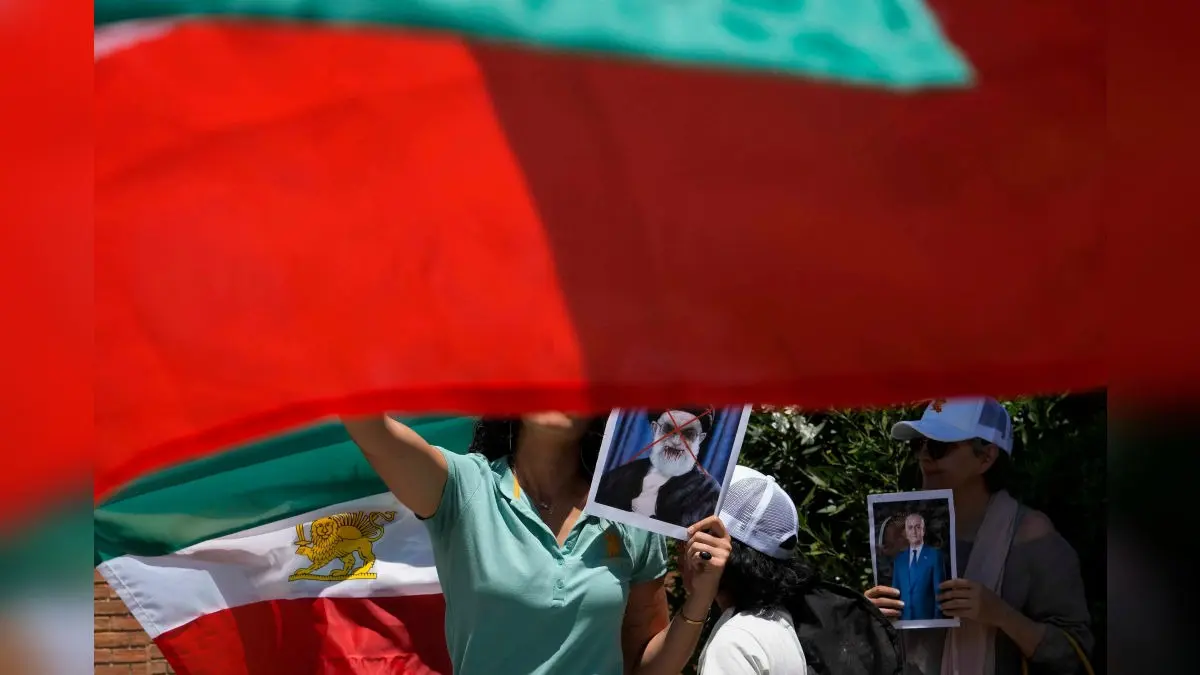
There comes a moment in the life of every oppressive regime when fear stops working. When hunger outweighs terror. When dignity becomes more valuable than survival. Iran has reached that moment.
For years, the people of Iran have lived under a system that perfected repression while hollowing out hope. Poverty is no longer merely an economic condition there; it is a weapon of governance. Inflation has crushed livelihoods, unemployment has stripped families of dignity, and corruption has ensured that whatever little remains flows upward - to the clerical elite, the security establishment, and the machinery of repression. Daily life for millions of Iranians is no longer about aspiration or progress; it is a relentless struggle for survival.
And when people have nothing left to lose, the balance of power shifts.
Fear, the most reliable tool of tyranny, collapses.
Advertisement
ALSO WATCH - How Pakistan Is Opening Doors for US Attack in Iran
A National Awakening
What we are witnessing today in Iran is not a protest. It is not unrest. It is not even a rebellion in the conventional sense. It is a collective awakening. A national conclusion reached not in conference rooms or political salons, but in kitchens without food, hospitals without medicine, and streets soaked in blood.
Advertisement
This is why there can be no outcome now short of revolution.
For decades, the world has been told to wait. Reform will come, we were assured. Dialogue will soften the regime, diplomats insisted. Appeasement would moderate the clerics, strategists claimed. Each of these theories has failed - not because the Iranian people lacked patience, but because the system itself is structurally not reformable. You cannot negotiate with a regime that survives only by crushing dissent. You cannot reform a system that treats brutality as doctrine.
The Architecture of Resistance
Unlike previous uprisings, this movement is not a reaction to a single spark - a rigged election, a brutal killing, or a social decree. It is the accumulation of decades of humiliation. It is organised, layered, and deeply rooted across the country. Networks quietly built over years - among students, workers, women, ethnic minorities, and even disillusioned insiders - are now active simultaneously.
This decentralisation is precisely why the regime has failed to contain the uprising.
There is no single leader to arrest. No headquarters to raid. No central command to dismantle. Instead, there are hundreds of localised centres of resistance, each guiding and mobilising its own community, each reinforcing the other. It is a structure born not of ideological luxury, but of hard-earned survival instincts. Iranians know too well what happens to centralised movements under tyranny.
The regime understands this reality. And because it cannot decapitate the movement, it has chosen extermination.
Mass killing has become its final instrument of survival.
According to reports cited by major international media outlets, the death toll is believed to be between 12,000 and 20,000 people. These are not speculative figures conjured by activists. They are supported by the steady stream of videos and images that continue to emerge despite a near-total internet blackout. That blackout itself is an admission of guilt - a calculated effort to hide mass killing from the world.
Silence in Iran today is not accidental. It is policy.
We have seen this script before. The same regime spent more than a decade propping up Syria’s ruler as his forces massacred over half a million civilians and displaced more than 13 million people. The world watched. It condemned. It expressed concern. And then it did nothing.
That failure was not neutral. It was enabling.
Today, Iran risks following the same path - this time against its own people. The same methods. The same indifference. The same deadly patience disguised as diplomacy.
World Must Act Decisively, Without Hypocrisy
Only days after imposing the internet blackout, the country’s supreme leader addressed the nation. His words were not conciliatory. They were chilling. He openly framed the uprising as something built on blood and made it clear that mass killing is necessary to preserve the regime. These were not rhetorical flourishes meant for domestic consumption. They were operational instructions, swiftly reflected in the actions of the armed forces on the streets.
Let us be clear: when a regime declares war on its own citizens, neutrality becomes complicity.
The Iranian people are resisting with extraordinary courage. Women confronting armed forces with bare hands. Young men standing their ground knowing full well they may never return home. Families burying their dead and returning to the streets the very next day. This is bravery of the highest order. But courage alone cannot stop bullets. Determination cannot neutralise tanks. Sacrifice does not disable drones.
This is where the international community must confront its own moral bankruptcy.
Statements will not stop the killing. Sanctions - long exhausted as a moral fig leaf - have already devastated ordinary citizens far more than the ruling elite. Diplomatic notes will not resurrect the dead. If the world genuinely believes in human rights, if it truly means “never again,” then it must act decisively and without hypocrisy.
Fear Has Died In Iran
The Iranian people need international military support.
Not tomorrow. Not after another round of talks. Not after another carefully worded resolution. Now.
Without credible intervention - protection of civilians, disruption of the regime’s killing apparatus, and the imposition of real consequences - the massacre will continue with impunity. History will not judge this moment by how carefully global powers balanced their geopolitical interests. It will judge it by how many lives they chose not to save.
Fear has died in Iran. Tyranny survives only because the world allows it to.
And history, as it always does, will remember who looked away