
‘Bharat Is A Reliable Power’: PM Modi Defines India’s Global Identity, Asserts India’s Role In Shaping Next 1000 Years
At the Republic Summit 2026, PM Modi stressed that Bharat positioned itself as “a reliable power” in the world, asserting “The world knows its nation first for India” and declaring with responsibility that India will write the future for the next 1000 years.
- Republic Summit
- 9 min read

;'%3e%3cpath%20d='m8,15.99c4.41,0,7.99-3.58,7.99-7.99S12.41,0,8,0,0,3.59,0,8s3.58,7.99,7.99,7.99Z'%20style='stroke:%23fff;%20stroke-miterlimit:10;%20stroke-width:.02px;'/%3e%3cpath%20d='m3.08,3.37l3.82,5.11-3.84,4.15h.87l3.37-3.64,2.72,3.64h2.94l-4.04-5.39,3.58-3.87h-.86l-3.1,3.35-2.5-3.35h-2.94Zm1.27.64h1.35l5.97,7.99h-1.35l-5.97-7.99Z'%20style='fill:%23fff;'/%3e%3c/g%3e%3c/svg%3e)


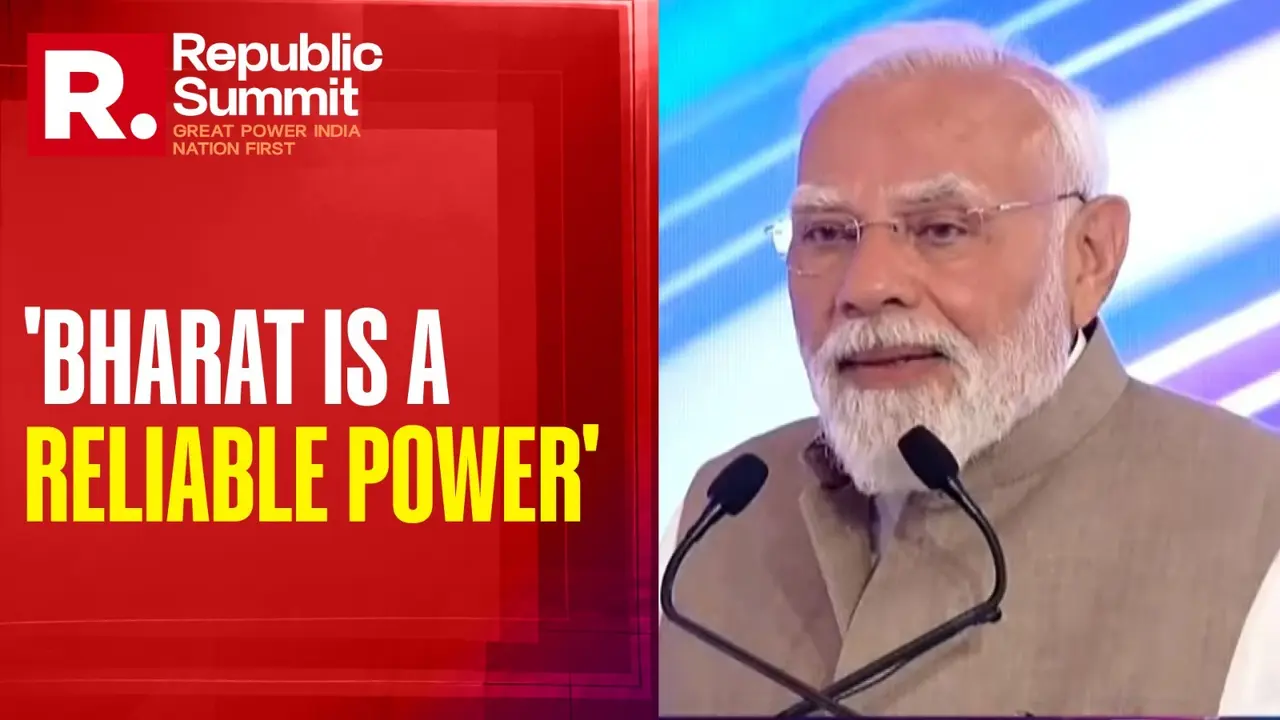
New Delhi: At the Republic Summit 2026, Prime Minister Narendra Modi has declared that while the world speaks of Bharat becoming a superpower or great power, the nation’s true identity lies in dependability. Addressing the annual summit of the Republic Media Network, PM Modi said, “Bharat is a reliable power", framing India’s strength around trust and consistency rather than labels of dominance.
The Prime Minister's remark at the nation's biggest summit of 2026 underlined a vision of leadership built on responsibility, not rhetoric.
PM Narendra Modi went on to outline how India’s priorities are already understood globally. “The world knows it's nation first for India," he asserted, pointing to a growing international recognition of the country’s ethos and values. In his view, the world now associates India first and foremost with its civilisational identity and approach to global challenges, rather than with transient political or economic trends.
PM Modi then extended the horizon of India’s ambition far beyond immediate policy cycles. Speaking with conviction, he stated, “I am saying this with lot of responsibility. India will write the future for the next 1000 years.” His comment positioned Bharat not merely as a participant in contemporary geopolitics, but as a civilisational force that will shape long-term global narratives through culture, innovation and governance.
Advertisement
From Superpower Talk To Reliable Power
The Prime Minister’s framing of a new adjective shifts the conversation from conventional power metrics to credibility. Terming Bharat a “reliable power”, he suggested that India’s influence will rest on keeping commitments, strengthening stability and offering a predictable partnership to other nations.
The phrasing distances India from the often-militaristic connotations of “superpower”, replacing them with an emphasis on steadiness and moral authority. The articulation aligns with Delhi’s recent diplomatic messaging that stresses developmental cooperation, digital public goods and climate responsibility as pillars of influence.
Advertisement
India’s Present Move Will Define Its Future
India’s choices in the present will define its trajectory for centuries to come, asserted PM Narendra Modi. Addressing the nation’s biggest summit of 2026 on Monday, the PM framed the country as a fast-growing, rising, and reliable economy whose civilisational depth sets it apart from nations driven solely by short-term calculations. He stressed that the decisions being taken now carry weight far beyond the electoral cycle, saying, “I say this with a deep sense of responsibility. What India is doing today will shape the future for the next thousand years.”
The Prime Minister contrasted India’s long-term vision with impulsive reactions to fleeting events, observing, “India is not a nation that reacts impulsively to fleeting events. We are the people who have both witnessed and endured the cycles of growth and destruction. We are a nation that carries the 'memory chip' of ages within its consciousness.”
He noted that he had just returned from the G7 Summit, where he felt global leaders had acknowledged this shift, saying, “Every world leader and nation fully understands that for the India of today, 'Nation First' is the supreme mantra and the guiding principle.”
Talking about the 12 years of the NDA government, PM Modi stated that the spirit of ‘Nation First’ had been the thread running through every major decision since 2014. “If you weigh all the achievements the country has had in the last 12 years on the scales, every decision, every step, every effort... at their core, the spirit of 'Nation First' is what remains at the centre,” he said.
He emphasised that from ‘Swachh Bharat’ to ‘Make in India’ and the push to buy khadi and local products, the citizens had placed the nation above self-interest. “For this, I salute the citizens of the country,” he said.
Middle Class Relief And Tax Reforms
The Prime Minister devoted a section of his address to the middle class, pointing to changes in taxation and healthcare costs. He recalled that in 2013-14, income above Rs 2 lakh attracted tax, placing a heavy burden on salaried families. “Today, income up to Rs 12 lakh per annum is exempt from tax, resulting in a substantial increase in tax-free income,” he said, adding that the GST reforms had simplified compliance.
“The introduction of GST reforms has also benefited the middle class by simplifying the tax process, saving both time and effort in tax filing. Individuals can now file their Income Tax Returns (ITR) from home with ease,” he added. On healthcare, he outlined ‘Jan Aushadhi Kendras’ for making diabetes and other medicines affordable.
“Healthcare, particularly expenses related to diabetes treatment, is a major concern for the middle class. Jan Aushadhi Kendras are addressing this issue by providing medicines at an 80% discount, leading to total savings of Rs 40,000 crore for the people,” he said.
Infrastructure Push And Aspirational Districts
The Prime Minister spoke at length about infrastructure upgrades meant to speed up growth, noting that the metro usage had risen sharply over the decade. “In 2014, approximately 28 lakh people traveled by metro each day. Today, that number has risen to about 1.28 crore daily commuters,” he said. High-speed rail and air connectivity have expanded, too.
“Additionally, Namo Bharat, Vande Bharat, and Amrut Bharat high-speed trains are now connecting different regions across the country. Not only this, over the past few years, the number of airports has doubled, providing greater opportunities for the middle class to travel by air,” he added.
He also spoke of the transformation of districts once labelled “backward”, saying, “I would like to discuss more than 100 districts and over 500 blocks that, for years, lagged behind on every development parameter. The previous governments had labelled these areas as backward regions. We undertook the challenge of transforming these regions, helping them rise above despair and igniting their aspirations for progress. To reflect this new approach, we renamed them aspirational districts and blocks. Today, these aspirational districts and blocks are driving the growth of the state.”
End Of Maoist Violence
Amidst the ongoing final phase of anti-Maoist operations in the country, PM Modi called the government’s campaign against Maoism a defining example of ‘Nation First’ in practice. He recalled that the tribal regions had been held back for decades, saying, “For decades, these areas were plagued by Maoist terrorism, which prevented the delivery of basic government amenities well into the 21st century. Successive governments and generations passed, yet hope remained elusive for the local population.”
Counting the efforts by his government to uproot the left-wing extremism, he painted a clear picture of what was done by the previous UPA government between 2004 and 2014 to counter Maoism, saying, “over 17,000 violent incidents occurred due to Maoist terrorism, resulting in the loss of more than 7,000 lives…..Maoist terrorism has been eradicated from these regions, a remarkable achievement that should not be underestimated." He linked the security turnaround to poverty reduction, noting, “Over the past few years, 25 crore poor people have overcome poverty, with aspirational districts playing a crucial role in this achievement."
During his address, PM Modi was critical of earlier Congress-led governments, accusing them of inaction. “Those who frequently brandish the Constitution these days: when they were in power, and people were shot dead for even mentioning the Constitution in Naxal-affected areas, they remained silent. The Constitution was nowhere to be seen in their hands back then; their hands were trembling. The Congress was largely indifferent to that harrowing situation. After 2014, we moved forward with a 'Nation First' spirit to transform the situation. We set out on this path,” he said.
“We didn't speak about it, nor did they make announcements, but they certainly took action. We resolved to root out Naxalism and Maoism completely. Today, the entire nation is witnessing the results; Maoist terror in the country is breathing its last,” the PM added.
PM Modi said that the strategy combined security with development and trust-building, saying, “Over the past 12 years, our government has constructed more than 12,000 km of roads there,” he said, recalling how machinery was once set ablaze and contractors driven away. “We often witnessed our road-construction machinery being set ablaze and contractors being driven away. If 25 people were working on a road, 200 police personnel had to provide security just to keep the work going. We did all this because we were determined. We installed over 9500 mobile towers. We extended mobile connectivity to nearly 45,000 villages. Over 1800 bank branches were opened in Naxal-affected districts, alongside the deployment of around 75,000 banking correspondents and the establishment of over 6,000 new post offices. We didn't rely solely on bombs, guns, and bullets; we dedicated every ounce of strength God gave us to winning over hearts,” the PM embedded.
He gave the example of a high-reward Maoist leader whose mother had never received a ration card until the state intervened. He stressed, saying, “The result is visible in places like Bastar, where instead of bombs and guns, the 'Bastar Olympics' is the talk of the town……Two editions of these games have already been held. Over 150,000 youths participated in the first edition, and nearly 400,000 in the second. In other words, where terror once prevailed, talent is now finding opportunities, and sports are flourishing.”
Entrepreneurship And Global Recognition
Turning to enterprise, Prime Minister Modi cited Zoho founder Sridhar Vembu, who was present at the Summit, recalling a recent visit to VivaTech in France. “There must have been around 1.5-2 lakh young people present. The French President and I were visiting various stalls to see the work done by these young innovators. We visited the Zoho stall. I was amazed and felt a sense of pride to see the crowd of European youth gathered there. They were eager to understand this new global phenomenon. Perhaps it hasn't been discussed as much in India as I witnessed in France,” he said.
He asserted that such examples showed what happens when entrepreneurs work with a ‘Nation First’ mindset and align goals with national needs.
Presented By: RP-Sanjiv Goenka Group | Co-Presented By: ZOHO & TVS Motor Company | Powered By: Sister Nivedita University | Co-Powered By: Kalyani & Bharat Forge Ltd, Samtel Avionics, Ravin Group and MeghaShrey, Ease My Trip | State Partners: UP Govt, Haryana Govt, Andhra Pradesh Govt, Uttarakhand Govt and Assam Govt | Housing Partner: Gaurs Group | Prayer Partner: Cycle Agarbatti | Skincare Partner: Dr Rashel | Knowledge Partner: Shardha University| Stainless Partner: Jindal Stainless | Vision Partner: Alcon | Special Partners: Sanskriti University, Gallantt Group, Pan Bahar, Krishna's Ayurveda, BackBay, Wagh Bakri, Ferns N Petals, Nandini and Mysore Sandals | Celebration Partner: Allied blenders and distillers