
From 17,000 Violent Incidents To Bastar Olympics: How PM Modi Got The Maoists To Turn In
At Republic Summit 2026, PM Modi stated that Maoist extremism is breathing its last, from 17,000 violent incidents and 7000 deaths in 10 years, to the installation of 9500 towers, 1800 banks and Bastar Olympics as proof of development replacing violence.
- Republic Summit
- 9 min read

;'%3e%3cpath%20d='m8,15.99c4.41,0,7.99-3.58,7.99-7.99S12.41,0,8,0,0,3.59,0,8s3.58,7.99,7.99,7.99Z'%20style='stroke:%23fff;%20stroke-miterlimit:10;%20stroke-width:.02px;'/%3e%3cpath%20d='m3.08,3.37l3.82,5.11-3.84,4.15h.87l3.37-3.64,2.72,3.64h2.94l-4.04-5.39,3.58-3.87h-.86l-3.1,3.35-2.5-3.35h-2.94Zm1.27.64h1.35l5.97,7.99h-1.35l-5.97-7.99Z'%20style='fill:%23fff;'/%3e%3c/g%3e%3c/svg%3e)


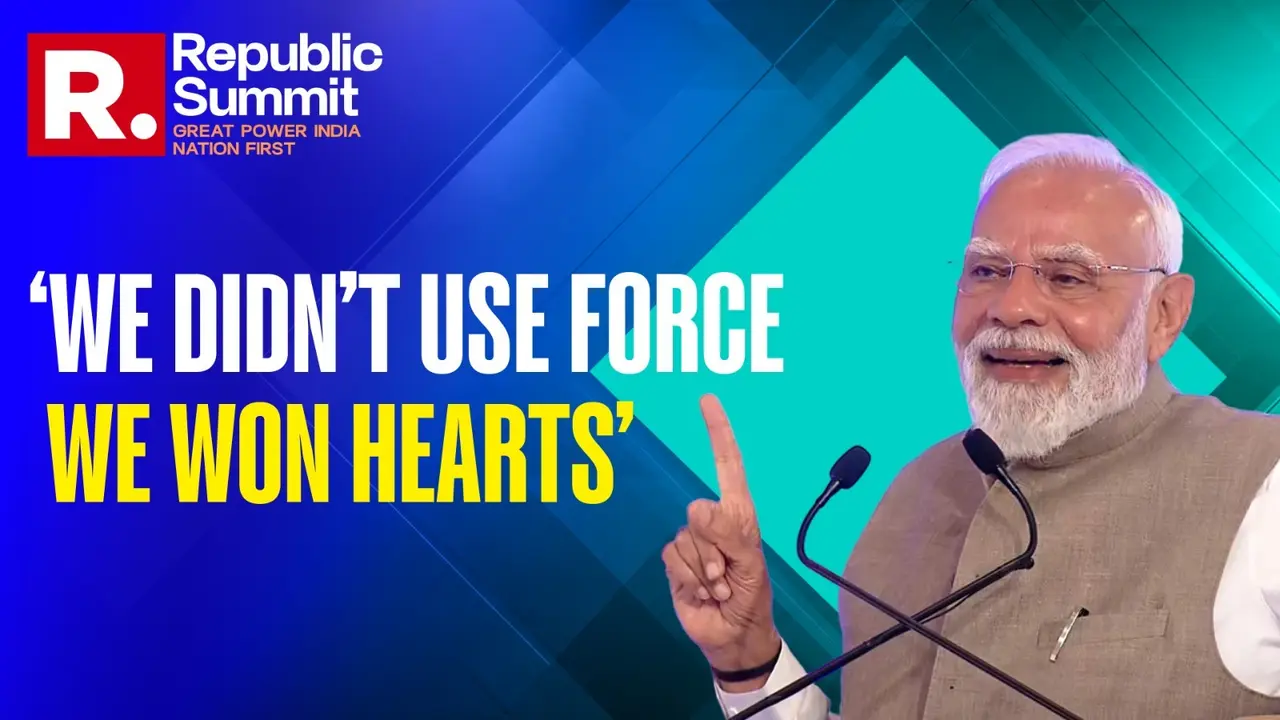
New Delhi: At the Republic Summit 2026 in Delhi, Prime Minister Narendra Modi delivered a detailed account of the government’s campaign against Maoism, insisting that the progress made in tribal regions was achieved through action rather than empty rhetoric. Addressing a packed hall at the Republic Summit 2026, PM Modi asserted that the government’s fight against Maoist extremism was built on decisive action, not just debate, stressing that the change visible in India’s tribal belts today is proof of what a “Nation First” approach can achieve.
He recalled that the left-wing extremism had held sway for decades in regions home to over 10 crore tribal citizens, blocking even the most basic services and making the presence of the state feel like a difficult idea.
The Prime Minister painted a picture of the years before 2014, when violence defined daily life in many forested districts. He noted that between 2004 and 2014, over 17,000 incidents linked to Maoist terror took place, costing around 7000 lives. “Governments came and went, and it felt as if the tragedy of violence would continue forever,” he said, adding that there were times when not a single government vehicle could enter certain areas. He stressed that what looks today like a brief news update is in fact the result of years of sustained effort and sacrifice.
PM Modi asserted that since 2014, the strategy shifted from rhetoric to resolve, saying, “We took action. We did not just speak, we did not just make announcements, we worked.” He stated that the objective was to uproot Maoism completely, claiming that the results are now visible across the country and that Maoist extremism is “breathing its last”. PM Modi emphasised that the transformation is not only about security operations but also about winning trust, expanding connectivity and giving local communities a stake in peace.
Advertisement
He underlined the scale of the challenge in process, noting that over 10 crore people live in India’s tribal areas, regions where left-wing extremism had taken deep root. “Even in the 21st century, these extremists did not allow basic facilities to reach these areas. There were times when the government could not even send a single vehicle into these regions,” he said, explaining how administrations changed, but the cycle of violence appeared unending.
Prime Minister Modi cited concerning figures to illustrate the pre-2014 situation, saying, “Between 2004 and 2014, more than 17,000 incidents of violence took place due to Maoist extremism, and around 7,000 lives were lost.” He stated that for decades, it seemed the tragedy would persist forever, with generations passing while Maoist terror remained entrenched. “Friends, today it might just be a one-line news item or a half-hour TV debate for you that Maoist terrorism has ended, but things do not happen that way; it requires immense dedication and sacrifice,” he added, framing the current gains as the result of sustained commitment.
Advertisement
Contrasting the past with the “Nation First” approach adopted after 2014, the PM asserted that the government did not limit itself to dialogue and announcements. “We took action. We did not just speak, we did not just make announcements, we worked. We resolved that we would uproot Naxalism and Maoism completely, and today the entire country is seeing the results. Today, Maoist extremism in the country is breathing its last,” he declared, presenting the decline of left-wing extremism as a visible outcome of that resolve.
From Violence To Development In Tribal Belts
The Prime Minister pointed out that defeating Maoism required more than security operations. “Only bombs, guns, and bullets were not used, friends. We worked to win people’s hearts. We utilized the strength that God had given us,” he said. Outlining that replacing fear with civic life was central to the strategy, he also pointed to Bastar as a symbol of change, noting that “today, you can see that in areas like Bastar, there is no longer the sound of bombs and guns; instead, there is the excitement of the Bastar Olympics. Where once there was terror, today talent is getting opportunities.”
He listed concrete infrastructure gains to back the claim, saying, “Friends, more than 9,500 mobile towers have been built. Earlier, even if a tower was not installed, they would destroy an installed tower because they always wanted to create fear. Connectivity has been provided in around 45,000 villages.”
He added that banking and postal networks had expanded sharply, “In Maoist-affected districts, more than 1,800 bank branches have been opened. Around 75,000 banking correspondents and more than 6,000 new post offices have been set up…..We did not work only with bombs and bullets, friends... With strong determination, we went to Maoist-affected areas to fulfil the hopes and aspirations of the common people.”
Constitution And Political Accountability
PM Modi also took aim at opposition parties over their record in Maoist-affected regions. “Today, some people keep talking about the Constitution, but when they were in power and in Naxal-affected areas, people were even shot for taking the name of the Constitution, and at that time, they remained silent. In those hands, the Constitution was not visible. In that painful situation, the Congress did not seem to care at all,” he said.
The remark tied the fight against Maoism to a bigger argument about constitutional values and governance accountability, suggesting that earlier silence contrasted with the current government’s emphasis on both security and development.
Here's What PM Modi Said:
“An example of what ‘Nation First’ impact looks like is our tribal regions. More than 10 crore population of India living in tribal areas, and we all know how Maoist extremism had entrenched itself there. Even in the 21st century, these extremists did not allow basic facilities to reach these areas. There were times when the government could not even send a single vehicle into these regions. Governments came and went, and it felt as if the tragedy of violence would continue forever. Between 2004 and 2014, more than 17,000 incidents of violence took place due to Maoist extremism, and around 7,000 lives were lost.”
“After 2014, in order to change the situation, we moved forward with the spirit of Nation First. We took action. We did not just speak, we did not just make announcements, we worked. We resolved that we would uproot Naxalism and Maoism completely, and today the entire country is seeing the results. Today, Maoist extremism in the country is breathing its last.”
“Today, some people keep talking about the Constitution, but when they were in power and in Naxal-affected areas, people were even shot for taking the name of the Constitution, and at that time they remained silent. In those hands, the Constitution was not visible. In that painful situation, the Congress did not seem to care at all.”
“Only bombs, guns, and bullets were not used, friends. We worked to win people’s hearts. We utilized the strength that God had given us.”
“Today, you can see that in areas like Bastar, there is no longer the sound of bombs and guns; instead, there is the excitement of the Bastar Olympics. Where once there was terror, today talent is getting opportunities.”
“Friends, more than 9,500 mobile towers have been built. Earlier, even if a tower was not installed, they would destroy an installed tower because they always wanted to create fear. Connectivity has been provided in around 45,000 villages. In Maoist-affected districts, more than 1,800 bank branches have been opened. Around 75,000 banking correspondents and more than 6,000 new post offices have been set up. We did not work only with bombs and bullets, friends... With strong determination, we went to Maoist-affected areas to fulfil the hopes and aspirations of the common people”
Presented By: RP-Sanjiv Goenka Group | Co-Presented By: ZOHO & TVS Motor Company | Powered By: Sister Nivedita University | Co-Powered By: Kalyani & Bharat Forge Ltd, Samtel Avionics, Ravin Group and MeghaShrey, Ease My Trip | State Partners: UP Govt, Haryana Govt, Andhra Pradesh Govt, Uttarakhand Govt and Assam Govt | Housing Partner: Gaurs Group | Prayer Partner: Cycle Agarbatti | Skincare Partner: Dr Rashel | Knowledge Partner: Shardha University| Stainless Partner: Jindal Stainless | Vision Partner: Alcon | Special Partners: Sanskriti University, Gallantt Group, Pan Bahar, Krishna's Ayurveda, BackBay, Wagh Bakri, Ferns N Petals, Nandini and Mysore Sandals | Celebration Partner: Allied blenders and distillers