
‘What India Does Today Will Shape Next 1,000 Years’: PM Modi Unveils Great Power Blueprint At Republic Summit
Prime Minister Narendra Modi unveiled a sweeping 1,000-year vision for India at Republic Summit 2026, declaring that decisions taken today will shape the country's future for the next millennium. He outlined a Nation First roadmap built on economic growth, governance reforms, infrastructure expansion, poverty reduction and global leadership.
- Republic Summit
- 8 min read

;'%3e%3cpath%20d='m8,15.99c4.41,0,7.99-3.58,7.99-7.99S12.41,0,8,0,0,3.59,0,8s3.58,7.99,7.99,7.99Z'%20style='stroke:%23fff;%20stroke-miterlimit:10;%20stroke-width:.02px;'/%3e%3cpath%20d='m3.08,3.37l3.82,5.11-3.84,4.15h.87l3.37-3.64,2.72,3.64h2.94l-4.04-5.39,3.58-3.87h-.86l-3.1,3.35-2.5-3.35h-2.94Zm1.27.64h1.35l5.97,7.99h-1.35l-5.97-7.99Z'%20style='fill:%23fff;'/%3e%3c/g%3e%3c/svg%3e)


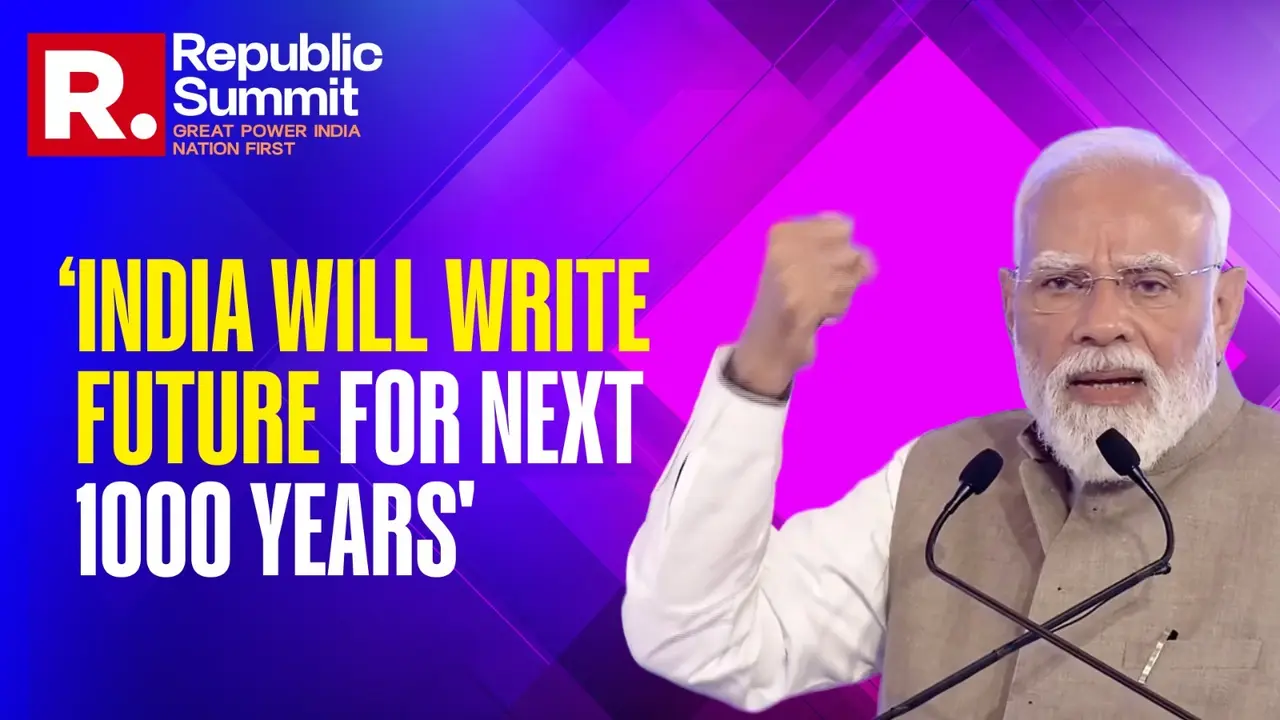
New Delhi: Prime Minister Narendra Modi on Monday outlined a long-term roadmap for India's rise as a global power, saying the decisions being taken today would shape the country's future for the next 1,000 years.
Addressing the Republic Summit 2026 on the theme “Great Power India: Nation First”, PM Modi said India was not only emerging as a fast-growing economy but also as a “credible” and “reliable” power, with the principle of Nation First guiding its development journey.
“We are a nation with the memory chip of millennia. What India is doing today will write the future of the next thousand years," the Prime Minister said, presenting his vision for a developed India driven by economic growth, infrastructure expansion, poverty reduction, technological innovation and national confidence.
'India Is A Rising & Reliable Power'
PM Modi argued that India's rise is fundamentally different from that of many emerging powers because it is rooted in trust, stability and long-term thinking.
Advertisement
"India is not only a fast-growing economy, it is also a credible economy," he said.
Describing India's growing global stature, he said, "Alongside being a rising power, India is also a reliable power."
Advertisement
The Prime Minister said world leaders increasingly viewed India through the prism of dependability and strategic consistency. Referring to his recent participation at the G7 Summit, PM Modi said there was a clear recognition among global leaders that "Nation First" remains India's guiding principle.
Nation First As The Foundation Of Great Power India
At the heart of PM Modi's speech was the assertion that India's rise as a great power cannot be measured solely through military, economic or technological indicators.
Drawing from the ancient maxim "Yato Dharmastato Jayah" (Where there is Dharma, there is victory), PM Modi said India's strength is anchored in duty, justice, equality, dialogue and compassion.
According to him, this ethos is reflected in the concept of "Nation First", which has shaped every major policy decision of the last 12 years.
From Swachh Bharat and Make in India to the promotion of khadi and local manufacturing, PM Modi argued that India's transformation has been driven by a collective national commitment rather than government action alone.
A New National Mindset
One of the most significant themes of the speech was what PM Modi described as a psychological transformation within India.
"The shift in mindset from 'this can never be done' to 'this will be done' is India's greatest achievement," he said.
The Prime Minister argued that the country has emerged from an era of pessimism and institutional paralysis into an era defined by confidence and aspiration.
According to PM Modi, this shift in public mindset may ultimately prove more consequential than any single infrastructure project or welfare scheme.
"Challenges will always remain. They change form. But when a nation believes 'it can be done and we will do it', dreams become reality," he said.
From Poverty Reduction To Aspirational India
As part of his blueprint for a developed India, PM Modi highlighted a massive social transformation over the last decade.
He pointed to government efforts in "aspirational districts" and "aspirational blocks", arguing that regions once labelled backward had been converted into engines of growth.
The Prime Minister said around 250 million people had moved out of poverty in recent years, creating what he called a new "neo-middle class".
According to PM Modi, poverty alleviation should not merely be viewed as welfare but as a strategy for economic expansion.
"When people emerge from poverty, they become consumers, entrepreneurs and contributors to growth. The entire nation benefits," he said.
Maoism To Development
PM Modi also used the speech to present the government's anti-Naxal campaign as an example of the Nation First approach in action.
He claimed Maoist violence was now in its final phase after years of sustained intervention.
"Maoist terrorism in India is counting its final breaths," he declared.
The Prime Minister highlighted infrastructure expansion in affected regions, including over 12,000 kilometres of roads, more than 9,500 mobile towers, banking facilities and postal networks.
He said the government's strategy combined security measures with welfare and development initiatives aimed at winning public trust.
Pointing to the transformation of Bastar, PM Modi noted that regions once associated with insurgency now host large-scale sporting events such as the Bastar Olympics, attracting lakhs of young participants.
The Middle-Class Growth Story
A significant portion of the speech focused on the middle class, which PM Modi described as a central pillar of India's growth story.
He highlighted reduced income tax burdens, expanded transport infrastructure, cheaper home loans, housing project completion, metro expansion and healthcare initiatives.
The Prime Minister noted that while taxable income stood at around Rs 2 lakh before 2014, incomes up to Rs 12 lakh are now tax-free.
He also cited savings generated through Jan Aushadhi medicine centres and healthcare schemes for senior citizens.
According to PM Modi, governance reforms have not only increased incomes but also enhanced savings and quality of life for middle-class families.
Technology, Innovation & The Next Frontier
Looking ahead, PM Modi argued that the next phase of India's rise would be driven by technology, innovation and entrepreneurship.
He praised Indian innovation on the global stage, citing his recent visit to France's VivaTech event where he witnessed strong international interest in Indian technology companies such as Zoho.
The Prime Minister urged startups, innovators and young entrepreneurs to focus on emerging opportunities created by global disruptions.
"India is now riding the Reform Express. This momentum will only accelerate," he said.
A Vision Beyond Political Cycles
Perhaps the most striking aspect of PM Modi's address was its timescale.
Unlike conventional political speeches focused on immediate electoral or policy goals, PM Modi repeatedly framed India's future in civilisational terms stretching across centuries.
His central argument was that India stands at a historic inflection point where present-day decisions will influence not just the next decade but the next millennium.
The speech sought to position India's rise as more than an economic story or geopolitical shift. Instead, PM Modi presented it as the re-emergence of a civilisation-state seeking to become a trusted, reliable and developed global power.
PM Modi expressed confidence that the dream of a developed India would be realised within the lifetime of the current generation.
"The collective efforts of 140 crore Indians will build a developed India. You will see this developed India with your own eyes," he said.
The message underscored the core theme of his address that India's journey to becoming a great power is not a distant aspiration, but a project already underway, one that could shape the next 1,000 years of history.