
10 Days, 1 Giant Leap: NASA’s Artemis II Crew Splashes Down After First Crewed Moon Voyage In Over 50 Years | Key Highlights
Artemis II Splashdown: Notably, it was a triumphant homecoming for the crew of four, whose record-breaking lunar flyby offered a rare double-spectacle including a firsthand view of the Moon's rugged far side and the breathtaking sight of a total solar eclipse from deep space.
- Science News
- 5 min read

;'%3e%3cpath%20d='m8,15.99c4.41,0,7.99-3.58,7.99-7.99S12.41,0,8,0,0,3.59,0,8s3.58,7.99,7.99,7.99Z'%20style='stroke:%23fff;%20stroke-miterlimit:10;%20stroke-width:.02px;'/%3e%3cpath%20d='m3.08,3.37l3.82,5.11-3.84,4.15h.87l3.37-3.64,2.72,3.64h2.94l-4.04-5.39,3.58-3.87h-.86l-3.1,3.35-2.5-3.35h-2.94Zm1.27.64h1.35l5.97,7.99h-1.35l-5.97-7.99Z'%20style='fill:%23fff;'/%3e%3c/g%3e%3c/svg%3e)


New Delhi: Humanity’s long-awaited return to the lunar vicinity reached a triumphant conclusion on Saturday, April 11, at 5:37 AM IST.
NASA’s Orion spacecraft, christened Integrity, splashed down safely in the Pacific Ocean, successfully marking the end of the historic 10-day Artemis II mission.
The mission, the first crewed voyage to the Moon since Apollo 17 in 1972, has paved the way for a permanent human presence on the lunar surface later this decade.
Notably, it was a triumphant homecoming for the crew of four, whose record-breaking lunar flyby offered a rare double-spectacle including a firsthand view of the Moon's rugged far side and the breathtaking sight of a total solar eclipse from deep space.
Advertisement
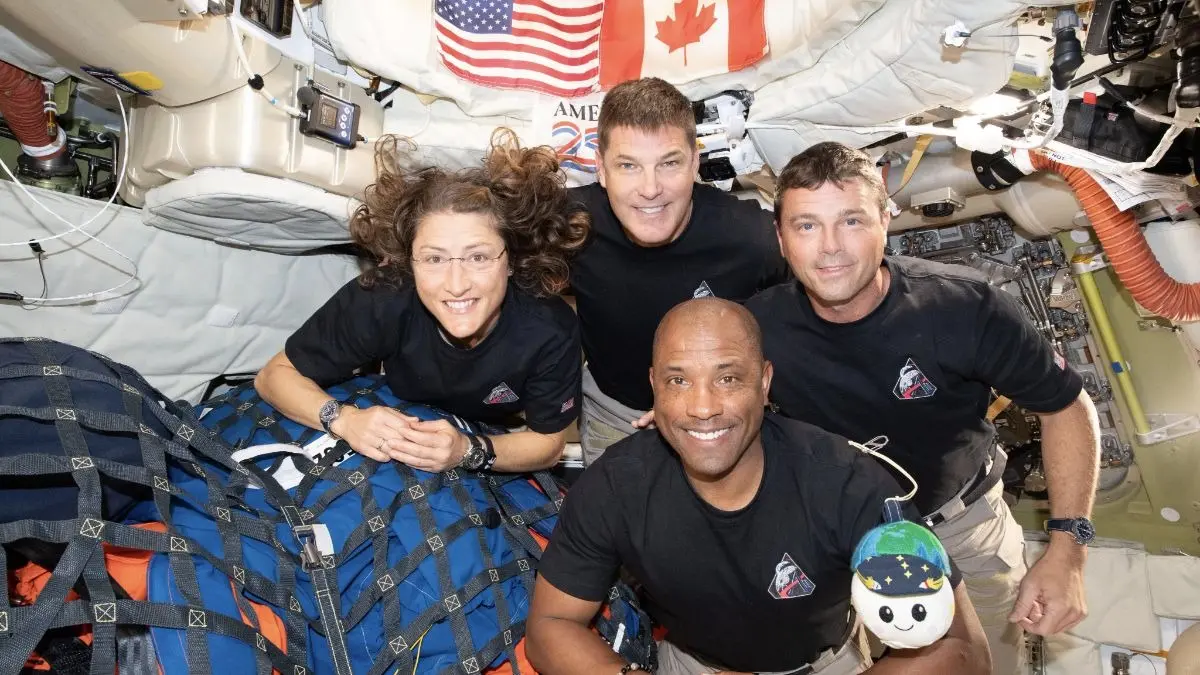
Commander Reid Wiseman, pilot Victor Glover, Christina Koch and Canada's Jeremy Hansen hit the atmosphere traveling Mach 33, or 33 times the speed of sound, a blistering blur not seen since NASA's Apollo moonshots of the 1960s and 1970s. Their Orion capsule, dubbed Integrity, made the plunge on automatic pilot.
Key Mission Highlights
The 10-day journey was more than just a "commute" to the Moon; it was a gruelling test of hardware and human endurance. Here are the defining moments:
Advertisement
Breaking Records: The crew- Commander Reid Wiseman, Pilot Victor Glover, and Mission Specialists Christina Koch and Jeremy Hansen- travelled farther from Earth than any human in history. They reached a maximum distance of 252,760 miles, surpassing the record set by the Apollo 13 crew by over 4,000 miles.
The Lunar Flyby: On April 6, Orion swung around the far side of the Moon, coming within 4,070 miles of the cratered surface. The astronauts became the first humans to see the lunar far side with their own eyes in over half a century.
A "Cosmic" Coincidence: During their transit, the crew witnessed a rare total solar eclipse from deep space, providing a perspective of the celestial event never before captured by human observers.
Emotional Tribute: In a touching moment on Monday, the crew proposed naming a previously unnamed lunar crater after Carroll Taylor Wiseman, the late wife of Commander Reid Wiseman, who passed away in 2020.
Testing "Integrity": The mission served as a live-fire test for Orion’s life-support systems, radiation shielding, and next-generation communication arrays. The crew even conducted manual piloting maneuvers to ensure they could take control of the spacecraft if automated systems failed.
The Fiery Homecoming
The final 13 minutes of the mission, often described as the most dangerous, saw the Integrity capsule hit the Earth's atmosphere at nearly 25,000 mph.
"There's a great blue hue to it. It's beautiful," Commander Wiseman radioed back as Earth filled the capsule's windows during the descent.
The spacecraft’s heat shield endured temperatures of 5,000°F before a sequence of 11 parachutes slowed the craft to a gentle 17 mph splashdown. Recovery teams from the USS John P. Murtha were on-site within minutes to retrieve the crew and the capsule.
As the crew heads back to Houston for a reunion with their families, they leave behind a new milestone in the history of exploration: proof that the path to the stars is once again open to all of humanity.
Other Challenges faced by the crew
Despite its rich scientific yield, the nearly 10-day flight was not without technical issues. Both the capsule's drinking water and propellant systems were hit with valve problems. In perhaps the most high-profile predicament, the toilet kept malfunctioning, but the astronauts shrugged it all off.
"We can't explore deeper unless we are doing a few things that are inconvenient," Koch said, "unless we're making a few sacrifices, unless we're taking a few risks, and those things are all worth it."
What's next now
Under the revamped Artemis program, next year's Artemis III will see astronauts practice docking their capsule with a lunar lander or two in orbit around Earth. Artemis IV will attempt to land a crew of two near the moon's south pole in 2028.