
‘Earth Was Just A Lifeboat’: Artemis II Astronauts Reveal Chilling Realisation, Struggle To Describe What They Saw
After flying farther than any human ever has, NASA’s Artemis II crew is back on Earth, but their words, choked with awe, hint at a journey that may have changed how we see humanity itself.
- Science News
- 4 min read

;'%3e%3cpath%20d='m8,15.99c4.41,0,7.99-3.58,7.99-7.99S12.41,0,8,0,0,3.59,0,8s3.58,7.99,7.99,7.99Z'%20style='stroke:%23fff;%20stroke-miterlimit:10;%20stroke-width:.02px;'/%3e%3cpath%20d='m3.08,3.37l3.82,5.11-3.84,4.15h.87l3.37-3.64,2.72,3.64h2.94l-4.04-5.39,3.58-3.87h-.86l-3.1,3.35-2.5-3.35h-2.94Zm1.27.64h1.35l5.97,7.99h-1.35l-5.97-7.99Z'%20style='fill:%23fff;'/%3e%3c/g%3e%3c/svg%3e)


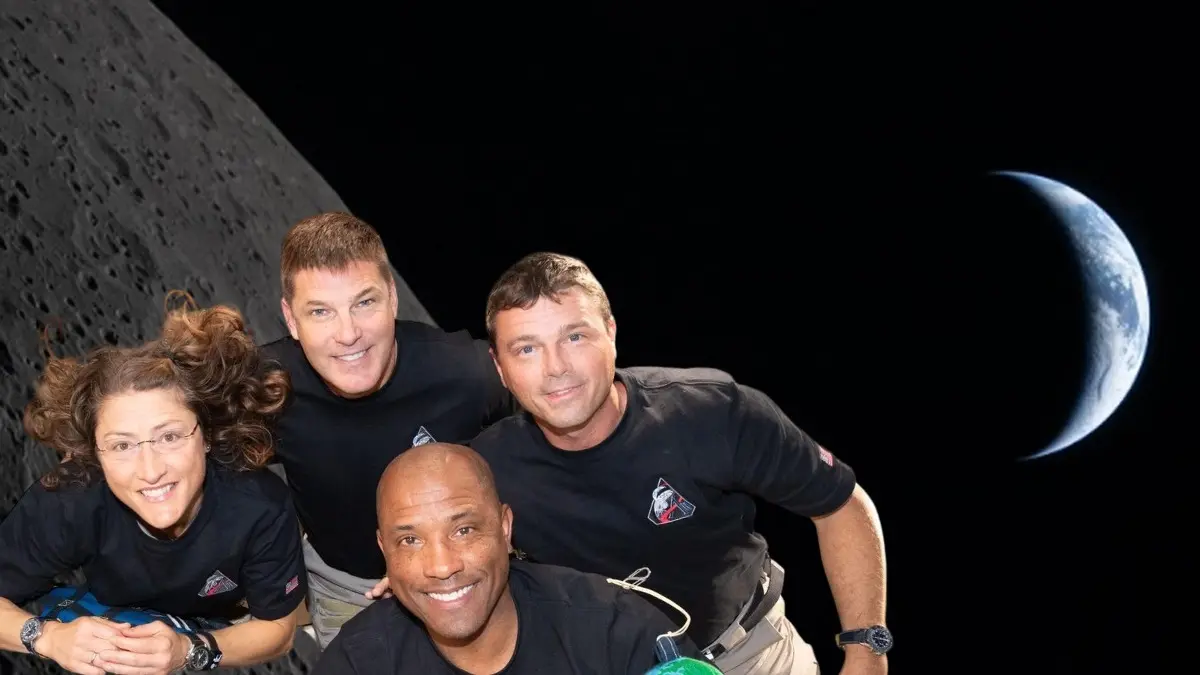
When NASA dropped a new episode of its Curious Universe podcast on X, it wasn’t just a mission recap. It was raw, unfiltered emotion from four astronauts, Reid Wiseman, Victor Glover, Christina Koch, and Jeremy Hansen, who’ve just done something no human has ever done.
They went farther than anyone in history. And came back… almost speechless.
“No one will ever know what we went through,” saying this, Commander Reid Wiseman didn’t try to sound poetic. He sounded overwhelmed.
“We are bonded forever… no one down here is ever going to know what the four of us just went through,” he added.
Advertisement
That “thing” was Artemis II: a 10-day journey aboard the Orion spacecraft Integrity, covering over 1.1 million kilometres, looping around the Moon and coming back through a fiery re-entry at about 35 times the speed of sound.
This wasn’t just a mission. It was a preview of humanity’s return to deep space.
Advertisement

Six Minutes Of Silence… Then A Breath Of Life
As Integrity slammed into Earth’s atmosphere, everything went dark. There were no signals, no communication, just six minutes of complete blackout. The mission control could only wait. Then, finally: “Houston, Integrity. We have you loud and clear.”
Moments later, parachutes burst open in the sky and the spacecraft splashed down safely into the Pacific Ocean. Inside: four astronauts, calm and composed, and forever changed.
“It’s too big to just be in one body,” Pilot Victor Glover perhaps said it best.
“The gratitude of seeing what we saw… it’s too big to just be in one body,” he said.
Even now, back on Earth, the crew admits they haven’t fully processed what they experienced.
Tiny Earth, Vast Darkness
For Christina Koch, the defining moment wasn’t just seeing Earth, it was everything around it.
“Earth was just this lifeboat… hanging in the universe. That realisation hit hard,” she said.
It’s the kind of perspective shift astronauts often talk about, but rarely with this kind of emotional weight.
“You’re not looking at us… you’re looking at yourselves,” mission specialist Jeremy Hansen turned the spotlight back on humanity.
Standing arm-in-arm with his crewmates, he said, “We are a mirror reflecting you… this is you.”
It wasn’t just a celebration of four astronauts. It was a message: exploration belongs to all of us.
From Spacefire To Homecoming Cheers
After surviving extreme heat, plasma and a high-speed descent, the crew was pulled from the capsule by Navy divers to cheers and fist bumps.
Back in Houston, they were greeted like heroes.
But even amid applause, Wiseman kept it real, “24 hours ago, Earth was that big out the window… and here we are. Still processing. Still human. This isn’t the end. It’s the beginning.”
Jared Isaacman made one thing clear, “Artemis II will always be remembered.”
But even that feels like an understatement.
Because as NASA pushes forward with its Artemis programme, aiming not just to return to the Moon, but to stay, this mission is just the relay baton being passed.
Or as one NASA leader put it, “The path to the lunar surface is open… but the work ahead is greater than the work behind us.”