
'From Japanese Cartoons to the Moon': NASA's Artemis III Crew Reveals Inspirations, Apollo Legacy And Prep Ahead Of Historic Mission
From childhood inspirations and favourite Apollo missions to the mental challenges of astronaut training, the crew reflected on what drives them as they prepare for one of the most complex human spaceflight missions in decades.
- Science News
- 4 min read

;'%3e%3cpath%20d='m8,15.99c4.41,0,7.99-3.58,7.99-7.99S12.41,0,8,0,0,3.59,0,8s3.58,7.99,7.99,7.99Z'%20style='stroke:%23fff;%20stroke-miterlimit:10;%20stroke-width:.02px;'/%3e%3cpath%20d='m3.08,3.37l3.82,5.11-3.84,4.15h.87l3.37-3.64,2.72,3.64h2.94l-4.04-5.39,3.58-3.87h-.86l-3.1,3.35-2.5-3.35h-2.94Zm1.27.64h1.35l5.97,7.99h-1.35l-5.97-7.99Z'%20style='fill:%23fff;'/%3e%3c/g%3e%3c/svg%3e)


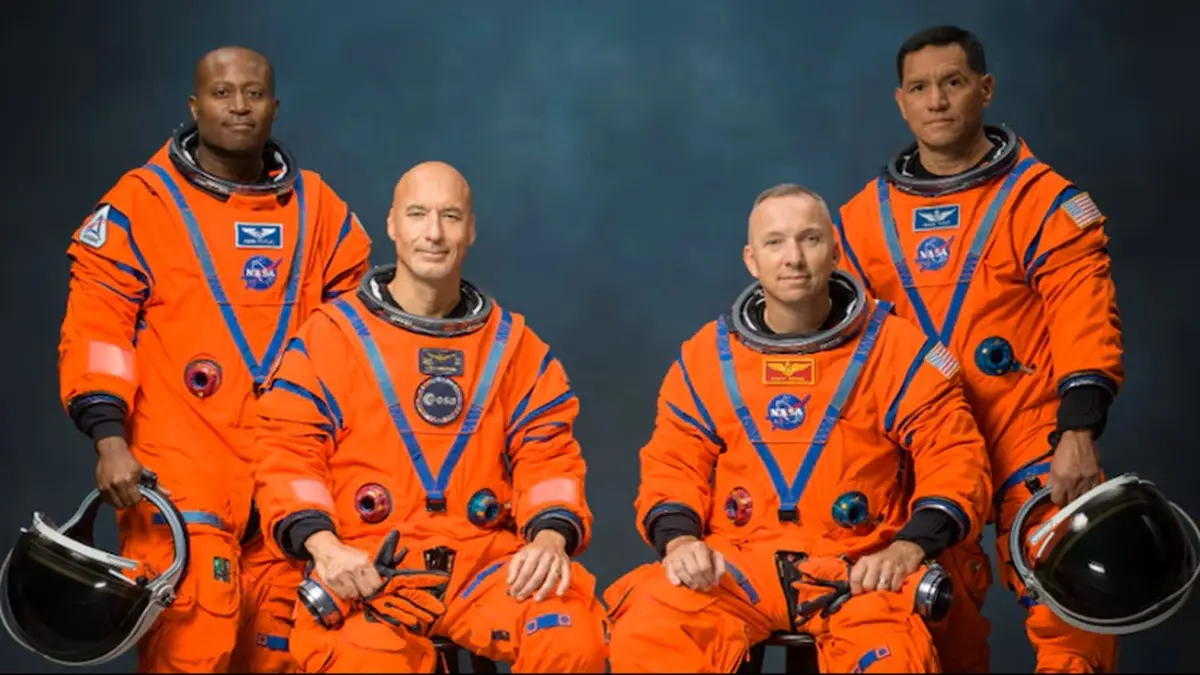
As NASA unveiled the four-member crew for the Artemis III mission, astronauts offered a more personal glimpse into their journey during a question-and-answer session shared on their official Instagram page.
From childhood inspirations and favourite Apollo missions to the mental challenges of astronaut training, the crew reflected on what drives them as they prepare for one of the most complex human spaceflight missions in decades.
The Artemis III mission, scheduled for 2027, will test critical technologies and spacecraft operations in Earth orbit before paving the way for Artemis IV, the first planned crewed mission to the Moon's South Pole in 2028.
'I Love Apollo 9': Luca Parmitano Picks 'Unusual' Mission
When asked about their favourite Apollo mission, European Space Agency astronaut Luca Parmitano surprised viewers by choosing Apollo 9 rather than the more widely celebrated Apollo 11 Moon landing mission.
Advertisement
"I may be unusual, but I love Apollo 9," the astronaut said.

Apollo 9, launched in 1969, played a crucial role in proving that the Lunar Module could operate independently in space, laying the groundwork for future Moon landings. The response highlighted the crew's appreciation for the technical milestones that made later achievements possible.
Advertisement
Commander Randy Bresnik chose Apollo 17, with others selecting 13 and an entire apollo mission.
Childhood Dreams Shaped By Cartoons
Answering a question on how the dream of becoming an astronaut began, European Space Agency astronaut Luca Parmitano revealed that inspiration came from an unexpected source.
"I can talk for five minutes about everything that inspired me. I grew up with Japanese cartoons in the eighties," the astronaut said.
The response underscored how dreams of space exploration often begin long before formal training, with popular culture, science fiction and childhood curiosity playing a significant role in shaping future astronauts.
Crew Reflects On Mental And Physical Preparation
Responding to a question about preparing mentally and physically for a mission of this scale, NASA mission specialists Andre Douglas emphasised resilience and maintaining enthusiasm despite challenges.
"Training is not easy and you're going to need to have that excitement when things don't go well with training," one astronaut explained.
Commander Randy Bresnik also shared his advice for school going children stating that you have to learn and practice it.
The crew stressed that while astronaut training is physically demanding, maintaining motivation and a positive mindset is equally important when dealing with setbacks and complex mission preparations.
Meet Artemis III Crew
NASA announced the following prime crew members for Artemis III:
- Randy Bresnik (NASA) – Commander
- Luca Parmitano (European Space Agency) – Pilot
- Andre Douglas (NASA) – Mission Specialist
- Frank Rubio (NASA) – Mission Specialist
- NASA astronaut Bob Hines will serve as the backup crew member.
The mission marks a historic milestone for Europe, with Parmitano becoming the first European Space Agency astronaut assigned to an Artemis mission.
What NASA Seeks To Achieve Through Artemis III
Unlike previous Artemis missions, Artemis III will focus on testing critical rendezvous and docking operations between NASA's Orion spacecraft and lunar lander systems being developed by Blue Origin and SpaceX.
The crew will launch aboard NASA's Space Launch System (SLS) rocket and spend approximately two weeks in space conducting a series of technology demonstrations and operational tests in Earth orbit.
NASA officials described the mission as a key step toward establishing a sustained human presence on the Moon and eventually sending astronauts to Mars.
How Is Artemis III Different
As per reports, the expanded role for commercial partners distinguishes Artemis III. Blue Origin will launch a prototype of its Blue Moon lander into low-Earth orbit, where the Orion crew will meet and dock with it to rehearse key operations. SpaceX will also participate, with its Starship human landing system taking part in similar docking tests. NASA stated that using live data from these encounters is the most effective way to validate the systems that will later support lunar landings, and the lessons learned will feed directly into planning for Artemis IV.
The experts stressed that the crew announcement carries weight beyond the headlines, as it confirms that mission design is sufficiently mature for advanced training and systems integration to begin. Artemis III for NASA represents a critical step in re-establishing a sustained human presence beyond Earth orbit. The flight will also serve as a benchmark for next-generation spacecraft, cross-agency collaboration with the European Space Agency, and the growing reliance on private industry to deliver hardware.
NASA’s long-term vision under Artemis extended beyond a single Moon landing, as the space agency is working toward a reusable transport system and infrastructure that can support a permanent lunar base, technologies that will later enable humans to push on to Mars. Artemis III now anchors the roadmap, connecting early test flights with future surface missions and shaping the next phase of human space exploration. The experts suggested that the success of the mission will set the stage for Artemis IV, currently targeted for a 2028 launch that looks to land astronauts on the Moon.