
ISRO Set to Launch 6,500 Kg Communication Satellite Built By USA Soon: Chairman
From a country which did not have satellite technology 50 years back, ISRO has, to date, launched 433 satellites of 34 countries using its own launch vehicles.
- Science News
- 3 min read

;'%3e%3cpath%20d='m8,15.99c4.41,0,7.99-3.58,7.99-7.99S12.41,0,8,0,0,3.59,0,8s3.58,7.99,7.99,7.99Z'%20style='stroke:%23fff;%20stroke-miterlimit:10;%20stroke-width:.02px;'/%3e%3cpath%20d='m3.08,3.37l3.82,5.11-3.84,4.15h.87l3.37-3.64,2.72,3.64h2.94l-4.04-5.39,3.58-3.87h-.86l-3.1,3.35-2.5-3.35h-2.94Zm1.27.64h1.35l5.97,7.99h-1.35l-5.97-7.99Z'%20style='fill:%23fff;'/%3e%3c/g%3e%3c/svg%3e)


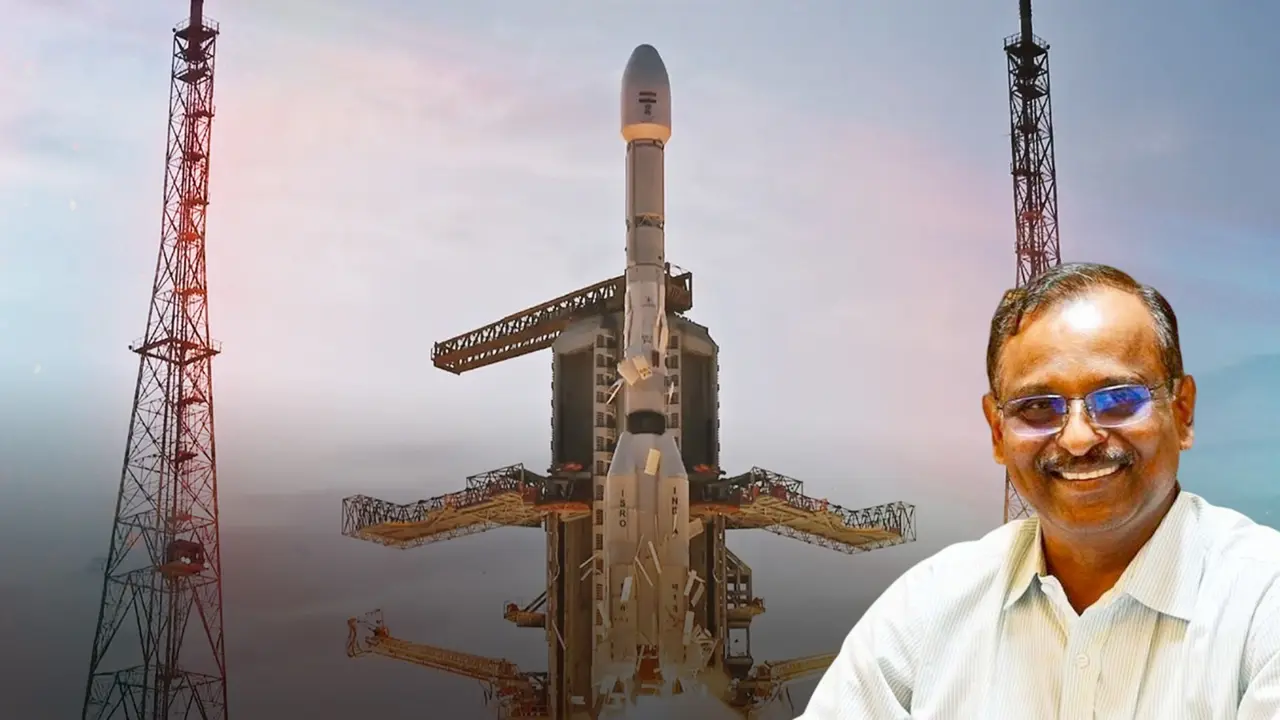
Chennai: ISRO is set to launch a 6,500 kg communication satellite built in the United States within the next two months, ISRO Chairman V. Narayanan announced on Sunday.
The announcement came shortly after the successful July 30 launch of NISAR, a joint NASA–ISRO Earth observation satellite, carried into orbit by ISRO’s GSLV-F16 rocket.
V. Narayanan, who also serves as Secretary in the Department of Space, made the announcement at the 21st Convocation of the SRM Institute of Science and Technology in Kattankulathur, where he was conferred an honorary Doctor of Science degree by Maharashtra Governor C.P. Radhakrishnan.
He opened his address by recalling ISRO’s modest beginnings in 1963, noting that India was “already lagging 6–7 years behind other technologically advanced nations.” In the same year, he said, “a tiny rocket was donated by the United States marking the beginnings of the Indian Space Programme. It was on November 21, 1963.”
Advertisement
Highlighting the progress since then, Narayanan cited ISRO’s 1975 achievement of demonstrating “mass communication” using U.S.-provided satellite data by placing 2,400 television sets in 2,400 villages across six Indian states. “From that (kind of humble beginnings), the 30th of July was a historical day for Indian space programme,” he said.
Speaking about NISAR, he described it as “the costliest satellite ever built in the world,” equipped with an L-Band SAR payload from the USA and an S-Band payload from ISRO, placed into orbit “precisely” by an Indian launcher. “And today, we are shoulder to shoulder with advanced countries,” he added, noting NASA’s praise for the accuracy of the GSLV-F16/NISAR mission.
Advertisement
“In another couple of months, a country which received a tiny rocket from the United States, is going to launch a 6,500 kg communication satellite built by the America using our own launcher from Indian soil. What a significant growth it is,” Narayanan remarked. He pointed out that ISRO has so far launched 433 satellites from 34 countries using its own launch vehicles.
What Do We Know About NISAR?
NISAR represents a pioneering collaboration between NASA and ISRO, marking the first dual-frequency radar imaging mission of its kind. The 2,392-kilogram satellite carries advanced L-band and S-band Synthetic Aperture Radar systems designed to capture high-resolution observations of Earth's surface.
The mission will provide comprehensive data on land and ice deformations, ecosystem changes, and oceanic patterns, with a revisit cycle of 12 days to monitor dynamic environmental processes.
The satellite's configuration combines technological contributions from both space agencies. ISRO has developed the S-band radar system, spacecraft bus, and launch vehicle, while NASA has provided the L-band radar and large deployable antenna system. During its five-year operational life, NISAR will follow a sun-synchronous polar orbit at 747 kilometers altitude, systematically mapping the planet's surface with unprecedented detail.
Following its launch, the satellite will undergo a crucial 90-day commissioning phase before commencing full scientific operations. This period will be dedicated to system checks, instrument calibration, and performance validation to ensure optimal functionality of the sophisticated radar systems.