
Can Mission ShakthiSAT Produce India's Next Kalpana Chawla? Inside The Moon Mission Training Young Girls
Mission ShakthiSAT is more than a student space programme. Here's how the world's first all-girls lunar CubeSat mission is training young girls in satellite engineering, preparing India's future space scientists and inspiring the next Kalpana Chawla.
- Science News
- 4 min read

;'%3e%3cpath%20d='m8,15.99c4.41,0,7.99-3.58,7.99-7.99S12.41,0,8,0,0,3.59,0,8s3.58,7.99,7.99,7.99Z'%20style='stroke:%23fff;%20stroke-miterlimit:10;%20stroke-width:.02px;'/%3e%3cpath%20d='m3.08,3.37l3.82,5.11-3.84,4.15h.87l3.37-3.64,2.72,3.64h2.94l-4.04-5.39,3.58-3.87h-.86l-3.1,3.35-2.5-3.35h-2.94Zm1.27.64h1.35l5.97,7.99h-1.35l-5.97-7.99Z'%20style='fill:%23fff;'/%3e%3c/g%3e%3c/svg%3e)


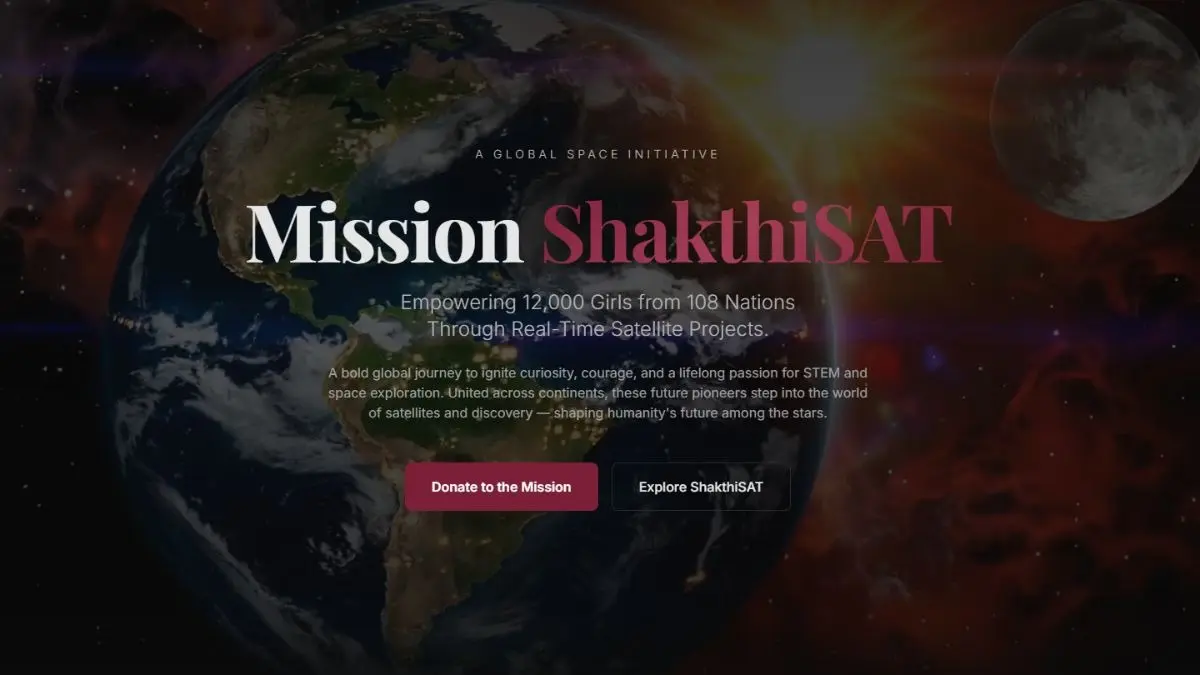
New Delhi: Four decades after Kalpana Chawla inspired millions of Indians to dream beyond the skies, another generation of young girls is being trained to think even bigger. This time through a mission that aims to put a student-built CubeSat around the Moon.
Mission ShakthiSAT, billed as the world's first global all-girls lunar CubeSat mission, is emerging as much more than a space education programme. It is an ambitious attempt to nurture the next generation of women scientists, engineers and innovators who could shape India's future space missions.
The programme has already attracted nearly 12,000 registrations from 108 countries, with only a select group of students making the cut. Among them are 20 girls from India, including 14-year-old Kandula Jessie, a Class 10 student from Andhra Pradesh's Dhavaleswaram, whose journey from a government school classroom to a global lunar mission has become a symbol of the opportunities now opening up for young girls in STEM.
Why Mission ShakthiSAT Matters
Unlike conventional science competitions, Mission ShakthiSAT exposes school students to the kind of technologies typically encountered only in engineering colleges or research institutions.
Advertisement
Participants undergo nearly 550 learning sessions spread across 21 modules covering satellite systems, thermodynamics, propulsion, payload development, electronics and mission operations.
The next phase, beginning in New Delhi on August 23, will move beyond classrooms as students receive practical training from scientists before working towards the CubeSat mission scheduled for launch from Sriharikota on October 11.
Advertisement
For India, the programme represents a unique experiment in creating a talent pipeline years before students even enter college.
Building Tomorrow's Space Workforce
India's space ambitions have expanded dramatically over the past few years. Following the success of Chandrayaan-3, ISRO is preparing for the Gaganyaan human spaceflight mission while also working towards an Indian space station and a crewed Moon mission in the coming decades.
Such ambitious goals will require thousands of highly skilled scientists, aerospace engineers, software developers and satellite specialists.
Identifying talent early and giving students exposure to advanced technologies during school can play a crucial role in building that workforce.
Mission ShakthiSAT attempts to do precisely that by allowing teenagers to work on real-world satellite concepts rather than limiting learning to textbooks.
Breaking Barriers In STEM
Women's participation in science, technology, engineering and mathematics (STEM) continues to remain lower than desired across many high-technology sectors.
By focusing exclusively on girls, Mission ShakthiSAT seeks to encourage students to pursue careers that have traditionally seen lower female representation.
Jessie's own story reflects that vision.
The daughter of a carpenter, she balanced Class 10 board preparations with demanding online sessions covering advanced aerospace concepts. She also worked on improving her English communication skills before appearing for interviews with international scientists.
Her selection demonstrates that access to opportunities, not economic background, can determine how far talent travels.
Govt Schools Can Produce Global Talent
Another significant takeaway from the programme is the growing role of government schools in nurturing innovation.
Jessie was encouraged by her teachers at the school's Atal Tinkering Lab, where her interest in science was first identified. The initiative not only helped her compete globally but also encouraged several other girls from the school to apply.
It reinforces the idea that with the right mentorship, laboratories and exposure, students from modest backgrounds can compete alongside peers from across the world.
Can India Find Its Next Kalpana Chawla?
No one can predict whether today's participants will become tomorrow's astronauts or ISRO scientists.
But programmes like Mission ShakthiSAT are planting the seeds early.
Whether these students eventually design satellites, lead lunar missions or contribute to India's human spaceflight programme, the initiative has already achieved something significant. It has expanded the horizons of thousands of young girls who now see space not as an impossible dream, but as a realistic career.
If even a handful of these students go on to shape India's future in space exploration, Mission ShakthiSAT may one day be remembered not merely as an educational programme, but as the launchpad that helped create India's next generation of scientists.