
NASA’s Stunning Pinwheel Galaxy Image: Hubble-Webb Join Forces To Capture Cosmic Spiral
NASA released a breathtaking new image of the Pinwheel Galaxy, captured by the Hubble and James Webb telescopes. Located 25 million light-years away, the giant spiral galaxy is 170,000 light-years wide and holds nearly one trillion stars. Cosmic Powerhouse: NASA’s Pinwheel Galaxy Dazzles in New Hubble-Webb Collaboration
- Science News
- 2 min read

;'%3e%3cpath%20d='m8,15.99c4.41,0,7.99-3.58,7.99-7.99S12.41,0,8,0,0,3.59,0,8s3.58,7.99,7.99,7.99Z'%20style='stroke:%23fff;%20stroke-miterlimit:10;%20stroke-width:.02px;'/%3e%3cpath%20d='m3.08,3.37l3.82,5.11-3.84,4.15h.87l3.37-3.64,2.72,3.64h2.94l-4.04-5.39,3.58-3.87h-.86l-3.1,3.35-2.5-3.35h-2.94Zm1.27.64h1.35l5.97,7.99h-1.35l-5.97-7.99Z'%20style='fill:%23fff;'/%3e%3c/g%3e%3c/svg%3e)


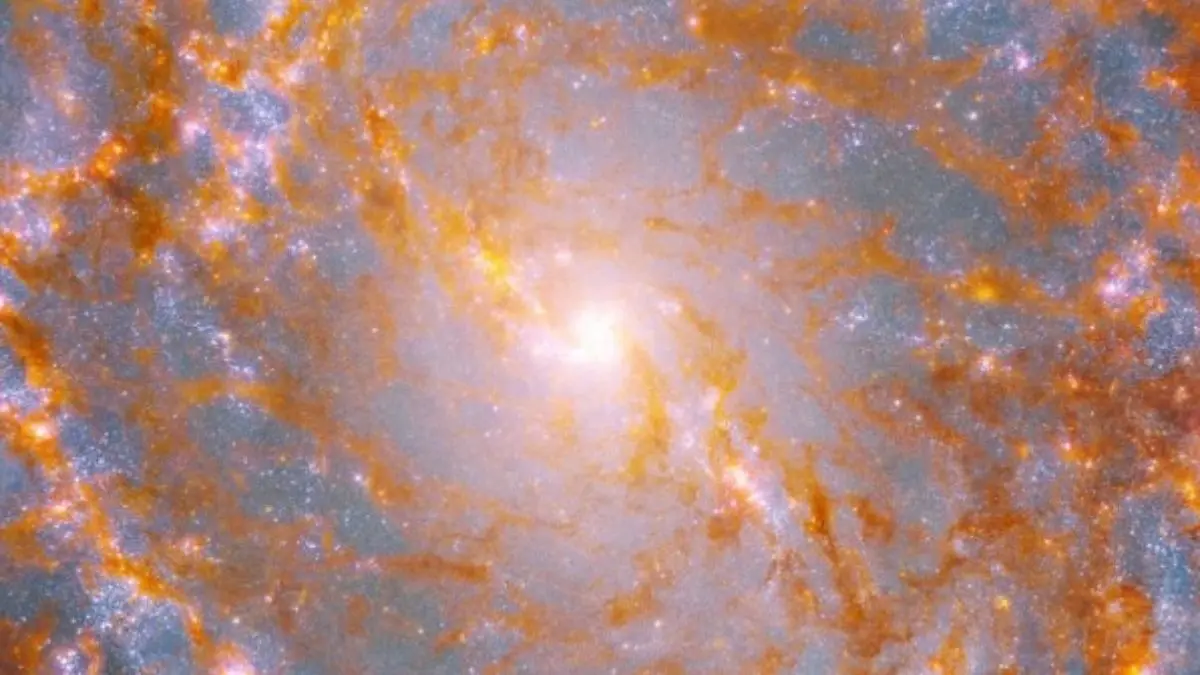
NASA has unveiled a breathtaking new view of the famous Pinwheel Galaxy (Messier 101), showcasing the combined technological might of the Hubble Space Telescope and the James Webb Space Telescope (JWST).
This composite image, a masterclass in multi-wavelength astronomy, offers an unprecedented look at the intricate face-on spiral structure that has fascinated observers since its discovery in 1781.
Located approximately 25 million light-years away in the constellation Ursa Major, M101 is a behemoth of the cosmos.
Spanning nearly 170,000 light-years across, almost twice the diameter of our own Milky Way, it is estimated to contain at least one trillion stars.
Advertisement
While Hubble has famously captured this galaxy in visible light before, the integration of Webb’s infrared data has peeled back layers of cosmic dust to the galaxy's skeleton.
A Symphony of Light
The new release highlights the complementary strengths of NASA’s premier observatories:
Advertisement
1. Hubble’s Contribution:
Utilising ultraviolet and visible light data, Hubble highlights the hot features. Brilliant blue clumps indicate massive clusters of young, hot stars, while the yellowish core reveals the dense population of older stars.
2. Webb’s Contribution:
Looking through the near- and mid-infrared spectrum, Webb captures the glow of polycyclic aromatic hydrocarbons (PAHs), complex, carbon-based molecules that act as the smallest dust grains in space. These grains trace the dark, winding dust lanes that define the galaxy's spiral arms.
Scientific Significance
This isn't just a pretty picture; it’s a vital tool for understanding galactic evolution. By combining these datasets, astronomers can track the entire life cycle of stars.
Hubble identifies where the stars are currently shining, while Webb identifies the nurseries, the cold, dense clouds of molecular hydrogen where gravity is just beginning to pull matter together to ignite new suns.
Furthermore, the Pinwheel Galaxy’s "face-on" orientation provides a perfect laboratory for studying spiral density waves.
These are the gravitational ripples that compress gas and dust as they sweep through the disk, triggering the star-forming regions that give the galaxy its namesake "pinwheel" shape.
As the James Webb Space Telescope continues its third year of high-productivity science in 2026, collaborations like this serve as a reminder that the most profound secrets of the universe are often found by looking at the same object through different eyes.
This stunning cosmic wheel stands as a testament to humanity's reaching into the dark, turning cold data into a vivid map of our celestial neighbourhood.