
NASA’s Parker Solar Probe Captures Closest-Ever Footage of the Sun’s Atmosphere, Just 3.8 Million Miles Away
NASA has released breathtaking new footage from its Parker Solar Probe, which flew 3.8 million miles from the Sun’s surface. The probe captured stunning live visuals from inside the Sun’s corona, the outermost part of its atmosphere.
- Science News
- 2 min read

;'%3e%3cpath%20d='m8,15.99c4.41,0,7.99-3.58,7.99-7.99S12.41,0,8,0,0,3.59,0,8s3.58,7.99,7.99,7.99Z'%20style='stroke:%23fff;%20stroke-miterlimit:10;%20stroke-width:.02px;'/%3e%3cpath%20d='m3.08,3.37l3.82,5.11-3.84,4.15h.87l3.37-3.64,2.72,3.64h2.94l-4.04-5.39,3.58-3.87h-.86l-3.1,3.35-2.5-3.35h-2.94Zm1.27.64h1.35l5.97,7.99h-1.35l-5.97-7.99Z'%20style='fill:%23fff;'/%3e%3c/g%3e%3c/svg%3e)


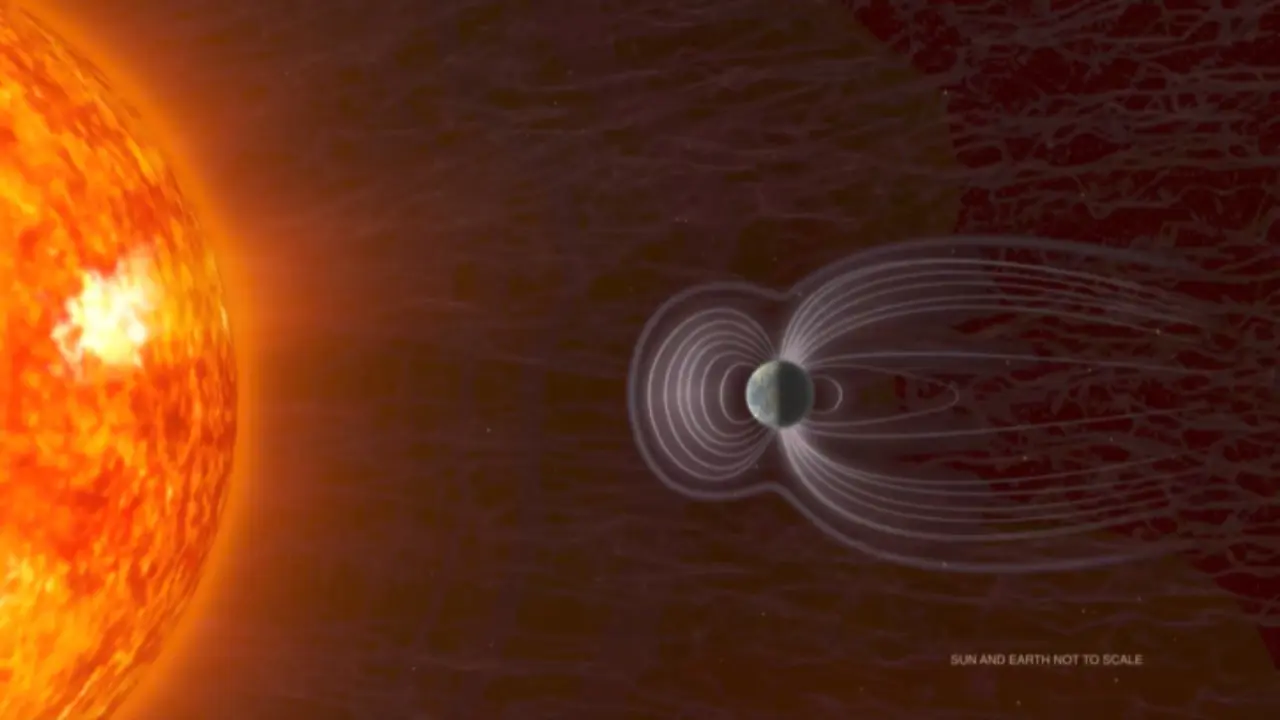
Science: NASA has released breathtaking new footage from its Parker Solar Probe, which flew just 3.8 million miles from the Sun’s surface on December 24, 2024—closer than any spacecraft in history.
NASA's Closest-Ever Footage of the Sun’s Atmosphere
The probe captured live visuals from inside the Sun’s corona (the outermost part of its atmosphere), offering a mysterious look at the origins of solar winds and coronal mass ejections (CMEs).
What the Footage Reveals?
The probe’s Wide-Field Imager for Solar Probe (WISPR) camera recorded Kelvin-Helmholtz instabilities showing wave-like patterns formed by colliding solar flows, which was previously only a theory.
Scientists observed CMEs merging in real time, helping decode how space weather forms and intensifies.
Advertisement
The footage shows solar wind particles accelerating and magnetic switchbacks, zigzagging fields that may explain why the corona is hotter than the Sun’s surface.
NASA’s Parker Solar Probe
Why It Matters
Solar winds can disrupt satellites, GPS, radio signals, and even power grids on Earth.
Advertisement
Understanding their behavior helps build early-warning systems for space weather threats.
The probe’s survival through 1,300°C heat and intense radiation is hailed as a historic engineering feat.
Parker's Next Fly
Parker’s next flyby is scheduled for September 15, 2025, where it will venture even closer to the Sun.
Scientists are now hopeful to further discover the mystery of slow Vs fast solar winds, and how they interact to trigger geomagnetic storms.