
24 Hours Minus 1 Second in World Clock? How July 9, Human History's Shortest Day, Will Affect Global Timekeeping
On July 9, 2025, Earth may experience its shortest day ever, with the Moon’s position speeding up the planet’s rotation by about 1.3-1.6 milliseconds.
- Science News
- 2 min read

;'%3e%3cpath%20d='m8,15.99c4.41,0,7.99-3.58,7.99-7.99S12.41,0,8,0,0,3.59,0,8s3.58,7.99,7.99,7.99Z'%20style='stroke:%23fff;%20stroke-miterlimit:10;%20stroke-width:.02px;'/%3e%3cpath%20d='m3.08,3.37l3.82,5.11-3.84,4.15h.87l3.37-3.64,2.72,3.64h2.94l-4.04-5.39,3.58-3.87h-.86l-3.1,3.35-2.5-3.35h-2.94Zm1.27.64h1.35l5.97,7.99h-1.35l-5.97-7.99Z'%20style='fill:%23fff;'/%3e%3c/g%3e%3c/svg%3e)


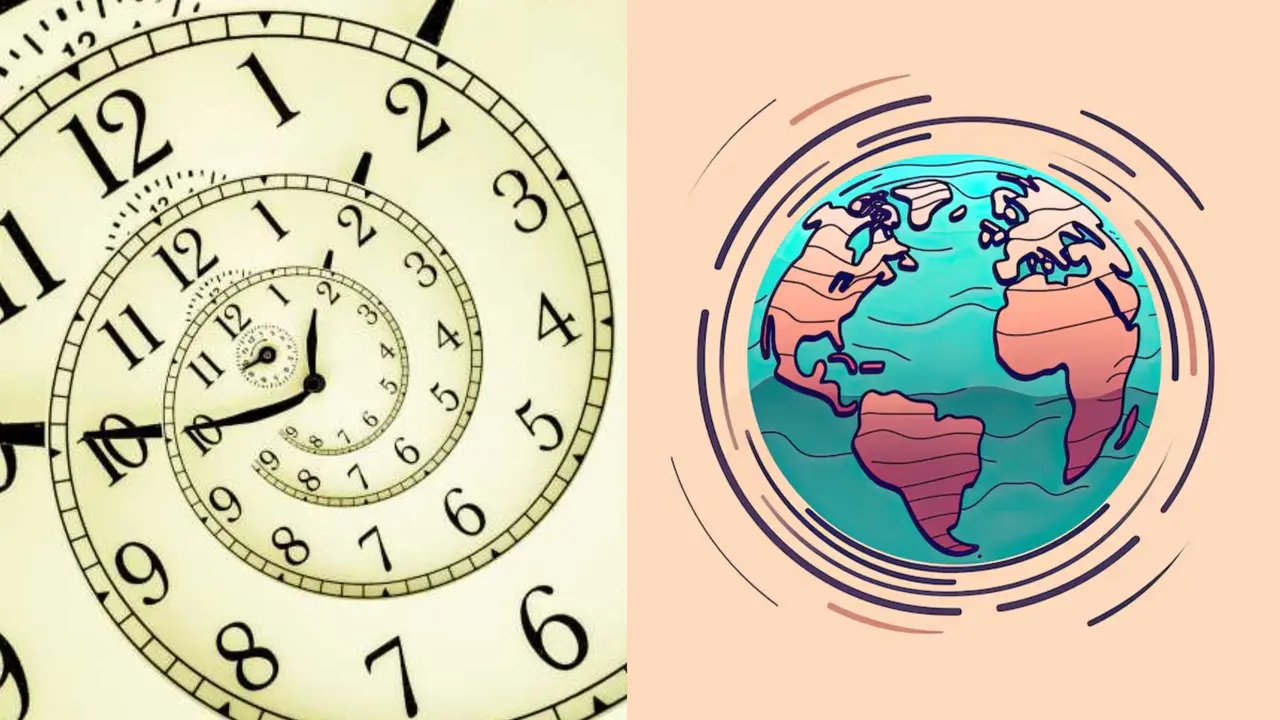
The Earth is currently rotating faster than usual, thanks to the gravitational influence of the moon, which is positioned in a way that subtly affects the Earth's spinning speed. Experts believe this acceleration will result in July 9, 2025, being the shortest day in human history.
Recent studies indicate that this day will be approximately 1.3 to 1.6 milliseconds shorter than the standard 24-hour cycle.
Not The First Time Earth Has Sped Up?
Natural factors such as seasonal variations, seismic activity, the moon's positioning, and even the melting of glaciers can all affect the Earth's rotational speed. Even slight changes in the Earth's spinning speed can be detected using advanced atomic clocks and space-based monitoring systems.
Recently, advanced technology has once again identified a change in the Earth’s rotation. This is not the first instance of this phenomenon; according to the International Earth Rotation and Reference Systems Service (IERS), July 9th marks the sixth time since 2020 that the Earth's rotation has noticeably sped up.
Advertisement
Additionally, it has been predicted that July 22 and August 5 will be slightly shorter than usual.
One Second to Be Removed from the World Clock
As Earth prepares for the shortest day in human history, scientists will need to make adjustments to global timekeeping in the near future.
Advertisement
When Earth spins faster, maintaining the accuracy of our clocks becomes a challenging task. A rare correction known as a "negative leap second" might be introduced to keep pace with the planet's increased rotation speed. This means that one second will be removed from the world clock to align with Earth's faster movement.
Media reports suggest that this adjustment is expected to take place for the first time in 2029.
Global timekeeping requires a high level of precision. Ducan Agnew, a geophysicist at the University of California, San Diego, emphasized that while this change is not harmful, it is scientifically significant. He described the situation as highly unusual and highlighted that this adjustment illustrates the need for precision in global timekeeping.