
Red Auroras Over Hanle Explained: What Caused Ladakh’s Crimson Night Sky
A powerful solar storm, one of the strongest in over 20 years, caused rare red auroras by disturbing Earth's magnetic field and allowing solar particles deep into the atmosphere.
- Science News
- 2 min read

;'%3e%3cpath%20d='m8,15.99c4.41,0,7.99-3.58,7.99-7.99S12.41,0,8,0,0,3.59,0,8s3.58,7.99,7.99,7.99Z'%20style='stroke:%23fff;%20stroke-miterlimit:10;%20stroke-width:.02px;'/%3e%3cpath%20d='m3.08,3.37l3.82,5.11-3.84,4.15h.87l3.37-3.64,2.72,3.64h2.94l-4.04-5.39,3.58-3.87h-.86l-3.1,3.35-2.5-3.35h-2.94Zm1.27.64h1.35l5.97,7.99h-1.35l-5.97-7.99Z'%20style='fill:%23fff;'/%3e%3c/g%3e%3c/svg%3e)


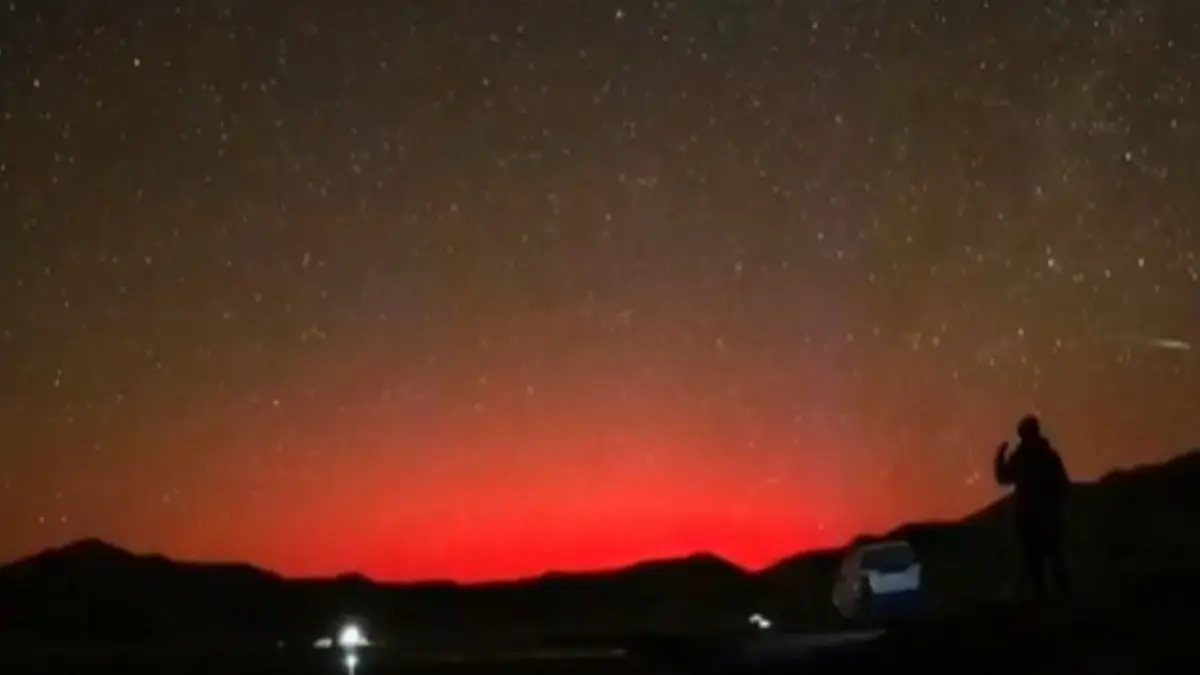
New Delhi: People across the world have always been drawn to the sky, as it touches something deep within the human soul. From ancient paintings and poems to modern photographs, it long held a special place in human imagination. That fascination turned into awe over Hanle in Ladakh last week, when rare red auroras lit up the night sky following the most intense solar storm since 2003.
A rare crimson glow over Ladakh
The night sky over Hanle, known for its calm and predictable conditions, turned an unusual shade of red on the nights of January 19 and 20. The phenomenon was witnessed above the Indian Astronomical Observatory, located at an altitude of over 4,500 metres, stunning scientists and skywatchers alike. Auroras are rarely visible at such low latitudes, making the sighting over Ladakh exceptional.
What caused the red aurora
The red auroras were caused by an extremely powerful solar storm, one of the strongest recorded in over two decades. Such intense solar activity can disturb Earth’s magnetic field, allowing charged particles from the Sun to penetrate deeper into the atmosphere and create luminous displays far from the polar regions.
The Indian Institute of Astrophysics (IIA), which operates the Hanle observatory, said the geomagnetic storm began around 3.30 am on January 20. According to the institute, the storm reached its peak intensity at 8.30 pm the same day, recording a maximum disturbance of minus 218 nanoTesla, a sign of an exceptionally strong geomagnetic event.