
Why Does Sunset on Mars Looks Blue? Know Scientific Reason Behind Mars’ Mysterious Twilight
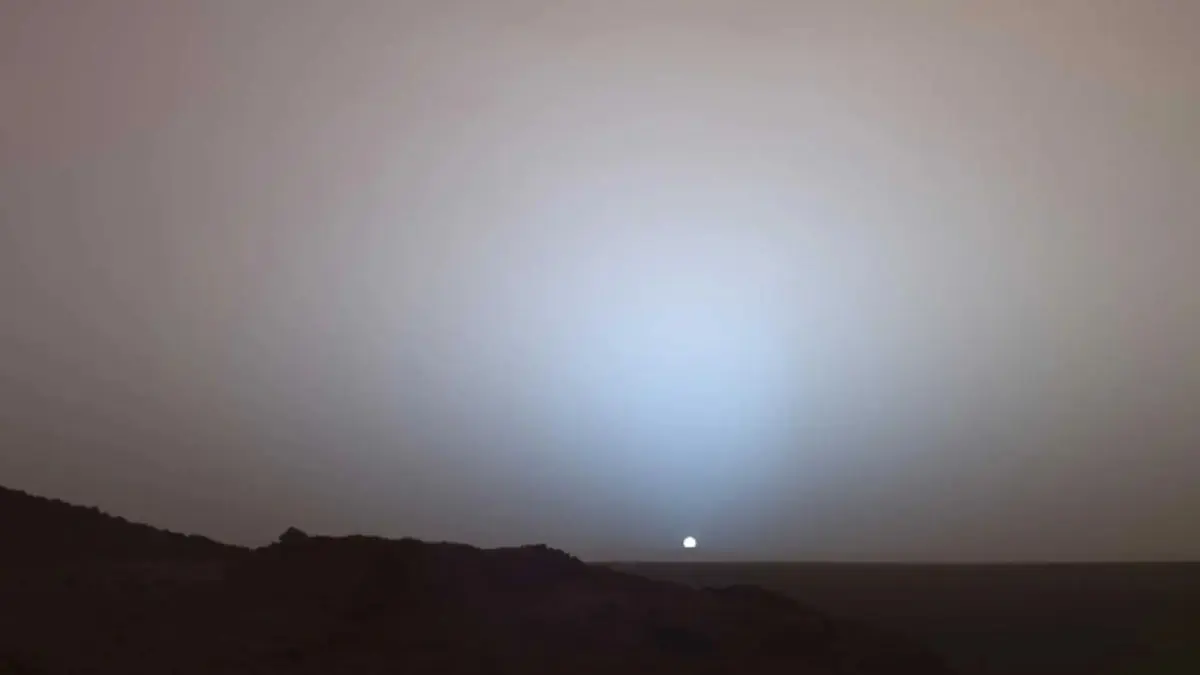
Unlike Earth’s orange-red sunsets, Mars shows a blue sunset. This happens due to fine dust particles in the Martian atmosphere, which scatter blue light forward more efficiently than red—reversing what we see on Earth.
- Science News
- 2 min read

;'%3e%3cpath%20d='m8,15.99c4.41,0,7.99-3.58,7.99-7.99S12.41,0,8,0,0,3.59,0,8s3.58,7.99,7.99,7.99Z'%20style='stroke:%23fff;%20stroke-miterlimit:10;%20stroke-width:.02px;'/%3e%3cpath%20d='m3.08,3.37l3.82,5.11-3.84,4.15h.87l3.37-3.64,2.72,3.64h2.94l-4.04-5.39,3.58-3.87h-.86l-3.1,3.35-2.5-3.35h-2.94Zm1.27.64h1.35l5.97,7.99h-1.35l-5.97-7.99Z'%20style='fill:%23fff;'/%3e%3c/g%3e%3c/svg%3e)


People around the world love watching sunsets, as they touch something deep within the human soul. From paintings and poems to countless photographs, sunsets have always held a special significance in our lives.
The sunsets and sunrises are never just one single colour. They paint the sky with a vibrant spectrum ranging from deep reds and fiery oranges to soft pinks. But not every world in our solar system shares this view.
Take Mars, for instance. Being farther from the Sun than Earth, the Martian Sun not only appears about two-thirds the size we see here but is also known for the sunsets that stand out for their distinctive blue hue and twilight experience, unlike Earth’s warm tones.
Why Do Martian Sunsets Look Blue?
The answer lies in Mars’ thin, dusty atmosphere. Fine dust particles allow blue light to penetrate the atmosphere more efficiently than longer wavelengths like red or yellow. This makes the area around the Sun appear bluish at sunset, while the rest of the sky remains tinted yellow to orange.
Advertisement
According to Mark Lemmon of Texas A&M University, a science team member of NASA’s Curiosity rover mission, “The very fine dust is the right size so that blue light penetrates the atmosphere slightly more efficiently. When the blue light scatters off the dust, it stays closer to the direction of the Sun, while red and yellow light scatter more widely across the sky.”

NASA’s rovers have given us these rare glimpses of these Martian sunsets. On May 19, 2005, the Mars Exploration Rover Spirit captured a stunning view of the Sun sinking below the rim of Gusev Crater. Later, the Perseverance rover provided another striking sunset image—this time showing a more muted tone, caused by less dust in the atmosphere.
Advertisement
Interestingly, a similar effect can occur on Earth. When powerful volcanic eruptions release fine dust into the upper atmosphere, sunsets and sunrises often appear unusually vivid or last longer than usual.
So, while Earth gifts us fiery orange skies, Mars offers a twilight of blue, a reminder that every planet paints its sunsets differently.
These photographs are not just beautiful, they serve an important scientific purpose. By studying Martian sunsets and twilights, scientists can learn how high dust particles extend into the atmosphere and detect the presence of dust or ice clouds.