
One Lift Off, Million Possibilities: How India's 1st Private Rocket Vikram 1 By Skyroot Made History
Skyroot Aerospace successfully launched its Vikram-1 rocket, marking a historic milestone for India's space industry. Here's everything you need to know about the mission -- from launch objectives and payloads to why it is a breakthrough for India's commercial space ambitions.
- Science News
- 6 min read

;'%3e%3cpath%20d='m8,15.99c4.41,0,7.99-3.58,7.99-7.99S12.41,0,8,0,0,3.59,0,8s3.58,7.99,7.99,7.99Z'%20style='stroke:%23fff;%20stroke-miterlimit:10;%20stroke-width:.02px;'/%3e%3cpath%20d='m3.08,3.37l3.82,5.11-3.84,4.15h.87l3.37-3.64,2.72,3.64h2.94l-4.04-5.39,3.58-3.87h-.86l-3.1,3.35-2.5-3.35h-2.94Zm1.27.64h1.35l5.97,7.99h-1.35l-5.97-7.99Z'%20style='fill:%23fff;'/%3e%3c/g%3e%3c/svg%3e)


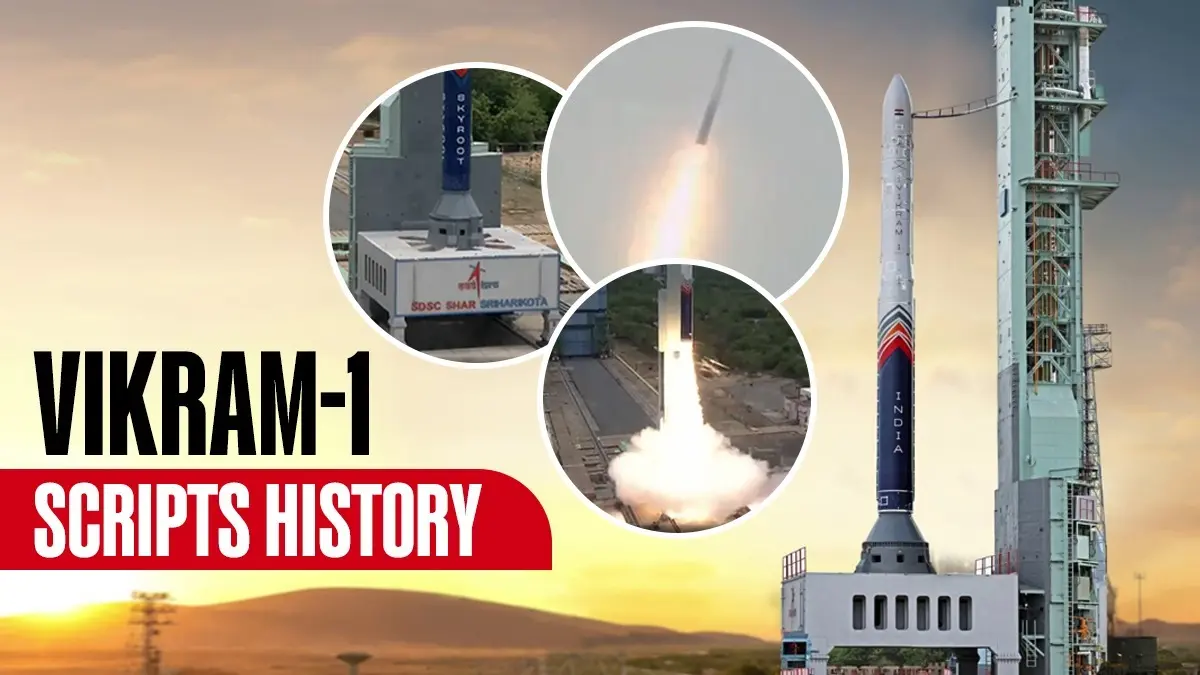
Sriharikota: In a historic triumph for the nation's aerospace ecosystem, Hyderabad-based startup Skyroot Aerospace successfully executed "Mission Aagaman," launching its maiden orbital-class rocket, Vikram-1, into space on its very first attempt.
This milestone marks the first time a privately manufactured orbital rocket from India has successfully conquered Earth's orbit, blasting off from the Satish Dhawan Space Centre in Sriharikota, Andhra Pradesh.
Named "Mission Aagaman" (meaning "Arrival"), the multi-stage launch vehicle lifted off from the First Launch Pad at the Satish Dhawan Space Centre at 12:05 IST on Saturday, July 18, 2026.
The deployment makes India the third country in the world, following the United States and China, to possess private orbital launch capabilities, validating years of deep-tech reforms designed to decentralise the nation's state-dominated space sector.
Advertisement
Features:
Standing approximately 24 meters tall with a diameter of 1.7 meters, Vikram-1 is structured to handle the fast-growing demand for small-satellite launch services.
Designed for a high launch cadence and rapid on-demand manufacturing, the small-lift launch vehicle utilises cutting-edge materials and manufacturing techniques.
Advertisement
The entire rocket structure is made from ultra-lightweight, high-strength carbon fibre, significantly minimising dead weight to maximise payload potential.
Vikram-1 functions using a highly specialised hybrid configuration. The first three stages burn solid fuel for sheer mechanical thrust, while the final upper stage utilises earth-storable liquid propellant for hyper-precise orbital manoeuvring.
The total flight sequence from liftoff to final deployment lasted exactly 15.46 minutes, successfully clearing 14 pre-programmed structural milestones.
Moments after clearing the launchpad, the solid-propellant Kalam-1200 booster pushed Vikram-1 past Mach 1 (the speed of sound) in just 25 seconds.
By the 90-second mark, the launcher accelerated past a hypersonic threshold of Mach 5. Following sequential stage drop-offs, the aerodynamic payload fairing split cleanly in a two-piece clamshell mechanism, exposing the cargo to the vacuum of space.
Ultimately, the liquid-fueled Orbit Adjustment Module (OAM) executed its final orbital insertion burn, cleanly delivering the cargo into a 450-kilometre Low Earth Orbit (LEO) at a 60-degree inclination.
PM Modi Celebrates Milestone Moment
Prime Minister Narendra Modi joined the nation in celebrating the historic moment and lauded the team of Skyroot Aerospace for this feat.
In a post on X, PM Modi said, "A historic new frontier for India's space journey! Skyroot Aerospace will undertake the maiden orbital launch of Vikram-1, India's first privately developed launch vehicle. This four-stage rocket is designed to provide rapid and on-demand launch services. This mission highlights the talent, determination and entrepreneurial spirit of our youth. It also shows how our space-sector reforms are unlocking new opportunities for innovation and enterprise. My best wishes to the entire Skyroot Aerospace team for a successful launch. May Vikram-1 soar high, create history and inspire a generation of innovators. I urge all Indians, especially my young friends, to follow this historic mission and join in wishing Team Skyroot success using #IndiaWithVikram1."
The Cargo
Vikram-1 successfully carried six distinct technical and symbolic payloads on its inaugural mission:
1. Project Embrace (Cosmoserve Space): An active space debris removal payload featuring a robotic servicing arm. During the flight, the system executed the world’s first successful live demonstration of "soft robotic capture" in orbit, marking a massive milestone for orbital sustainability.
2. Nanosatellites & Technical Demos: The rocket deployed the SOLARAS S3 Earth-observation nanosatellite by Grahaa Space, an international mechanism developed by Germany's DCubed GmbH, and Skyroot’s native SCOPE satellite designed to gather primary in-flight performance data.
3. Cultural & National Symbols: Nestled alongside the satellites was "Cosmic Bloom," a custom micro-art installation made of lab-grown diamonds paying tribute to Indian space pioneers. Most notably, the upper stage carried a handwritten postcard signed by Prime Minister Narendra Modi featuring the words "Vande Mataram," giving rise to Skyroot CEO Pawan Kumar Chandana's triumphant declaration post-launch: “Vande Mataram is in orbit now.”

The Global Space Market
Until today, every orbital launch originating from Indian soil required the direct infrastructure of the Indian Space Research Organisation (ISRO).
Following the groundbreaking structural policy changes enacted by the central government via IN-SPACe, private aerospace companies are officially permitted to independently operate custom orbital launches.
The successful debut of Vikram-1 provides a direct, flexible, and affordable "on-demand" launch solution for the commercial small-satellite market.
Rather than forcing small telemetry, mapping, and internet startups to wait months or years to hitch a ride as secondary payloads on heavy public rockets, Skyroot can now offer dedicated, targeted orbital insertion flights on short notice.
With three developmental flights planned before entering full commercial service, India's private sector has officially arrived on the global stage.
The rocket also transported a lab-grown diamond art piece named "Cosmic Bloom," micro-sculptures carved inside the eyes of needles honouring Indian scientific legends, and a handwritten "Vande Mataram" postcard penned by Prime Minister Modi himself.
With Mission Aagaman completed, Skyroot Aerospace founders also spoke with PM Narendra Modi to share their joy.