
Artemis Lunar Gateway: Three instruments that will enable astronauts for deep space trips
The Lunar Gateway is being developed under NASA's Artemis programme and once launched in 2024, it would serve as a platform for many in-orbit experiments.
- Science News
- 3 min read

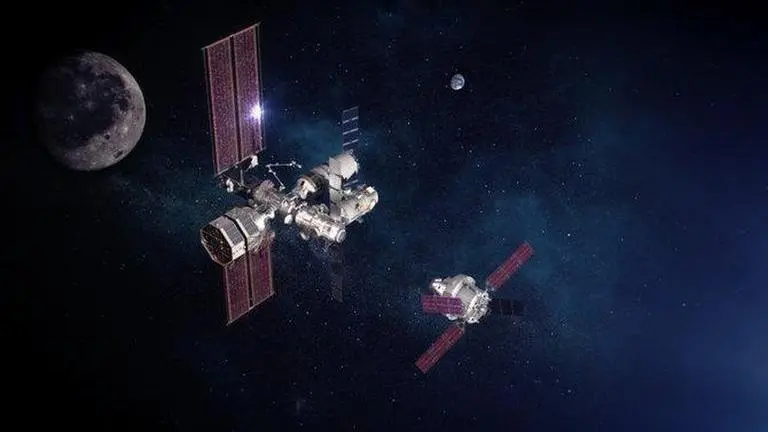
The developmental work on the Lunar Gateway is in full swing, modules of which will start launching to space starting late 2024. Once launched, the Gateway, which would orbit the Moon, will serve as a platform for many science experiments to make humans capable of deep space missions. Recently, NASA shared a list of instruments that will be deployed on the lunar space station initially to plan for the unpredictable space weather resulting from the Sun and galactic cosmic rays.
Radiation can have adverse effects on the human body. Good news is we're studying it extensively on #Artemis missions and @NASA_Gateway to help protect @NASA_Astronauts as they travel further into space: https://t.co/QgkAGzaeIi pic.twitter.com/W4wNZ4EYa0
— Jim Free (@JimFree) July 13, 2022
The Lunar Gateway will be installed around the Moon in the near-rectilinear halo orbit under NASA's Artemis Program which starts later this year. The outpost will serve as a habitat for astronauts as well as a docking port for visiting spacecraft apart from enabling in-orbiting research. Learn more about the Gateway here.
According to NASA, the first instruments to be tested on the space station are the Heliophysics Environmental and Radiation Measurement Experiment Suite (HERMES), the European Radiation Sensors Array (ERSA), and the Internal Dosimeter Array (IDA). As the name suggests, all three of them will be used to study the effects of radiation on astronauts and devise ways to mitigate those effects and make the astronauts capable of long-distance journeys through harmful radiation to Mars.

(Illustration showing the interaction of solar wind with Earth's magnetic field; Image: NASA)
Advertisement
The HERMES payload
This payload will be attached to the outside of the Gateway and it will observe the Earth's magnetotail to reconstruct solar wind behaviour as it changes over time. Scientists would use the data collected by HERMES to compare them with data from two of the five Time History of Events and Macroscale Interactions (THEMIS) spacecraft, a pair of Moon-orbiters that carry instruments similar to HERMES.
"The ability to collect data simultaneously from the three instrument suites in different locations is a rare opportunity", NASA says. The HERMES payload would consist of four instruments to measure the magnetic fields around Gateway along with the ions and electrons, the constituent particles of solar winds.
Advertisement
Instrument ERSA
A contribution from the European Space Agency (ESA), ERSA will also be located on the Gateway's exterior to study the solar wind and radiation from deep space. Notably, the Gateway will orbit the Moon far from the protection of Earth's protective atmosphere and magnetic fields, making it the perfect location for such experiments. According to NASA, ERSA will measure energetic particles from the Sun, galactic cosmic rays, neutrons, ions, and magnetic fields, and yield data on solar radiation and overall space weather.
The Internal Dosimeter Array
The IDA is the third payload and it will be installed inside the Gateway to study how well the outpost shields the interior from harmful radiation. This experiment will be highly significant as it would be located in NASA’s Habitation and Logistics Outpost (HALO) module, which would serve as the cabin for the first astronaut crew. Jointly developed by ESA and the Japan Aerospace Exploration Agency (JAXA), the instrument will allow direct comparison of the internal and external radiation environments.