
Asteroid twice the size of Great pyramids to pass by Earth on December 29
The asteroid 2017 AE3 will be skimming past the Earth at a safe distance of 354 million kilometres, NASA’s Jet Propulsion Laboratory has confirmed.
- Science News
- 2 min read

;'%3e%3cpath%20d='m8,15.99c4.41,0,7.99-3.58,7.99-7.99S12.41,0,8,0,0,3.59,0,8s3.58,7.99,7.99,7.99Z'%20style='stroke:%23fff;%20stroke-miterlimit:10;%20stroke-width:.02px;'/%3e%3cpath%20d='m3.08,3.37l3.82,5.11-3.84,4.15h.87l3.37-3.64,2.72,3.64h2.94l-4.04-5.39,3.58-3.87h-.86l-3.1,3.35-2.5-3.35h-2.94Zm1.27.64h1.35l5.97,7.99h-1.35l-5.97-7.99Z'%20style='fill:%23fff;'/%3e%3c/g%3e%3c/svg%3e)


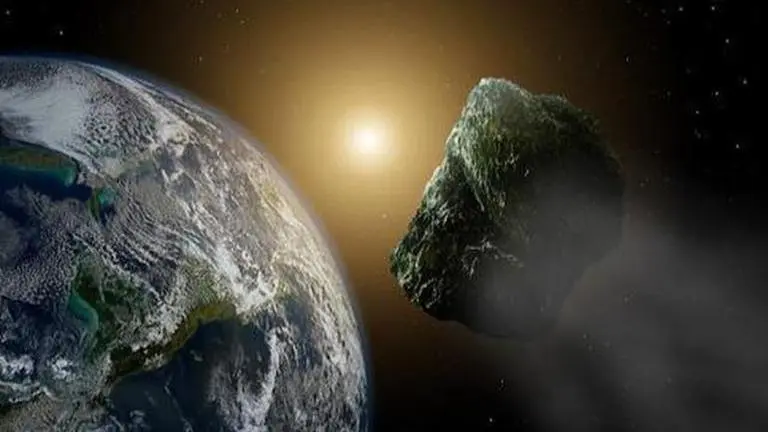
Earth is about to host the last asteroid of 2021 which will be making its closest flyby on December 29. Dubbed 2017 AE3, the asteroid reportedly measures between 120 meters and 260 meters in diameter, making it twice the size of Egypt’s Pyramid of Giza and 1.15 times the height of San Francisco's Golden Gate Bridge, as per The Jerusalem Post. This asteroid is the third major celestial body approaching Earth this month after Comet Leonard and asteroid 4660 Nereus.
No signs of asteroid being threat, NASA confirms
Since the asteroid 2017 AE3 will be skimming past the Earth at a safe distance of 354 million kilometres, NASA’s Jet Propulsion Laboratory has confirmed that it poses no threat to our planet. Considering the Moon’s distance from Earth, which is 3,84,000 kilometres, 354 million kilometres seems something to be relieved about. An asteroid is generally considered 'potentially hazardous' if it has a diameter of more than 140 meters and passes within the range of 7.48 million kilometers.
Other major asteroids, comets hosted by Earth in December
Asteroid 4660 Nereus made a flyby of Earth on December 11 and measured 330 meters in diameter. Interestingly, the asteroid, which zoomed past our planet from a distance of 3.93 million kilometres, was worth around $4.71 billion owing to the elements it was composed of. The asteroid was reportedly loaded with elements such as nickel, iron and cobalt which made it so valuable.
Comet Leonard was another major celestial body that got close to Earth on December 13. Discovered on January 3, 2021, by astronomer Greg Leonard, the comet was around 34 million kilometres far from our planet. The comet will now be at its brightest on January 3 in 2022, exactly one year after its discovery, as it will race past the sun from a distance of 90 million kilometres. Interestingly, comet Leonard takes thousands of years to complete its orbit considering the fact that its farthest distance from the sun (aphelion) is 3,500 times the distance between our planet and the sun. NASA recently captured the comet racing towards the sun as its tail glowed in the night sky.