
Astronomers confirm snapping direct image of 'youngest exoplanet' 400 light-years away
In a startling discovery, astronomers have spotted the youngest exoplanet- a planet located outside our solar system, over 400 light-years away.
- Science News
- 2 min read

;'%3e%3cpath%20d='m8,15.99c4.41,0,7.99-3.58,7.99-7.99S12.41,0,8,0,0,3.59,0,8s3.58,7.99,7.99,7.99Z'%20style='stroke:%23fff;%20stroke-miterlimit:10;%20stroke-width:.02px;'/%3e%3cpath%20d='m3.08,3.37l3.82,5.11-3.84,4.15h.87l3.37-3.64,2.72,3.64h2.94l-4.04-5.39,3.58-3.87h-.86l-3.1,3.35-2.5-3.35h-2.94Zm1.27.64h1.35l5.97,7.99h-1.35l-5.97-7.99Z'%20style='fill:%23fff;'/%3e%3c/g%3e%3c/svg%3e)


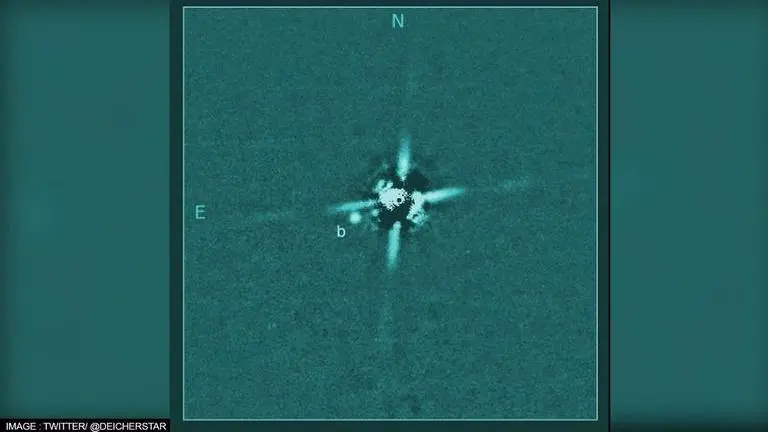
In a startling discovery, astronomers have spotted the youngest exoplanet - a planet located outside our solar system, over 400 light-years away. Although astronomers have by now identified thousands of exoplanets by now, this particular discovery is significant because the planet dubbed 2M0437b has been captured in a direct image, which is a rare feat.

2M0437b becomes one of the youngest exoplanets discovered to date
The planet 2M0437b is one of the youngest to have ever been spotted using the Subaru telescope located in Hawaii’s Maunakea. Astronomers have observed in a direct image from 2018 that the planet is revolving around a star over 400 million light-years away.
Talking about the serendipitous discovery, astronomer Eric Gaidos from the University of Hawaii at Mānoa said that this new exoplanet has now been added to the elite list of planets that can be directly observed using telescopes.
"By analyzing the light from this planet we can say something about its composition, and perhaps where and how it formed in a long-vanished disk of gas and dust around its host star”, he said, as per Science Alert.
Following analysis of the photograph, experts have concluded that the planet is considerably far away from its host starat around 100 astronomical units, and is massively large in size. Published in the Monthly Notices of the Royal Astronomical Society, the research is the result of three years of follow-up observations that the research team conducted to confirm the exoplanet's existence.
Advertisement
According to the research, the exoplanet is a few million years old and still maintains a temperature of 1,127 to 1,227 degrees Celsius owing to the planetary formation processes. Besides, due to its faint glow when observed in infrared, the planet can be spotted from a maximum distance of 417 light-years.
With the exoplanet being subjected to analysis only through Earth-based observatories, experts believe that studying it using the Hubble Space telescope will widen their view about the exoplanet and might even reveal traces of chemical signatures in its atmosphere. Currently, obtaining a direct image of an exoplanet is extremely difficult since they are outshone by their host stars and can only be detected by noticing the impacts they have on their respective stars.