
Chandrayaan-3 budget: How much did India's 3rd moonshot cost?
The Chandrayaan-3 was initially announced in 2019 as a follow-up to the unsuccessful Chandrayaan-2 mission, and it was planned to launch in 2021.
- Science News
- 4 min read

;'%3e%3cpath%20d='m8,15.99c4.41,0,7.99-3.58,7.99-7.99S12.41,0,8,0,0,3.59,0,8s3.58,7.99,7.99,7.99Z'%20style='stroke:%23fff;%20stroke-miterlimit:10;%20stroke-width:.02px;'/%3e%3cpath%20d='m3.08,3.37l3.82,5.11-3.84,4.15h.87l3.37-3.64,2.72,3.64h2.94l-4.04-5.39,3.58-3.87h-.86l-3.1,3.35-2.5-3.35h-2.94Zm1.27.64h1.35l5.97,7.99h-1.35l-5.97-7.99Z'%20style='fill:%23fff;'/%3e%3c/g%3e%3c/svg%3e)


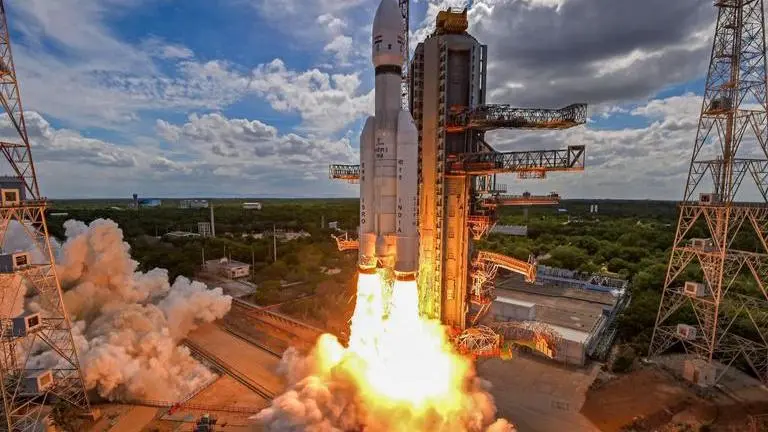
Chandrayaan-3’s Vikram lander with the Pragyan rover is anticipated to land on the lunar south pole on August 23, according to ISRO. Compared to its predecessors, Chandrayaan-3 is reported to be one of the most cost-effective space missions, with an anticipated expenditure of Rs 615 crore or $75 million.
Chandrayaan-3 was initially announced in 2019 as a follow-up to the unsuccessful Chandrayaan-2 mission, and was planned to launch in 2021. The launch, however, took place on July 14, 2023, as a result of major delays brought on by the COVID-19 pandemic.
How much did it cost to build Chandryaan-3?
Chandrayaan-3 has been built at a budget of around Rs 615 crore, according to K Sivan, Chairman of the Indian Space Research Organisation (ISRO). According to a report from January 2020, ISRO Chairman K Sivan estimated that the spacecraft's lander, rover, and propulsion module would cost about Rs 250 crore, and that the launch service would cost an additional Rs 365 crore.
Even while Chandrayaan-3 is more affordable than other space missions and even some Hollywood films, it is possible that the final price would exceed Rs 615 crore.
Advertisement
The estimate put forward by former ISRO chief Sivan was made before the pandemic struck and prior to the mission as a whole. It is likely that the mission's budget has increased given that Chandrayaan-3 was originally scheduled to launch in 2021 but has now taken off until well into 2023.
In December 2019, ISRO reportedly sought initial financing for the mission in the amount of Rs 75 crore, of which Rs 60 crore would be used to cover costs for equipment, machinery, and other capital expenses.
Advertisement
The remainder of Rs 15 crore was requested under revenue expenditure head.
In contrast, the Chandrayaan-2 project incurred India Rs 978 crore, of which Rs 603 crore was spent on the orbiter, lander, rover, navigation, and ground support network, and Rs 375 crore on the geo-stationary satellite launch vehicle.
On Sunday, the ISRO stated that it had successfully lowered the orbit of the Chandrayaan-3 mission's Lander Module (LM), bringing it even closer to the moon.
The LM would now be subject to internal inspections, according to the national space agency.
On the evening of August 23, the LM, which consists of the lander Vikram and the rover Pragyan, is anticipated to touchdown on the lunar surface.
The LM orbit has successfully been decreased to 25 km x 134 km as a result of the second and final deboosting (slowing down) operation. The module would go through internal inspections and wait at the specified landing spot until sunrise. According to an ISRO post on 'X' (previously Twitter) on Sunday, the powered descent is anticipated to begin on August 23, 2023, about 1745 IST.
Chandrayaan-3 Mission:
— ISRO (@isro) August 19, 2023
The second and final deboosting operation has successfully reduced the LM orbit to 25 km x 134 km.
The module would undergo internal checks and await the sun-rise at the designated landing site.
The powered descent is expected to commence on August… pic.twitter.com/7ygrlW8GQ5
The purpose of Chandrayaan-3 is to show end-to-end capabilities in safe landing and roving on the lunar surface being a follow-up mission to Chandrayaan-2.
The rover, which will conduct in-situ chemical study of the Moon's surface during its mobility, will be deployed by the lander, which has the potential to successfully land at a designated lunar spot.
The Russian space agency reported an "emergency situation" aboard its Luna-25 spacecraft, which is headed towards the moon in a race with India's Chandrayaan-3 to be the first to land on the moon's uncharted south pole. According to the nation's space agency Roscosmos, the spacecraft, which was launched earlier this month, encountered an unidentified technical issue while attempting to reach a pre-landing orbit. Analysis of the problem is being done by experts.
"Today, in accordance with the flight program, at 14:10 Moscow time, the automatic station Luna-25 gave an impulse to transfer to the pre-landing orbit. During the operation, an emergency situation occurred on board the automatic station, which did not allow the manoeuvre to be performed with the specified parameters," said Roscosmos, according to a translated statement.
(With inputs from Agencies)