
Damaged Russian spacecraft safely sinks in Pacific Ocean after deorbiting from ISS
The capsule was docked to the Poisk module of the ISS before it fired its deorbit engine at 8:45 am IST to undock from the ISS on Saturday for a splashdown.
- Science News
- 2 min read

;'%3e%3cpath%20d='m8,15.99c4.41,0,7.99-3.58,7.99-7.99S12.41,0,8,0,0,3.59,0,8s3.58,7.99,7.99,7.99Z'%20style='stroke:%23fff;%20stroke-miterlimit:10;%20stroke-width:.02px;'/%3e%3cpath%20d='m3.08,3.37l3.82,5.11-3.84,4.15h.87l3.37-3.64,2.72,3.64h2.94l-4.04-5.39,3.58-3.87h-.86l-3.1,3.35-2.5-3.35h-2.94Zm1.27.64h1.35l5.97,7.99h-1.35l-5.97-7.99Z'%20style='fill:%23fff;'/%3e%3c/g%3e%3c/svg%3e)


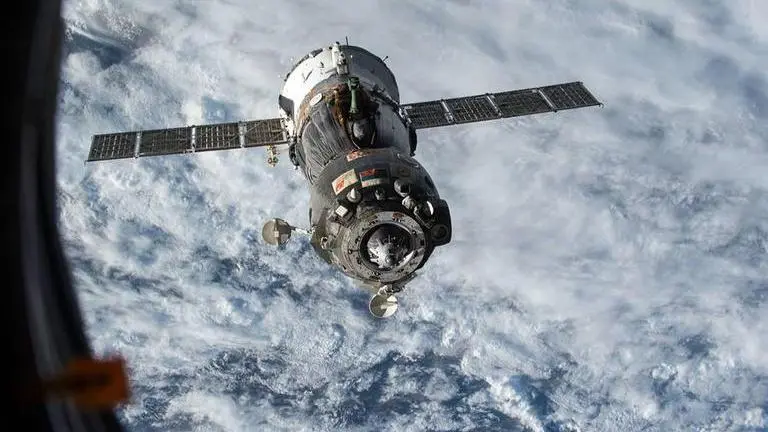
Russia's space agency Roscosmos confirmed that the MS-21 cargo spacecraft deorbited from the International Space Station (ISS) on Sunday and parts of it safely fell into the Pacific Ocean. The spacecraft was docked to the Poisk module of the space station before it fired its deorbit engine at 8:45 am IST to undock from the ISS on Saturday for a splashdown.
"Unburned elements of its structure fell in the non-navigable area of the South Pacific Ocean. Progress MS-21 was launched from Baikonur on October 26, 2022, by a Soyuz-2.1a carrier rocket and two days later delivered more than 2.5 tons of cargo to the ISS," Roscosmos wrote in a Telegram post.
The ISS Progress 82 cargo craft fired its deorbit engine at 10:15pm ET today sending it towards Earth's atmosphere above the Pacific Ocean. More... https://t.co/W8LTdx421e pic.twitter.com/4uWo6UxvLd
— International Space Station (@Space_Station) February 19, 2023
The mission of damaged spacecraft ends
The deorbiter spacecraft was one of the two Roscosmos ships that were found leaking coolant into outer space due to possible damage. While the first was in a crew spacecraft Soyuz MS-22 on December 15, 2022, the second on MS-21 was detected on February 12. A spacecraft uses coolant to avoid overheating and protect the avionics while keeping the crew members safe. The leakage even led to Roscosmos cancelling the spacewalk by its cosmonauts while NASA postponed the activity.
Problem with Soyuz MS-22 on the ISS right now! pic.twitter.com/V4Ymvnn2D1
— Chris Bergin - NSF (@NASASpaceflight) December 15, 2022
While the first leakage was believed to have been caused by a micrometeoroid, the cause of the second leak is still being investigated by both NASA and Roscosmos. Earlier this week, the inspection team used Canadarm 2 to gather imagery of the suspected area of damage on MS-21, which will be used to find the reason for the leak.
Advertisement
As for the MS-22 crew ship, it will be replaced with MS-23 that Roscosmos has planned to send on February 24. This replacement capsule will be sent to bring back cosmonauts Sergey Prokopyev and Dmitri Petelin and NASA's Frank Rubio who flew to the ISS last year for a six-month-long stay.